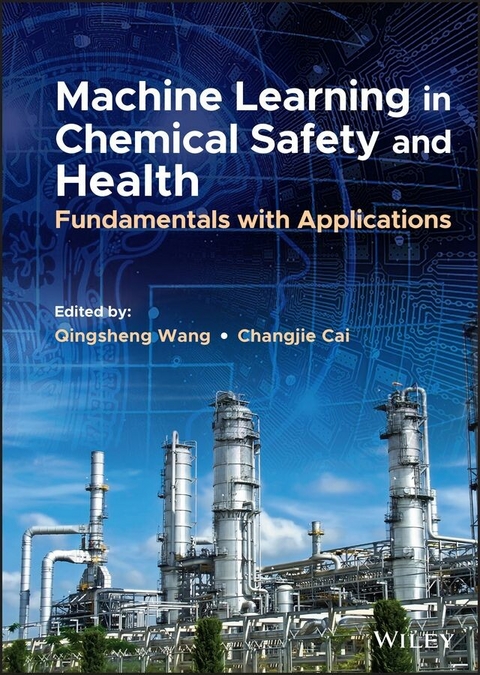
Machine Learning in Chemical Safety and Health (eBook)
320 Seiten
John Wiley & Sons (Verlag)
978-1-119-81749-9 (ISBN)
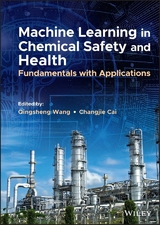
There is a growing interest in the application of machine learning algorithms in chemical safety and health-related model development, with applications in areas including property and toxicity prediction, consequence prediction, and fault detection. This book is the first to review the current status of machine learning implementation in chemical safety and health research and to provide guidance for implementing machine learning techniques and algorithms into chemical safety and health research.
Written by an international team of authors and edited by renowned experts in the areas of process safety and occupational and environmental health, sample topics covered within the work include:
* An introduction to the fundamentals of machine learning, including regression, classification and cross-validation, and an overview of software and tools
* Detailed reviews of various applications in the areas of chemical safety and health, including flammability prediction, consequence prediction, asset integrity management, predictive nanotoxicity and environmental exposure assessment, and more
* Perspective on the possible future development of this field
Machine Learning in Chemical Safety and Health serves as an essential guide on both the fundamentals and applications of machine learning for industry professionals and researchers in the fields of process safety, chemical safety, occupational and environmental health, and industrial hygiene.
Qingsheng Wang is Associate Professor of Chemical Engineering and George Armistead '23 Faculty Fellow at Texas A&M University. He has over 15 years of experience in the areas of process safety and fire protection. His experience is wide ranging, involving machine learning in chemical safety, flame retardant materials, fire and explosion dynamics, and composite manufacturing for safety and sustainability. He is a registered professional engineer (PE) and certified safety professional (CSP), and currently a principal member of the NFPA 18 and NFPA 30 committees. Professor Wang has established the Multiscale Process Safety Laboratory at Texas A&M and is currently leading the lab. He has published over 150 peer-reviewed journal publications and 6 book chapters. His work has been internationally recognized and heavily cited, and he is recognized as a world leader in the field of process safety. Changjie Cai is Assistant Professor of Occupational and Environmental Health from Hudson College of Public Health at the University of Oklahoma Health Sciences Center. Dr Cai has formed an interdisciplinary research lab focusing on three major areas: (i) Developing portable and cost-effective devices to identify, assess and control the safety and health hazards; (ii) Integrating artificial intelligence techniques into safety and health fields; (iii) Modeling the hazard dispersion and their climate effects using chemical transport models.
| Erscheint lt. Verlag | 19.10.2022 |
|---|---|
| Sprache | englisch |
| Themenwelt | Naturwissenschaften ► Chemie |
| Schlagworte | Arbeitssicherheit • Arbeitssicherheit u. Umweltschutz i. d. Chemie • Artificial Intelligence • Chemical and Environmental Health and Safety • chemical engineering • Chemie • Chemische Verfahrenstechnik • Chemistry • Computer Science • Informatik • Künstliche Intelligenz • Maschinelles Lernen • Process Safety • Prozesssicherheit |
| ISBN-10 | 1-119-81749-8 / 1119817498 |
| ISBN-13 | 978-1-119-81749-9 / 9781119817499 |
| Informationen gemäß Produktsicherheitsverordnung (GPSR) | |
| Haben Sie eine Frage zum Produkt? |
 PDF (Adobe DRM)
Kopierschutz: Adobe-DRM
Adobe-DRM ist ein Kopierschutz, der das eBook vor Mißbrauch schützen soll. Dabei wird das eBook bereits beim Download auf Ihre persönliche Adobe-ID autorisiert. Lesen können Sie das eBook dann nur auf den Geräten, welche ebenfalls auf Ihre Adobe-ID registriert sind.
Details zum Adobe-DRM
Dateiformat: PDF (Portable Document Format)
Mit einem festen Seitenlayout eignet sich die PDF besonders für Fachbücher mit Spalten, Tabellen und Abbildungen. Eine PDF kann auf fast allen Geräten angezeigt werden, ist aber für kleine Displays (Smartphone, eReader) nur eingeschränkt geeignet.
Systemvoraussetzungen:
PC/Mac: Mit einem PC oder Mac können Sie dieses eBook lesen. Sie benötigen eine
eReader: Dieses eBook kann mit (fast) allen eBook-Readern gelesen werden. Mit dem amazon-Kindle ist es aber nicht kompatibel.
Smartphone/Tablet: Egal ob Apple oder Android, dieses eBook können Sie lesen. Sie benötigen eine
Geräteliste und zusätzliche Hinweise
Buying eBooks from abroad
For tax law reasons we can sell eBooks just within Germany and Switzerland. Regrettably we cannot fulfill eBook-orders from other countries.
aus dem Bereich