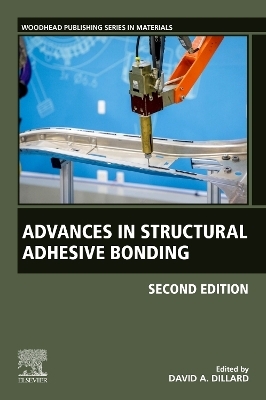
Advances in Structural Adhesive Bonding
Woodhead Publishing (Verlag)
978-0-323-91214-3 (ISBN)
This is a valuable guide for all those working with structural adhesives, including those in an industrial setting, adhesive specialists, structural engineers, design engineers, R&D professionals, and scientists, as well as academic researchers and advanced students in adhesives, joining technology, materials science and mechanical engineering.
David A. Dillard is Adhesive and Sealant Science Professor, in the Biomedical Engineering and Mechanics Department at Virginia Polytechnic Institute and State University, USA. He has worked extensively in the field of adhesive bonding, having experience in structural adhesives for aerospace, automotive, and infrastructure applications, adhesives and coatings for microelectronic applications, pressure sensitive adhesives, elastomeric adhesives and sealants, and polymeric membranes. Prof. Dillard has authored or co-authored over 185-refereed publications and regularly teaches courses in adhesion science, polymer viscoelasticity, and sustainable energy solutions. His research involves developing test methods and predictive models for understanding and estimating the performance and durability of polymeric materials, adhesives and bonded joints, using the principles of fracture mechanics and viscoelasticity. Over the past several years, he has become active in applying these concepts to sustainable energy products including proton exchange membrane fuel cells and solar photovoltaic applications. Prof. Dillard has received several awards in recognition of his research.
Part One: Adhesive chemistries and formulations
1 Advances in epoxy adhesives
2 Advances in acrylic structural adhesives
3 Advances in anaerobic adhesives
4 Advances in polyurethane structural adhesives
5 Advances in structural silicone adhesives
6 Emerging structural adhesive chemistries and innovations
7 Advances in toughening strategies for structural adhesives
Part Two: Adherends and surfaces: Addressing and troubleshooting bonding challenges
8 Advances in cyanoacrylate structural adhesives
9 What went wrong? Solving bonding challenges through surface science
10 Advances in bonding plastics
11 Structural bonds without an adhesive: Understanding adhesion of semicrystalline thermoplastic interfaces
12 Adhesive joining of thermoplastic composites
13 Advances in structural wood products adhesive bonding
Part Three: Joint design, testing and modeling for performance & durability
14 Improving joint performance through graded materials and geometries
15 Standard test methods and their need to evolve
16 Innovations in fracture testing of structural adhesive bonds
17 Understanding fracture mode-mixity and its effects on bond performance
18 Predicting adhesive bond performance
19 Bondline thickness: Fracture mechanics perspective
20 Evaluating and predicting fatigue behavior in adhesively bonded joints
21 Durability and accelerated characterization of adhesive bonds
22 High-rate testing of structural adhesives
23 Application of high-throughput methodologies and artificial intelligence for adhesion testing
Part Four: Adhesive specification, quality control, & risk mitigation
24 Architected adhesive joints with improved fracture toughness
25 Structural monitoring of adhesive joints using machine learning
26 Aerospace structural bonding: Qualification, quality control, substantiation, and risk mitigation
27 Automotive adhesives: Specification, qualification, and quality control
28 Construction adhesives: Qualification, specification, quality control, and risk mitigation
29 General industrial adhesive applications: Qualification, specification, quality control, and risk mitigation
30 Digital image correlation: Advancing mechanical property characterization of adhesive joints
31 Biomedical adhesives: Qualification, specification, quality control, and risk mitigation
Part Five: Emerging technologies for structural bonding
32 Sustainable adhesives: Bioadhesives, chemistries, recyclability, and reversibility
33 Accelerated curing of bonded joints
34 Residual stress development in curing processes: Material characterization and modeling
35 Sensing stresses and damage in adhesive bonds using mechanophores
| Erscheinungsdatum | 10.07.2023 |
|---|---|
| Reihe/Serie | Woodhead Publishing in Materials |
| Zusatzinfo | 250 illustrations (50 in full color); Illustrations |
| Sprache | englisch |
| Maße | 152 x 229 mm |
| Gewicht | 1000 g |
| Themenwelt | Naturwissenschaften ► Chemie ► Physikalische Chemie |
| Technik ► Bauwesen | |
| Technik ► Maschinenbau | |
| ISBN-10 | 0-323-91214-1 / 0323912141 |
| ISBN-13 | 978-0-323-91214-3 / 9780323912143 |
| Zustand | Neuware |
| Informationen gemäß Produktsicherheitsverordnung (GPSR) | |
| Haben Sie eine Frage zum Produkt? |
aus dem Bereich