


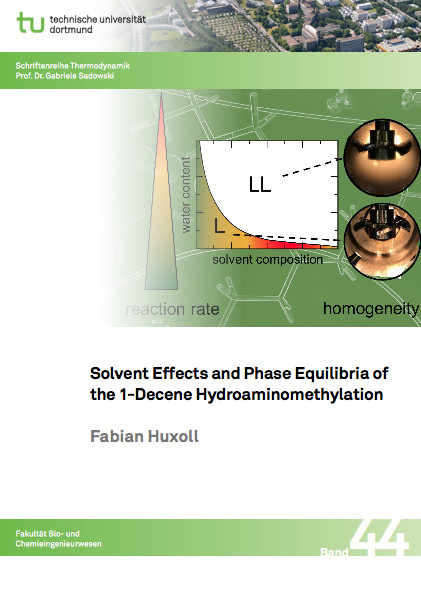
Solvent Effects and Phase Equilibria of the 1-Decene Hydroaminomethylation
Seiten
2022
Dr. Hut (Verlag)
9783843951531 (ISBN)
Dr. Hut (Verlag)
9783843951531 (ISBN)
- Keine Verlagsinformationen verfügbar
- Artikel merken
Solvents may have an enormous impact on reaction rates, selectivity, and the phase behavior of chemical reactions in complex media. However, there is a lack of consistent model-based tools to a priori characterize these effects. Many decision steps in chemical process design are nonetheless based on expert knowledge or empirical models.
In this work, solvent effects on the homogeneously catalyzed hydroaminomethylation (HAM) of 1-decene were modeled and validated by experiments to gain in-depth process knowledge and accelerate process development. A physically based solvent selection workflow was developed for this purpose, which successfully predicted promising solvents for liquid-phase reactions to reach high reaction rates and yields. A detailed thermodynamic framework was generated by measuring and modeling phase equilibria (including vapor-liquid equilibria (VLE), liquid-liquid equilibria (LLE), and solid-liquid equilibria (SLE)) via PCP-SAFT, which then allowed fully describing the thermodynamics of the investigated HAM. Finally, a novel activity-coefficient-based approach was applied to predict solvent effects on both the reaction rates and phase behavior. The thermodynamic activities of the reactants and LLE of the reaction system were simultaneously modeled using PCP-SAFT, accounting for all interactions between the components.
The presented thermodynamic-consistent solvent selection methodologies apply to a wide variety of liquid-phase reactions and are thus a valuable tool for optimizing these reactions. Since no experimental reaction data are required for the modeling, time-consuming experiments are reduced to a minimum.
In this work, solvent effects on the homogeneously catalyzed hydroaminomethylation (HAM) of 1-decene were modeled and validated by experiments to gain in-depth process knowledge and accelerate process development. A physically based solvent selection workflow was developed for this purpose, which successfully predicted promising solvents for liquid-phase reactions to reach high reaction rates and yields. A detailed thermodynamic framework was generated by measuring and modeling phase equilibria (including vapor-liquid equilibria (VLE), liquid-liquid equilibria (LLE), and solid-liquid equilibria (SLE)) via PCP-SAFT, which then allowed fully describing the thermodynamics of the investigated HAM. Finally, a novel activity-coefficient-based approach was applied to predict solvent effects on both the reaction rates and phase behavior. The thermodynamic activities of the reactants and LLE of the reaction system were simultaneously modeled using PCP-SAFT, accounting for all interactions between the components.
The presented thermodynamic-consistent solvent selection methodologies apply to a wide variety of liquid-phase reactions and are thus a valuable tool for optimizing these reactions. Since no experimental reaction data are required for the modeling, time-consuming experiments are reduced to a minimum.
| Erscheinungsdatum | 18.10.2022 |
|---|---|
| Reihe/Serie | Thermodynamik |
| Verlagsort | München |
| Sprache | englisch |
| Maße | 148 x 210 mm |
| Gewicht | 256 g |
| Themenwelt | Naturwissenschaften ► Physik / Astronomie ► Thermodynamik |
| Technik | |
| Schlagworte | PC-SAFT • thermodynamics • UNIFAC |
| ISBN-13 | 9783843951531 / 9783843951531 |
| Zustand | Neuware |
| Informationen gemäß Produktsicherheitsverordnung (GPSR) | |
| Haben Sie eine Frage zum Produkt? |
Mehr entdecken
aus dem Bereich

aus dem Bereich
zur Materialproblematik der modernen Elektronik
Buch | Hardcover (2025)
Alfred Kröner Verlag
CHF 27,85
Von Energie und Entropie zu Wärmeübertragung und Phasenübergängen
Buch | Softcover (2023)
De Gruyter Oldenbourg (Verlag)
CHF 83,90


