


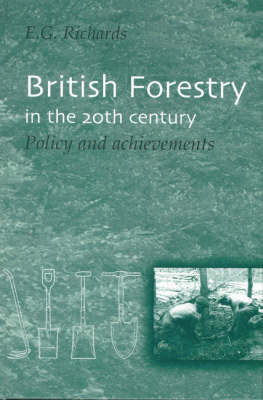
British Forestry in the 20th Century
Policy and Achievements
Seiten
2003
VSP International Science Publishers (Verlag)
978-90-6764-360-3 (ISBN)
VSP International Science Publishers (Verlag)
978-90-6764-360-3 (ISBN)
- Titel ist leider vergriffen;
keine Neuauflage - Artikel merken
Tells the story of the policies and projects that resulted in doubling the size of British forests and of the acts and actors that played a role in the area of forests in the United Kingdom (including Northern Ireland) had risen to over two and three quarter million hectares and covered eleven per cent of the land area.
This book tells the fascinating story of the policies and projects that resulted in doubling the size of British forests over the past eighty years and of the Acts and actors that played a role in this development. By the end of the century the area of forests in the United Kingdom (including Northern Ireland) had risen to over two and three quarter million hectares and covered eleven per cent of the land area. Three quarters of them consisted of plantations. Few other countries - Ireland and Denmark are two - have achieved a comparable change in the rural landscape in favour of forestry over as short a time. Furthermore, from being in a deplorable state by the end of the First World War, British forests are now well above the European average in terms of productivity (wood yield per hectare). At the same time they are being called upon to meet increasingly heavy social and environmental demands from a dense, largely urbanised society.
This book tells the fascinating story of the policies and projects that resulted in doubling the size of British forests over the past eighty years and of the Acts and actors that played a role in this development. By the end of the century the area of forests in the United Kingdom (including Northern Ireland) had risen to over two and three quarter million hectares and covered eleven per cent of the land area. Three quarters of them consisted of plantations. Few other countries - Ireland and Denmark are two - have achieved a comparable change in the rural landscape in favour of forestry over as short a time. Furthermore, from being in a deplorable state by the end of the First World War, British forests are now well above the European average in terms of productivity (wood yield per hectare). At the same time they are being called upon to meet increasingly heavy social and environmental demands from a dense, largely urbanised society.
E. G. Richards gained his B.Sc. in forestry at Aberdeen University in 1938. After the war, he joined the Forestry Commission as District Forest Officer in North Scotland and stayed with the Commission for the whole of his career until his retirement as Director at Headquarters in 1978. He held a number of positions, including responsibilities for the utilisation of timber. Since his retirement from the Forestry Commission, he has remained active as a consultant in the field of forestry and forest industries.
| Erscheint lt. Verlag | 31.8.2003 |
|---|---|
| Verlagsort | Zeist |
| Sprache | englisch |
| Gewicht | 711 g |
| Themenwelt | Naturwissenschaften ► Biologie ► Ökologie / Naturschutz |
| ISBN-10 | 90-6764-360-2 / 9067643602 |
| ISBN-13 | 978-90-6764-360-3 / 9789067643603 |
| Zustand | Neuware |
| Informationen gemäß Produktsicherheitsverordnung (GPSR) | |
| Haben Sie eine Frage zum Produkt? |
Mehr entdecken
aus dem Bereich


aus dem Bereich
Methoden – Lösungen – Anwendungen
Buch | Hardcover (2025)
Hanser (Verlag)
CHF 69,95


