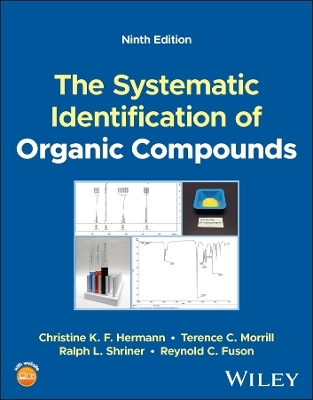
The Systematic Identification of Organic Compounds
John Wiley & Sons Inc (Verlag)
978-1-119-79966-5 (ISBN)
- Lieferbar (Termin unbekannt)
- Versandkostenfrei
- Auch auf Rechnung
- Artikel merken
Identifying unknown compounds is one of the most important parts of the study of chemistry. From basic characteristics such as melting and/or boiling point to more complex data generated through cutting-edge techniques, the range of possible methods for identifying unknown organic compounds is substantial. The utility of a research reference which compiles known techniques and characteristics of possible compounds is clear.
The Systematic Identification of Organic Compounds provides such a reference, designed to teach a hands-on approach in the chemistry lab. It takes readers step-by-step through the process of identifying an unknown compound and elucidating its structure from infrared, nuclear magnetic resonance, and mass spectra in addition to solubility characteristics, melting point, boiling point, and classification tests. The result is an essential overview for advanced chemistry students looking to understand this exciting area of laboratory work.
Readers of the ninth edition of The Systematic Identification of Organic Compounds will also find:
A detailed chapter on safety, personal protection equipment, chemical storage, safety data sheets, and other safety concerns
New NMR, IR, and mass spectra with detailed explanations on interpretation
Questions at the end of each chapter designed to facilitate and reinforce progression, keyed to a companion website for instructors
Tables of known compounds including data relevant for identification
Companion website with structural problems from experimental data for students to practice how to reason and solve
The Systematic Identification of Organic Compounds is a useful reference for advanced undergraduates and graduate students studying organic chemistry, organic spectroscopy, and related subjects.
Christine K. F. Hermann, PhD is Professor and Chair of the Department of Chemistry, Radford University, Radford, Virginia, USA.
Preface ix
About the Companion Website xi
Chapter 1 Introduction 1
1.1 Systematic Identification of Organic Compounds: The Need for Organic Qualitative Analysis 1
1.2 Suggestions to Students and Instructors 3
Chapter 2 Laboratory Safety 7
2.1 Working Safely in the Laboratory 7
2.2 Training 10
2.3 Personal Protection Equipment 10
2.4 Safety Data Sheets 11
2.5 Storage of Chemicals 12
2.6 Disposal of Chemicals 13
2.7 Safely Using Equipment in the Laboratory 13
Chapter 3 Identification of Unknowns 15
3.1 Discussion of Report Form 15
3.2 Preliminary Examination 22
3.3 Physical Properties 22
3.4 Molecular Weight Determination 22
3.5 Molecular Formula Determination 23
3.6 Solubility Tests 23
3.7 Infrared, Nuclear Magnetic Resonance, and Mass Spectra Analyses 24
3.8 Classification Tests 24
3.9 Preparation of a Satisfactory Derivative 25
3.10 Mixtures 26
3.11 Report Forms 26
Chapter 4 Preliminary Examination, Physical Properties, and Elemental Analysis 31
4.1 Preliminary Examination 32
4.1.1 Physical State 32
4.1.2 Color 32
4.1.3 Odor 32
4.1.4 Ignition Test 33
4.1.5 Summary and Applications 33
4.2 Determination of Physical Properties 34
4.2.1 Melting Points and Freezing Points 34
4.2.2 Boiling Points 38
4.2.3 Specific Gravity 46
4.2.4 Index of Refraction of Liquids 51
4.3 Optical Rotation 53
4.3.1 Preparation of the Solution 54
4.3.2 Filling the Polarimeter Tube 54
4.3.3 The Use of the Polarimeter 55
4.3.4 Expression of Results 55
4.3.5 Optical Purity 57
4.4 Recrystallization 58
4.5 Qualitative Elemental Analysis 61
4.5.1 Fusion of Organic Compounds with Sodium 62
4.6 Quantitative Elemental Analysis 69
4.6.1 Combustion and Related Analyses 69
4.6.2 Formula Determination by Mass Spectrometry 73
Chapter 5 Classification of Organic Compounds by Solubility 75
5.1 Solubility in Water, Aqueous Acids and Bases, and Ether 76
5.1.1 Determination of Solubilities 78
5.1.2 Theory of Solubility 80
5.1.3 Theory of Acid- Base Solubility 85
5.1.4 Solubility in Water 87
5.1.5 Solubility in 5% Hydrochloric Acid Solution 88
5.1.6 Solubility in 5% Sodium Hydroxide and 5% Sodium Bicarbonate Solutions 88
5.1.7 Solubility of Amphoteric Compounds 90
5.1.8 Solubility in Cold, Concentrated Sulfuric Acid 91
5.1.9 Borderlines Between Solubility Classes 93
5.2 Solubility in Organic Solvents 95
Chapter 6 Separation of Mixtures 99
6.1 Preliminary Examinations of Mixtures 100
6.2 Distillation and Sublimation 101
6.2.1 Distillation 102
6.2.2 Steam Distillation 107
6.2.3 Sublimation 109
6.3 Extractions: Separations Based Upon Salt Formation 110
6.3.1 Extraction of Water Insoluble Mixtures 112
6.3.2 Extraction of Water Soluble Mixtures 115
6.4 Chromatography 119
6.4.1 Thin- Layer Chromatography 120
6.4.2 Gas Chromatography 124
6.4.3 Column Chromatography 134
6.4.4 High- Performance Liquid Chromatography 141
Chapter 7 Nuclear Magnetic Resonance Spectrometry 145
7.1 Theory of Nuclear Magnetic Resonance 145
7.1.1 Chemical Shift 147
7.1.2 Shielding and Deshielding 148
7.2 Preparation of the Sample 149
7.3 Proton Spectra 151
7.3.1 Chemical Shift 151
7.3.2 Integration 160
7.3.3 Splitting 161
7.4 13C Spectra 165
7.4.1 Chemical Shift 165
7.4.2 Splitting 174
7.5 DEPT 179
7.6 COSY 188
7.7 HSQC 190
Chapter 8 Infrared Spectrometry 227
8.1 Theory of Infrared Spectrometry 227
8.2 Preparation of the Sample 230
8.3 Functional Group Identification 234
Chapter 9 Mass Spectrometry 269
9.1 Theory of Mass Spectrometry 269
9.2 Cleavage Reactions 271
Chapter 10 Chemical Tests for Functional Groups 293
10.1 Acid Anhydrides 296
10.2 Acyl Halides 306
10.3 Alcohols 307
10.4 Aldehydes 323
10.5 Amides 332
10.6 Amines and Amine Salts 334
10.7 Amino Acids 349
10.8 Carbohydrates 351
10.9 Carboxylic Acids 359
10.10 Esters 360
10.11 Ethers 361
10.12 Halides 365
10.13 Hydrocarbons— Alkanes 371
10.14 Hydrocarbons— Alkenes 371
10.15 Hydrocarbons— Alkynes 378
10.16 Hydrocarbons— Aromatic 379
10.17 Ketones 384
10.18 Nitriles 386
10.19 Nitro Compounds 386
10.20 Phenols 389
10.21 Sulfonamides, Sulfonic Acids, Sulfonyl Chlorides 393
Chapter 11 The Preparation of Derivatives 397
11.1 Carboxylic Acids, Acid Anhydrides, Acid Halides 397
11.2 Alcohols 409
11.3 Aldehydes And Ketones 414
11.4 Amides 420
11.5 Amines 424
11.6 Amino Acids 432
11.7 Carbohydrates 437
11.8 Esters 440
11.9 Ethers— Aliphatic 450
11.10 Ethers— Aromatic 451
11.11 Halides— Alkyl 454
11.12 Halides— Aromatic 457
11.13 Hydrocarbons— Aromatic 460
11.14 Nitriles 462
11.15 Nitro Compounds 467
11.16 Phenols 468
11.17 Sulfonic Acids, Sulfonyl Chlorides, Sulfonamides 472
Chapter 12 Chemical Literature 479
12.1 Handbooks 480
12.2 Compendia 480
12.3 Spectral Collections 481
12.4 Journals 482
12.5 Abstracts and Indexes 483
12.6 Monographs 486
Appendix I Handy Tables for the Organic Laboratory 487
AI.1 Composition and Properties of Common Acids and Bases 487
AI.2 Composition of Common Buffer Solutions 488
AI.3 Pressure- Temperature Nomongraph for Vacuum Distillations 488
AI.4 Elution Solvents for Chromatography 489
AI.5 Salt- Ice Mixtures for Cooling Baths 490
AI.6 Liquid Media for Heating Baths 491
AI.7 Solvents for Extractions of Aqueous Solutions 491
AI.8 Drying Agents of Moderate Strength for Organic Solvents 492
AI.9 More Powerful Dehydrating Agents for Organic Liquids 492
Appendix II Table of Derivatives 493
AII. 1 Acid Anhydrides (Liquids) 494
AII. 2 Acid Anhydrides (Solids) 495
AII. 3 Acid Halides (Liquids) 497
AII. 4 Acid Halides (Solids) 499
AII. 5 Alcohols (Liquids) 501
AII. 6 Alcohols (Solids) 504
AII. 7 Aldehydes (Liquids) 505
AII. 8 Aldehydes (Solids) 508
AII. 9 Amides (Liquids) 512
AII.10 Amides (Solids) 513
AII.11 Amines— Primary and Secondary (Liquids) 539
AII.12 Amines— Primary and Secondary (Solids) 543
AII.13 Amines— Tertiary (Liquids) 555
AII.14 Amines— Tertiary (Solids) 558
AII.15 Amino Acids 559
AII.16 Carbohydrates 561
AII.17 Carboxylic Acids (Liquids) 563
AII.18 Carboxylic Acids (Solids) 566
AII.19 Esters (Liquids) 578
AII.20 Esters (Solids) 597
AII.21 Ethers— Aliphatic (Liquids) 606
AII.22 Ethers— Aromatic (Liquids) 608
AII.23 Ethers— Aromatic (Solids) 610
AII.24 Halides— Alkyl, Cycloalkyl, and Aralkyl (Liquids) 611
AII.25 Halides— Aromatic (Liquids) 614
AII.26 Halides— Aromatic (Solids) 615
AII.27 Hydrocarbons— Aromatic (Liquids) 616
AII.28 Hydrocarbons— Aromatic (Solids) 617
AII.29 Ketones (Liquids) 618
AII.30 Ketones (Solids) 623
AII.31 Nitriles (Liquids) 629
AII.32 Nitriles (Solids) 634
AII.33 Nitro Compounds (Liquids) 644
AII.34 Nitro Compounds (Solids) 645
AII.35 Phenols (Liquids) 647
AII.36 Phenols (Solids) 649
AII.37 Sulfonamides (Solids) 661
AII.38 Sulfonic Acids (Solids) 667
AII.39 Sulfonyl Chlorides (Solids) 671
Appendix III Equipment and Chemicals for the Laboratory 677
AIII.1 Apparatus 677
Individual Desk Equipment 677
Suggested Locker or Drawer Equipment 677
Suggested Miniscale Glassware Kit 678
Suggested Supplementary Kit 678
General Laboratory Equipment 678
Provided by Students 678
Available Instruments 679
Additional Items 679
Waste Containers Needed in the Laboratory 679
AIII.2 Chemicals Needed in the Laboratory 679
Organic Compounds 680
Inorganic Compounds 680
Acids and Bases 681
Solutions 681
Indicators 683
Other Items 683
AIII.3 Unknowns 683
Index 685
| Erscheinungsdatum | 31.03.2023 |
|---|---|
| Verlagsort | New York |
| Sprache | englisch |
| Maße | 216 x 274 mm |
| Gewicht | 1315 g |
| Themenwelt | Naturwissenschaften ► Chemie ► Organische Chemie |
| ISBN-10 | 1-119-79966-X / 111979966X |
| ISBN-13 | 978-1-119-79966-5 / 9781119799665 |
| Zustand | Neuware |
| Informationen gemäß Produktsicherheitsverordnung (GPSR) | |
| Haben Sie eine Frage zum Produkt? |
aus dem Bereich