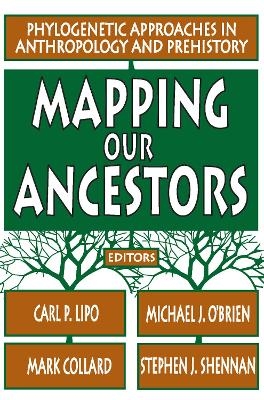
Mapping Our Ancestors
AldineTransaction (Verlag)
9780202307510 (ISBN)
Anthropologists are increasingly turning to quantitative phylogenetic methods. These methods depend on the transmission of information regardless of mode and as such are applicable to many anthropological questions. In this way, phylogenetic approaches have the potential for building bridges among the various subdisciplines of anthropology; an exciting prospect indeed. The structure of Mapping Our Ancestors reflects the editors' goal of developing a common understanding of the methods and conditions under which ancestral relations can be derived in a range of data classes of interest to anthropologists. Specifically, this volume explores the degree to which patterns of ancestry can be determined from artifactual, genetic, linguistic, and behavioral data and how processes such as selection, transmission, and geography impact the results of phylogenetic analyses.
Mapping Our Ancestors provides a solid demonstration of the potential of phylogenetic methods for studying the evolutionary history of human populations using a variety of data sources and thus helps explain how cultural material, language, and biology came to be as they are.
Carl P. Lipo is assistant professor of anthropology at California State University in Long Beach. Michael O'Brien is professor of anthropology and Director of the Museum of Anthropology at the University of Missouri, Mark Collard is assistant professor of anthropology at the University of British Columbia, Stephen J. Shennan is a professor and Director of the Institute of Archaeology at the University College London. Niles Eldredge is a curator in the department of invertebrates at the American Museum of Natural History, and adjunct professor at the City University of New York.
1: Introduction; 1: Cultural Phylogenies and Explanation: Why Historical Methods Matter; 2: Fundamentals and Methods; 2: What is a Culturally Transmitted Unit, and How Do We Find One?; 3: Cultural Traits and Linguistic Trees: Phylogenetic Signal in East Africa; 4: Branching versus Blending in Macroscale Cultural Evolution: A Comparative Study; 5: Sedation and Cladistics: The Difference between Anagenetic and Cladogenetic Evolution; 6: The Resolution of Cultural Phylogenies Using Graphs; 7: Measuring Relatedness; 3: Biology; 8: Phylogenetic Techniques and Methodological Lessons from Bioarchaeology; 9: Phylogeography of Archaeological Populations: A Case Study from Rapa Nui (Easter Island); 4: Culture; 10: Tracking Culture-Historical Lineages: Can “Descent with Modification” be Linked to “Association by Descent”?; 169: Cultural Transmission, Phylogenetics, and the Archaeological Record; 12: Using Cladistics to Construct Lineages of Projectile Points from Northeastern Missouri; 13: Reconstructing the Flow of Information across Time and Space: A Phylogenetic Analysis of Ceramic Traditions from Prehispanic Western and Northern Mexico and the American Southwest; 14: Archaeological-Materials Characterization as Phylogenetic Method: The Case of Copador Pottery from Southeastern Mesoamerica; 5: Language; 15: The Spread of Bantu Languages, Farming, and Pastoralism in Sub-Equatorial Africa; 16: Are Accurate Dates an Intractable Problem for Historical Linguistics?; 6: Concluding Remarks; 17: Afterword
| Erscheint lt. Verlag | 1.10.2005 |
|---|---|
| Verlagsort | Somerset |
| Sprache | englisch |
| Maße | 152 x 229 mm |
| Gewicht | 540 g |
| Themenwelt | Naturwissenschaften ► Biologie ► Genetik / Molekularbiologie |
| Naturwissenschaften ► Biologie ► Humanbiologie | |
| Sozialwissenschaften ► Ethnologie | |
| Sozialwissenschaften ► Soziologie | |
| ISBN-13 | 9780202307510 / 9780202307510 |
| Zustand | Neuware |
| Informationen gemäß Produktsicherheitsverordnung (GPSR) | |
| Haben Sie eine Frage zum Produkt? |
aus dem Bereich