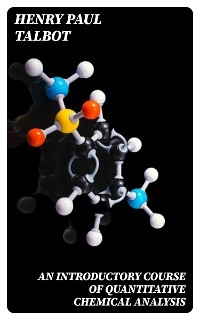
An Introductory Course of Quantitative Chemical Analysis (eBook)
172 Seiten
DigiCat (Verlag)
859-654711962-3 (EAN)

Professor Henry Paul Talbot (1860-1925) was a pivotal figure in the development of chemical education. A graduate of the Massachusetts Institute of Technology (MIT), Talbot went on to become one of the Institute's most revered professors, serving as a faculty member for more than three decades. His scholarly pursuits and commitment to education culminated in the authorship of 'An Introductory Course of Quantitative Chemical Analysis' – a comprehensive text that transformed analytical chemistry education at the beginning of the 20th century. Talbot's work is characterized by a meticulous approach to empirical science, emphasizing precision and the quantitative aspect of chemical analysis. The book, a staple in chemistry curricula for many years, has instructed countless students in the rigorous methods required for quantitative chemical examinations and was lauded for its clarity and practical detail. Talbot's legacy extends beyond his writing; as a professor, he was instrumental in the establishment of chemical standards and fostering a generation of chemists whose work would propel the field forward. His contributions to the American chemical community have earned him a respected place in the annals of science as an educator and an advocate of analytical chemistry.
| Erscheint lt. Verlag | 1.8.2022 |
|---|---|
| Verlagsort | Prague |
| Sprache | englisch |
| Themenwelt | Literatur |
| Naturwissenschaften ► Chemie | |
| Schlagworte | 19th century chemistry • Analytic • Analytical Chemistry • analytical chemistry classics • Chemical Analysis • chemical analysis reference • Chemical calculations • chemical education • Chemical education resource • Chemical experiments • Chemistry • chemistry in classical literature • chemistry textbook • Classic Literature • classic scientific manuals • educational science literature • Explanatory Notes • Gravimetric analysis methods • Henry Paul Talbot works • historical science texts • Instrumental methods overview • Laboratory Techniques • Novice chemist learning • Practical analysis applications • Quantitative • Quantitative Analysis • Quantitative analysis techniques • Quantitative Chemical Analysis • Scientific Method • scientific method in literature • scientific narratives • Stoichiometry application examples • Titration principles guide |
| Informationen gemäß Produktsicherheitsverordnung (GPSR) | |
| Haben Sie eine Frage zum Produkt? |
 EPUB (Wasserzeichen)
DRM: Digitales Wasserzeichen
Dieses eBook enthält ein digitales Wasserzeichen und ist damit für Sie personalisiert. Bei einer missbräuchlichen Weitergabe des eBooks an Dritte ist eine Rückverfolgung an die Quelle möglich.
Dateiformat: EPUB (Electronic Publication)
EPUB ist ein offener Standard für eBooks und eignet sich besonders zur Darstellung von Belletristik und Sachbüchern. Der Fließtext wird dynamisch an die Display- und Schriftgröße angepasst. Auch für mobile Lesegeräte ist EPUB daher gut geeignet.
Systemvoraussetzungen:
PC/Mac: Mit einem PC oder Mac können Sie dieses eBook lesen. Sie benötigen dafür die kostenlose Software Adobe Digital Editions.
eReader: Dieses eBook kann mit (fast) allen eBook-Readern gelesen werden. Mit dem amazon-Kindle ist es aber nicht kompatibel.
Smartphone/Tablet: Egal ob Apple oder Android, dieses eBook können Sie lesen. Sie benötigen dafür eine kostenlose App.
Geräteliste und zusätzliche Hinweise
Buying eBooks from abroad
For tax law reasons we can sell eBooks just within Germany and Switzerland. Regrettably we cannot fulfill eBook-orders from other countries.
aus dem Bereich