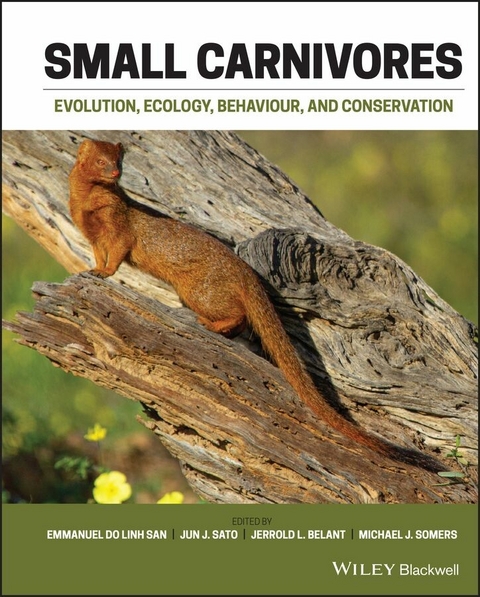
This book focuses on the 232 species of the mammalian Order Carnivora with an average body mass < 21.5 kg. Small carnivores inhabit virtually all of the Earth's ecosystems, adopting terrestrial, semi-fossorial, (semi-)arboreal or (semi-)aquatic lifestyles. They occupy multiple trophic levels and therefore play important roles in the regulation of ecosystems, such as natural pest control, seed dispersal and nutrient cycling. In areas where humans have extirpated large carnivores, small carnivores may become the dominant predators, which may increase their abundance ('mesopredator release') to the point that they can sometimes destabilize communities, drive local extirpations and reduce overall biodiversity. On the other hand, one third of the world's small carnivores are threatened or near threatened with extinction. This results from regionally burgeoning human populations' industrial and agricultural activities, causing habitat reduction, destruction, fragmentation and pollution. Overexploitation, persecution and the impacts of introduced predators, competitors, and pathogens have also negatively affected many small carnivore species. Although small carnivores have been intensively studied over the past decades, bibliometric studies showed that they have not received the same attention given to large carnivores. Furthermore, there is huge disparity in how research efforts on small carnivores have been distributed, with some species intensively studied and others superficially or not at all. This book aims at filling a gap in the scientific literature by elucidating the important roles of, and documenting the latest knowledge on, the world's small carnivores.
'This is a book that has been needed for decades. It is the first compendium of recent research on a group of mammals which has received almost no attention before the early 1970s. This book covers a wide range of subdisciplines and techniques and should be considered a solid baseline for further research on this little-known group of highly interesting mammals. As our knowledge regarding how ecosystems function increases, then the valuable role of small carnivores and the necessity for their conservation should be regarded as of paramount importance. The topics covered in this book should therefore be of great interest not only to academics and wildlife researchers, but also to the interested layman.'
Professor Anne Rasa, Ethologist
About the Editors
Emmanuel Do Linh San is an Associate Professor in the Department of Zoology and Entomology, University of Fort Hare, South Africa. He is the Founder and Director of African Small Carnivore Research Initiatives (ASCaRIs). He is currently an Associate Editor of African Journal of Wildlife Research, Mammal Study and Small Carnivore Conservation.
Jun J. Sato is a Professor in the Department of Biotechnology, Fukuyama University, Japan. He received Incentive Awards for Promising Young Researchers from the Mammal Society of Japan in 2012 and the Zoological Society of Japan in 2016. He is currently the Editor-in-Chief of Mammal Study.
Jerrold L. Belant is the Boone and Crockett Chair of Wildlife Conservation in the Department of Fisheries and Wildlife at Michigan State University, USA. He is a former Chair of the IUCN SSC Small Carnivore Specialist Group and Editor-in-Chief of Small Carnivore Conservation. He is currently on the Editorial Board of BioScience and Deputy Editor-in-Chief of Ursus.
Michael J. Somers is a Professor at the Mammal Research Institute, Department of Zoology and Entomology, University of Pretoria, South Africa. He is currently an Associate Editor of African Journal of Wildlife Research and Mammalian Biology, as well as a member of several IUCN SSC specialist groups.
Small Carnivores: Evolution, Ecology, Behaviour, and Conservation This book focuses on the 232 species of the mammalian Order Carnivora with an average body mass Professor Anne Rasa, Ethologist
About the Editors Emmanuel Do Linh San is an Associate Professor in the Department of Zoology and Entomology, University of Fort Hare, South Africa. He is the Founder and Director of African Small Carnivore Research Initiatives (ASCaRIs). He is currently an Associate Editor of African Journal of Wildlife Research, Mammal Study and Small Carnivore Conservation. Jun J. Sato is a Professor in the Department of Biotechnology, Fukuyama University, Japan. He received Incentive Awards for Promising Young Researchers from the Mammal Society of Japan in 2012 and the Zoological Society of Japan in 2016. He is currently the Editor-in-Chief of Mammal Study. Jerrold L. Belant is the Boone and Crockett Chair of Wildlife Conservation in the Department of Fisheries and Wildlife at Michigan State University, USA. He is a former Chair of the IUCN SSC Small Carnivore Specialist Group and Editor-in-Chief of Small Carnivore Conservation. He is currently on the Editorial Board of BioScience and Deputy Editor-in-Chief of Ursus. Michael J. Somers is a Professor at the Mammal Research Institute, Department of Zoology and Entomology, University of Pretoria, South Africa. He is currently an Associate Editor of African Journal of Wildlife Research and Mammalian Biology, as well as a member of several IUCN SSC specialist groups.
Foreword
Reviewing process and reviewers
List of contributors
Part I: Introduction
Chapter 1 The World's Small Carnivores Definitions, Richness, Distribution, Conservation Status, Ecological Roles, and Research Efforts
Part II: Evolution, Systematics and Distribution
Chapter 2 Molecular Systematics of the Caniform Carnivora and its Implications for Conservation
Chapter 3 Systematics and Evolution of the Mongooses (Herpestidae, Carnivora)
Chapter 4 Late Quaternary Biogeography of Small Carnivores in Europe
Chapter 5 Ecomorphological Disparity of Small Carnivore Guilds
Chapter 6 Beyond Black and White
Addressing Colour Variation in the Context of Local Environmental Conditions for the Aposematic American Hog-nosed Skunk
Part III: Ecology, Behaviour, and Diseases
Chaper 7 The function of Carnivore Latrines: Review, Case Studies, and a Research Framework for Hypothesis- Testing
Chaper 8 Factors Affecting European Badger Movement Lengths and Propensity: Evidence of Density-Dependent Effects?
Chapter 9 Behavioural Adaptations of Molina's Hog-Nosed Skunk to the Conversion of Natural Grasslands into Croplands in the Argentine Pampas
Chapter 10 Activity and Movement Patterns of Urban Stone Martens
Chapter 11 A 9-Year Demographic and Health Survey of a European Mink Population in Navarre (Spain): Role of the Canine Distemper Virus
Chapter 12 Density of African Civets in a Moist Mountain Bushveld Region of South Africa
Part IV: Interspecific Interactions and Community Ecology
Chapter 13 Spatio-Temporal Overlap Between a Native and an Exotic Carnivore in Madagascar: Evidence of Spatial Exclusion
Chapter 14 Colonization of Agricultural Landscapes by the Pine Marten: Influence of Habitat Constraints and Interspecific Competition
Chapter 15 Spatial and Temporal Resource Partitioning of Small Carnivores in the African Rainforest: Implications for Conservation and Management
Chapter 16 Ecological Separation and Coexistence in a Carnivore Community in North-Central Thailand
Chapter 17 Interactions Between Honey Badgers and Other Predators in the Southern Kalahari: Intraguild Predation and Facilitation
Chapter 18 Seed Dispersal by Mesocarnivores Importance and Functional Uniqueness in a Changing World
Chapter 19 Ecology and Conservation of Southeast Asian Civets (Viverridae) and Mongooses (Herpestidae)
Part V: Interactions with People and Conservation
Chapter 20 Small Carnivore Introductions Ecological and Biological Correlates of Success
Chapter 21 Global Review of the Effects of Small Carnivores on Threatened Species
Chapter 22 The Global Consumptive Use of Small Carnivores Social, Cultural, Religious, Economic, and Subsistence Trends from Prehistoric to Modern Times
Chapter 23 Conservation Status of the North American River Otter in the United States and Canada Assessing Management Practices and Public Perceptions of the Species
Index
List of Contributors
Etienne François Akomo‐Okoue
Institut de Recherche en Ecologie Tropicale, CENAREST, Libreville, Gabon
Chieko Ando
Graduate School of Science, Kyoto University, Kyoto, Japan
Vonjy Andrianjakarivelo
Wildlife Conservation Society Madagascar Program, WCS Makira Antseranamborondolo, Maroantsetra, Madagascar
Alessandro Balestrieri
Department of Earth and Environmental Sciences, University of Pavia, Pavia, Italy
Department of Environmental Sciences and Policy, University of Milan, Milan, Italy
Colleen M. Begg
Niassa Carnivore Project, The Ratel Trust, Rondebosch, South Africa
Keith S. Begg
Niassa Carnivore Project, The Ratel Trust, Rondebosch, South Africa
Jerrold L. Belant
Department of Fisheries and Wildlife, Michigan State University, East Lansing, MI, USA
Jennifer A. Bohrman
Department of Biology and Natural Resources, Frostburg State University, Frostburg, MD, USA
Emily A. Bricker
Department of Biology and Natural Resources, Frostburg State University, Frostburg, MD, USA
Christina D. Buesching
Department of Biology, The University of British Columbia, Okanagan Campus, Kelowna, Canada
Laëtitia Buisson
CNRS, UMR 5245 EcoLab (Laboratoire Ecologie Fonctionnelle et Environnement), Toulouse, France
INP, UPS, EcoLab, Université de Toulouse, Toulouse, France
Andrew W. Byrne
Centre for Veterinary Epidemiology and Risk Analysis, School of Veterinary Medicine, University College Dublin, Dublin, Ireland
Veterinary Sciences Division, Bacteriology Branch, Agri‐Food and Biosciences Institute, Belfast, UK
Department of Agriculture, Food and the Marine, Dublin, Ireland
Diego F. Castillo
Departamento de Biología, Bioquímica y Farmacia, Universidad Nacional del Sur, Bahía Blanca, Argentina
GECM, Instituto de Ciencias Biológicas y Biomédicas del Sur (INBIOSUR), Universidad Nacional del Sur (UNS) – CONICET, Bahía Blanca, Argentina
Juan‐Carlos Ceña
Ingeniero Técnico Forestal, Logroño, Spain
Michael V. Cove
Department of Applied Ecology and NC Cooperative Fish and Wildlife Research Unit, North Carolina State University, Raleigh, NC, USA
Jennifer J. Crees
Institute of Zoology, Zoological Society of London, London, UK
Thierry Diop Bineni
Institut de Recherche en Ecologie Tropicale, CENAREST, Libreville, Gabon
Emmanuel Do Linh San
Department of Zoology and Entomology, University of Fort Hare, Alice, South Africa
Robert C. Dowler
Department of Biology, Angelo State University, San Angelo, TX, USA
Johan T. du Toit
Department of Wildland Resources, Utah State University, Logan, UT, USA
Department of Zoology and Entomology, Mammal Research Institute, University of Pretoria, Pretoria, South Africa
Zach J. Farris
Department of Health & Exercise Science, Appalachian State University, Boone, NC, USA
Adam W. Ferguson
Department of Biological Sciences, Texas Tech University, Lubbock, TX, USA
Gantz Family Collection Center, Field Museum of Natural History, Chicago, IL, USA
M. Carmen Ferreras
Departamento de Sanidad Animal (Anatomía Patológica), Universidad de León, León, Spain
Pascal Fournier
GREGE, Villandraut, France
Christine Fournier‐Chambrillon
GREGE, Villandraut, France
Mariela G. Gantchoff
Global Wildlife Conservation Center, State University of New York College of Environmental Science and Forestry, Syracuse, NY, USA
Brian D. Gerber
Department of Natural Resources Science, University of Rhode Island, Kingston, RI, USA
Gloria Giralda‐Carrera
Servicio de Conservación de la Biodiversidad, Gobierno de Navarra, Pamplona, Spain
Lon I. Grassman Jr
Feline Research Center, Caesar Kleberg Wildlife Research Institute, Texas A&M University–Kingsville, Kingsville, TX, USA
Aaron M. Haines
Department of Biology, Applied Conservation Lab, Millersville University, Millersville, PA, USA
Zoe L. Hanley
Northwest Regional Office, Defenders of Wildlife, White Salmon, WA, USA
Jan Herr
Arrondissement Sud, Administration de la Nature et des Forêts, Leudelange, Luxembourg
Tim L. Hiller
Wildlife Ecology Institute, Helena, MT, USA
Eiji Inoue
Graduate School of Science, Kyoto University, Kyoto, Japan
Lisa Isaacs
Centre for Wildlife Management, University of Pretoria, Pretoria, South Africa
Yuji Iwata
Graduate School of Science, Kyoto University, Kyoto, Japan
Andrew P. Jennings
Small Carnivores – Research and Conservation, Portland, ME, USA
Neil R. Jordan
Centre for Ecosystem Science, School of Biological, Earth and Environmental Sciences, University of New South Wales, Sydney, Australia
Botswana Predator Conservation Trust, Maun, Botswana
Taronga Conservation Society Australia, Taronga Western Plains Zoo, Wildlife Reproduction Centre, Dubbo, Australia
Sarah Karpanty
Department of Fish & Wildlife Conservation, Virginia Tech, Blacksburg, VA, USA
Marcella J. Kelly
Department of Fish & Wildlife Conservation, Virginia Tech, Blacksburg, VA, USA
Thijs Kuiken
Viroscience Lab, Erasmus MC, Rotterdam, The Netherlands
Nathan S. Libal
Carnivore Ecology Laboratory, Mississippi State University, Mississippi State, MS, USA
Mauro Lucherini
Departamento de Biología, Bioquímica y Farmacia, Universidad Nacional del Sur, Bahía Blanca, Argentina
GECM, Instituto de Ciencias Biológicas y Biomédicas del Sur (INBIOSUR), Universidad Nacional del Sur (UNS) – CONICET, Bahía Blanca, Argentina
S. Wayne Martin
Department of Population Medicine, Ontario Veterinary College, University of Guelph, Guelph, Canada
Pierre Philippe Mbehang Nguema
Institut de Recherche en EcologieTropicale, CENAREST, Libreville, Gabon
Carlo Meloro
Research Centre in Evolutionary Anthropology and Palaeoecology, School of Biological and Environmental Sciences, Liverpool John Moores University, Liverpool, UK
Michael G.L. Mills
School of Biology and Environmental Sciences, Faculty of Agriculture and Natural Sciences, University of Mpumalanga, Nelspruit, South Africa
Yoshihiro Nakashima
College of Bioresource Science, Nihon University, Fujisawa City, Japan
Ludovic Ngok Banak
Institut de Recherche en Ecologie Tropicale, CENAREST, Libreville, Gabon
Alfred Ngomanda
Institut de Recherche en Ecologie Tropicale, CENAREST, Libreville, Gabon
Chimene Nze‐Nkogue
Institut de Recherche en Ecologie Tropicale, CENAREST, Libreville, Gabon
Allan F. O’Connell
USGS Patuxent Wildlife Research Center, Laurel, MD, USA
James O’Keeffe
Centre for Veterinary Epidemiology and Risk Analysis, School of Veterinary Medicine, University College Dublin, Dublin, Ireland
Department of Agriculture, Food and the Marine, Dublin, Ireland
Francisco Palomares
Departamento de Biología de la Conservación, Estación Biológica de Doñana, CSIC, Sevilla, Spain
Marie‐Lilith Patou
Biotope, Recherche & Développement, Mèze, France
Kelly J. Pearce
Marine‐Estuarine‐Environmental Sciences Graduate Program, University of Maryland, College Park, MD, USA
Felix Ratelolahy
Wildlife Conservation Society Madagascar Program, WCS Makira Antseranamborondolo, Maroantsetra, Madagascar
Luigi Remonti
Department of Earth and Environmental Sciences, University of Pavia, Pavia, Italy
Institut Agricole Régional, Aosta, Italy
Timothy J. Roper
Department of Biology and Environmental Science, University of Sussex, Brighton, UK
Aritz Ruiz‐González
Department of Zoology and Animal Cell Biology, University of the Basque Country (UPV‐EHU), Vitoria‐Gasteiz, Spain
Systematics, Biogeography and Population Dynamics Research Group, University of the Basque Country (UPV/EHU), Vitoria‐Gasteiz, Spain
Conservation Genetics Laboratory, National Institute for Environmental Protection and Research (ISPRA), Ozzano dell’Emilia, Italy
Jun J. Sato
Department of Biotechnology, Faculty of Life Science and Technology, Fukuyama University, Fukuyama, Japan
Thomas L. Serfass
Department of Biology and Natural Resources, Frostburg State University, Frostburg, MD, USA
Michael J. Somers
Eugène Marais Chair of Wildlife Management, Department of Zoology and Entomology, Mammal Research Institute, University of Pretoria, Pretoria, South Africa
Centre for Invasion Biology, University of Pretoria,...
| Erscheint lt. Verlag | 13.7.2022 |
|---|---|
| Sprache | englisch |
| Themenwelt | Naturwissenschaften ► Biologie ► Ökologie / Naturschutz |
| Schlagworte | Animal ecology • Biologie • Biowissenschaften • Conservation Science • Ecology • Ecosystems • Evolution • Life Sciences • Naturschutzbiologie • Ökologie • Ökologie / Tiere • Raubtiere • role of small mammals • small carnivore evolution • small carnivore research • small carnivore studies • Terrestrial • Zoologie |
| ISBN-10 | 1-118-94326-0 / 1118943260 |
| ISBN-13 | 978-1-118-94326-7 / 9781118943267 |
| Informationen gemäß Produktsicherheitsverordnung (GPSR) | |
| Haben Sie eine Frage zum Produkt? |
 EPUB (Adobe DRM)
Kopierschutz: Adobe-DRM
Adobe-DRM ist ein Kopierschutz, der das eBook vor Mißbrauch schützen soll. Dabei wird das eBook bereits beim Download auf Ihre persönliche Adobe-ID autorisiert. Lesen können Sie das eBook dann nur auf den Geräten, welche ebenfalls auf Ihre Adobe-ID registriert sind.
Details zum Adobe-DRM
Dateiformat: EPUB (Electronic Publication)
EPUB ist ein offener Standard für eBooks und eignet sich besonders zur Darstellung von Belletristik und Sachbüchern. Der Fließtext wird dynamisch an die Display- und Schriftgröße angepasst. Auch für mobile Lesegeräte ist EPUB daher gut geeignet.
Systemvoraussetzungen:
PC/Mac: Mit einem PC oder Mac können Sie dieses eBook lesen. Sie benötigen eine
eReader: Dieses eBook kann mit (fast) allen eBook-Readern gelesen werden. Mit dem amazon-Kindle ist es aber nicht kompatibel.
Smartphone/Tablet: Egal ob Apple oder Android, dieses eBook können Sie lesen. Sie benötigen eine
Geräteliste und zusätzliche Hinweise
Buying eBooks from abroad
For tax law reasons we can sell eBooks just within Germany and Switzerland. Regrettably we cannot fulfill eBook-orders from other countries.
aus dem Bereich