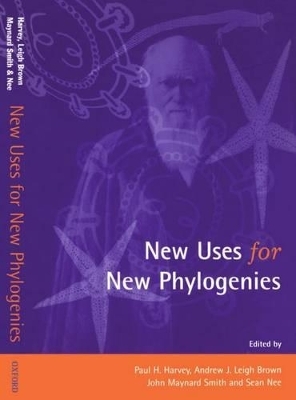
New Uses for New Phylogenies
Oxford University Press (Verlag)
978-0-19-854984-0 (ISBN)
Recent advances in molecular genetics make the sequencing of genes a straightforward exercise. Comparisons of sequenced genes from different individuals of a species, or from different species, allow the construction of family trees or evolutionary trees which reveal genetic relationships. This volume shows for the first time how those trees, or phylogenies, can be used to answer questions about population dynamics, epidemiology, development, biodiversity, conservation, and the evolution of genetic systems. The techniques for deciding what these new trees can tell us come together in a unified framework so that a common set of methods can be applied, whatever area of biology interests the research worker.
1. What this book is about ; 2. New phylogenies: an introductory look at the coalescent ; 3. Genealogies and geography ; 4. The coalescent process and background selection ; 5. Inferring population history from molecular phylogenies ; 6. Applications of intraspecific phylogenetics ; 7. Inferring phylogenies from DNA sequence data: the effects of sampling ; 8. Uses for evolutionary trees ; 9. Cross-species transmission and recombination of 'AIDS' viruses ; 10. Using interspecies phylogenies to test macroevolutionary hypotheses ; 11. Using phylogenetic trees to reconstruct the history of infectious disease epidemics ; 12. Relating geographic patterns to phylogenetic processes ; 13. Uses of molecular phylogenies for conservation ; 14. Testing the time axis of phylogenies ; 15. Comparative evolution of larval and adult life-history stages and small subunit ribosomal RNA amongst post-Palaeozoic echinoids ; 16. Molecular phylogenies and host-parasite cospeciation: gophers and lice as a model system ; 17. A microevolutionary link, between phylogenies and comparative data ; 18. Comparative test of evolutionary lability and rats using molecular phylogenies ; 19. Community evolution in Greater Antilean anolis lizards: phylogenetic patterns and experimental tests ; 20. The evolution of body plans: HOM/Hox cluster evolution, model systems, and the importance of phylogeny.
| Erscheint lt. Verlag | 16.5.1996 |
|---|---|
| Zusatzinfo | numerous line illustrations, tables |
| Verlagsort | Oxford |
| Sprache | englisch |
| Maße | 157 x 234 mm |
| Gewicht | 540 g |
| Themenwelt | Naturwissenschaften ► Biologie ► Evolution |
| Naturwissenschaften ► Biologie ► Zellbiologie | |
| ISBN-10 | 0-19-854984-9 / 0198549849 |
| ISBN-13 | 978-0-19-854984-0 / 9780198549840 |
| Zustand | Neuware |
| Informationen gemäß Produktsicherheitsverordnung (GPSR) | |
| Haben Sie eine Frage zum Produkt? |
aus dem Bereich