


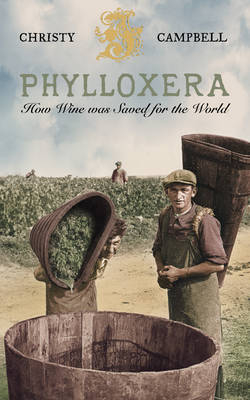
Phylloxera
How Wine Was Saved for the World
Seiten
2004
HarperPerennial (Verlag)
978-0-00-711536-5 (ISBN)
HarperPerennial (Verlag)
978-0-00-711536-5 (ISBN)
A historical investigation into the mysterious bug that wiped out the vineyards of France and Europe in the 1860s – and how one young botanist eventually ‘saved wine for the world’.
In the early 1860s, vines in the lower Rhône valley, and then around Bordeaux, inexplicably began to wither and die. Panic seized France, and Jules-Émile Planchon, a botanist from Montpellier, was sent to investigate. Magnifying glass in hand, he discovered the roots of a dying vine covered in microscopic yellow insects. The tiny aphid would be named Phylloxera vastatrix – 'the dry leaf devastator'. Where it had come from was utterly mysterious, but it advanced with the speed of an invading army. As the noblest vineyards of France came under biological siege, the world's greatest wine industry tottered on the brink of ruin. The grand owners fought the aphid with expensive insecticide, while peasant vignerons simply abandoned their ruined plots in despair. Within a few years the plague had spread across Europe, from Portugal to the Crimea.
Planchon, aided by the American entomologist Charles Riley, discovered that the parasite had accidentally been imported from America. He believed that only the introduction of American vines, which appeared to have developed a resistance to the aphid, could save France's vineyards. His opponents maintained that this would merely assist the spread of the disease. Meanwhile, encouraged by the French government's offer of a prize of 300,000 gold francs for a remedy, increasingly bizarre suggestions flooded in, and many wine-growing regions came close to revolution as whole local economies were obliterated. Eventually Planchon and his supporters won the day, and phylloxera-resistant American vines were grafted onto European root-stock. Despite some setbacks – the first fruits of transplanted American vines were universally pronounced undrinkable – by 1914 all vines cultivated in France were hybrid Americans.
Phylloxera is an entertaining, revealing and frequently astonishing account of one of the earliest and most successful applications of science to an ecological disaster.
In the early 1860s, vines in the lower Rhône valley, and then around Bordeaux, inexplicably began to wither and die. Panic seized France, and Jules-Émile Planchon, a botanist from Montpellier, was sent to investigate. Magnifying glass in hand, he discovered the roots of a dying vine covered in microscopic yellow insects. The tiny aphid would be named Phylloxera vastatrix – 'the dry leaf devastator'. Where it had come from was utterly mysterious, but it advanced with the speed of an invading army. As the noblest vineyards of France came under biological siege, the world's greatest wine industry tottered on the brink of ruin. The grand owners fought the aphid with expensive insecticide, while peasant vignerons simply abandoned their ruined plots in despair. Within a few years the plague had spread across Europe, from Portugal to the Crimea.
Planchon, aided by the American entomologist Charles Riley, discovered that the parasite had accidentally been imported from America. He believed that only the introduction of American vines, which appeared to have developed a resistance to the aphid, could save France's vineyards. His opponents maintained that this would merely assist the spread of the disease. Meanwhile, encouraged by the French government's offer of a prize of 300,000 gold francs for a remedy, increasingly bizarre suggestions flooded in, and many wine-growing regions came close to revolution as whole local economies were obliterated. Eventually Planchon and his supporters won the day, and phylloxera-resistant American vines were grafted onto European root-stock. Despite some setbacks – the first fruits of transplanted American vines were universally pronounced undrinkable – by 1914 all vines cultivated in France were hybrid Americans.
Phylloxera is an entertaining, revealing and frequently astonishing account of one of the earliest and most successful applications of science to an ecological disaster.
Christy Campbell was a publisher’s editor before turning freelance writer. He has written for the Sunday Telegraph since 1990 when he joined as Defence Correspondent covering the Gulf War. He has made a speciality of ‘forensic historical investigations’ and produced a series of special supplements for the Sunday Telegraph on 20th-century history. He has written a number of non-fiction books on World War II and broadcast on radio and television, and is the author of The Maharajah’s Box published by HarperCollins.
| Erscheint lt. Verlag | 18.2.2005 |
|---|---|
| Zusatzinfo | 16 b/w plates (16pp) |
| Verlagsort | London |
| Sprache | englisch |
| Maße | 129 x 198 mm |
| Gewicht | 280 g |
| Themenwelt | Literatur ► Biografien / Erfahrungsberichte |
| Sachbuch/Ratgeber ► Natur / Technik | |
| Geschichte ► Teilgebiete der Geschichte ► Kulturgeschichte | |
| Naturwissenschaften ► Biologie ► Botanik | |
| Weitere Fachgebiete ► Land- / Forstwirtschaft / Fischerei | |
| Schlagworte | Reblaus • Weinbau |
| ISBN-10 | 0-00-711536-9 / 0007115369 |
| ISBN-13 | 978-0-00-711536-5 / 9780007115365 |
| Zustand | Neuware |
| Informationen gemäß Produktsicherheitsverordnung (GPSR) | |
| Haben Sie eine Frage zum Produkt? |
Mehr entdecken
aus dem Bereich



aus dem Bereich
Die Revolution des Gemeinen Mannes
Buch | Softcover (2024)
C.H.Beck (Verlag)
CHF 16,80
Eine Geschichte des Geschmacks
Buch | Hardcover (2025)
C.H.Beck (Verlag)
CHF 49,95
vom Mittelalter bis zur Gegenwart
Buch | Softcover (2024)
C.H.Beck (Verlag)
CHF 16,80


