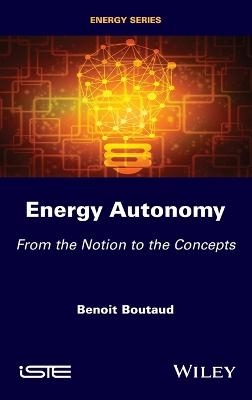
Energy Autonomy
ISTE Ltd and John Wiley & Sons Inc (Verlag)
978-1-78630-834-4 (ISBN)
While there are numerous new developments – renewable energies, smart grids and self-consumption – it is becoming difficult to know what this idea of “autonomy” covers, just as it is difficult to define "independence" and "self-sufficiency:, which are often associated with it. However, these three concepts are key to thinking about the energy system and deciding its future. Covering distinct ideas, they are often reduced to economic and productive factors. This ambiguity in their meanings is responsible for the misunderstandings, delusions and obstacles that hamper the implementation of the energy transition.
This book deconstructs the common idea of autonomy in favor of a set of more operational concepts. It demonstrates that these ideas are not interchangeable but rather represent practical and constructive tools for action. The world of energy is changing, and therefore we must rethink energy autonomy.
Benoit Boutaud holds a doctorate in Human and Social Sciences and is a leading expert on energy issues in France. He conducts research at the European Institute for Energy Research in Germany.
Introduction ix
Part 1. Self-Sufficiency, an Operational Concept 1
Chapter 1. The Two Autonomies 3
1.1. An old political and technical project 3
1.2. Autonomy of individuals 10
Chapter 2. New Perspectives on Production and Consumption 15
2.1. More numerous and "local" means of production 16
2.2. Improved energy efficiency and new levers to control demand 21
Chapter 3. Distinguish Between Self-Sufficiency and Self-Consumption 27
3.1. Self-sufficiency: a layered concept 27
3.1.1. Spontaneous self-sufficiency 27
3.1.2. Partial self-sufficiency 30
3.1.3. Extended self-sufficiency 30
3.2. Self-consumption, a convergence of technology and economics 34
3.2.1. Principle 34
3.2.2. Self-consumption and grid connection 38
3.3. Vehicle autonomy and self-sufficiency 44
Chapter 4. Measuring Self-Sufficiency and Self-Consumption 49
4.1. Satisfying one’s needs 49
4.2. Measuring, easy to say… 53
Chapter 5. Self-Sufficiency on a Territorial Scale 61
5.1. A network organization 61
5.2. An interconnected set 65
Chapter 6. Self-Sufficiency as an Analytical Tool 81
6.1. Knowing the level of self-sufficiency, a prerequisite 81
6.2. Calculation of self-sufficiency 87
Part 2. The Energy Autonomy of Territories, a Legal Issue 97
Chapter 7. Local Authorities Territories, Framework of the New Energy System 99
7.1. From territory to territories: the perimeter transition 101
7.2. The territory of local authorities, a consistent perimeter 106
Chapter 8. Energy, a "New" Competence 111
8.1. Competences for omnipresent local authorities 111
8.2. A broad spectrum of intervention 117
Chapter 9. Autonomy Seen Through Positive Energy Territories 123
9.1. TEPOS: deciding and doing things "locally" 123
9.2. Regionalization and "nationalization" of positive energy territories 137
Chapter 10. "Autonomy", from Slogan to Instrument 143
10.1. The local authority as a coordinator and catalyst 143
10.2. Autonomy as a means of communication and development 147
Chapter 11. Energy Autonomy: Local Authorities Within a Sovereign State 159
11.1. Autonomy and free administration 159
11.2. The issue of financing 167
Chapter 12. The Value of a Legal Perspective 171
12.1. Coexistence of autonomous territories 171
12.2. A pragmatic approach 175
Chapter 13. Territorial Energy Independence: A State Issue and a Nonsense for a Community 185
13.1. Autonomy and independence 185
13.2. Specific issues of independence 188
Conclusion 195
References 203
Index 223
| Erscheinungsdatum | 07.09.2022 |
|---|---|
| Verlagsort | London |
| Sprache | englisch |
| Maße | 10 x 10 mm |
| Gewicht | 454 g |
| Themenwelt | Naturwissenschaften ► Biologie ► Ökologie / Naturschutz |
| Technik ► Elektrotechnik / Energietechnik | |
| ISBN-10 | 1-78630-834-7 / 1786308347 |
| ISBN-13 | 978-1-78630-834-4 / 9781786308344 |
| Zustand | Neuware |
| Informationen gemäß Produktsicherheitsverordnung (GPSR) | |
| Haben Sie eine Frage zum Produkt? |
aus dem Bereich