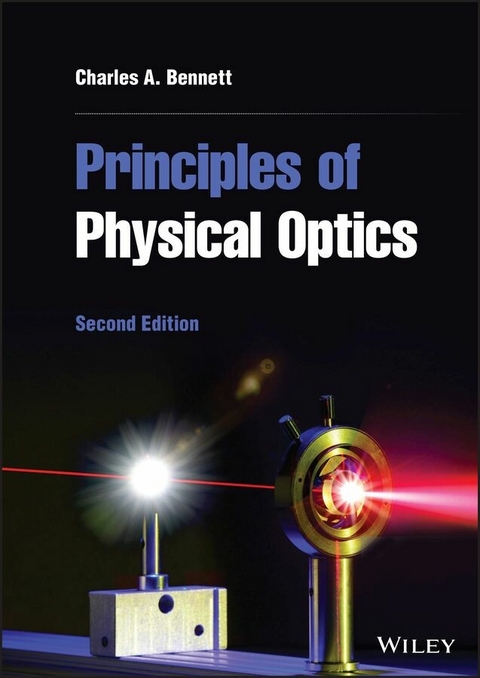
Principles of Physical Optics (eBook)
John Wiley & Sons (Verlag)
978-1-119-80182-5 (ISBN)
An intuitive and accessible approach to the fundamentals of physical optics
In the newly revised Second Edition of Principles of Physical Optics, eminent researcher Dr. Charles A. Bennett delivers an intuitive and practical text designed for a one-semester, introductory course in optics. The book helps readers build a firm foundation in physical optics and gain valuable, practical experience with a range of mathematical applications, including matrix methods, Fourier analysis, and complex algebra.
This latest edition is thoroughly updated and offers 20% more worked examples and 50% more homework problems than the First Edition. Only knowledge of standard introductory sequences in calculus and calculus-based physics is assumed, with the included mathematics limited to what is necessary to adequately address the subject matter. The book provides additional materials on optical imaging and nonlinear optics and dispersion for use in an accelerated course. It also offers:
• A thorough introduction to the physics of waves, including the one-dimensional wave equation and transverse traveling waves on a string
• Comprehensive explorations of electromagnetic waves and photons, including introductory material on electromagnetism and electromagnetic wave equations
• Practical discussions of reflection and refraction, including Maxwell’s equations at an interface and the Fresnel equations
• In-depth examinations of geometric optics, as well as superposition, interference, and diffraction
Perfect for advanced undergraduate students of physics, chemistry, and materials science, Principles of Physical Optics also belongs on the bookshelves of engineering students seeking a one-stop introduction to physical optics.
Charles A. Bennett, PhD, is Emeritus Professor of Physics at the University of North Carolina at Asheville and former Director of the UNCA Center for Teaching and Learning. Since 1983, he has collaborated with Oak Ridge National Laboratory. His research is focused on quantum optics, physical optics, and laser applications in environmental and fusion energy problems.
An intuitive and accessible approach to the fundamentals of physical optics In the newly revised Second Edition of Principles of Physical Optics, eminent researcher Dr. Charles A. Bennet delivers an intuitive and practical text designed for a one-semester, introductory course in optics. The book helps readers build a firm foundation in physical optics and gain valuable, practical experience with a range of mathematical applications, including matrix methods, Fourier analysis, and complex algebra. This latest edition is thoroughly updated and offers 20% more worked examples and 50% more homework problems than the First Edition. Only knowledge of standard introductory sequences in calculus and calculus-based physics is assumed, with the included mathematics limited to what is necessary to adequately address the subject matter. The book provides additional materials on optical imaging and nonlinear optics and dispersion for use in an accelerated course. It also offers: A thorough introduction to the physics of waves, including the one-dimensional wave equation and transverse traveling waves on a string Comprehensive explorations of electromagnetic waves and photons, including introductory material on electromagnetism and electromagnetic wave equations Practical discussions of reflection and refraction, including Maxwell s equations at an interface and the Fresnel equations In-depth examinations of geometric optics, as well as superposition, interference, and diffractionPerfect for advanced undergraduate students of physics, chemistry, and materials science, Principles of Physical Optics also belongs on the bookshelves of engineering students seeking a one-stop introduction to physical optics.
Charles A. Bennett, PhD, is Emeritus Professor of Physics at the University of North Carolina at Asheville and former Director of the UNCA Center for Teaching and Learning. Since 1983, he has collaborated with Oak Ridge National Laboratory. His research is focused on quantum optics, physical optics, and laser applications in environmental and fusion energy problems.
1
The Physics of Waves
The solution of the difficulty is that the two mental pictures which experiment lead us to form — the one of the particles, the other of the waves — are both incomplete and have only the validity of analogies which are accurate only in limiting cases.
Heisenberg
1.1 Introduction
The properties of waves are central to the study of optics. As we will see, light (or more properly, electromagnetic radiation) has both particle and wave properties. These complementary aspects are a result of quantum mechanics, and prior to the early 1900s, there were two schools of thought. Newton postulated that light consists of particles, while contemporaries Huygens and Hooke promoted a wave theory of light. The matter seemed settled with Young's important double‐slit experiment offering clear experimental evidence that light is a wave. Maxwell's sweeping theory of electromagnetism finally provided a deep and complete description of electromagnetic waves that we consider in detail in Chapter 2. Although current theories of optics include both wave and particle descriptions, the wave picture still forms the bedrock of most optical technology. In this chapter, we will outline some general properties that apply to traveling waves of all types.
1.2 One‐Dimensional Wave Equation
Mechanical waves travel within elastic media whose material properties provide restoring forces that result in oscillation. When a guitar string is plucked, it is displaced away from its equilibrium position, and the mechanical energy of this disturbance subsequently propagates along the string as traveling waves. In this case, the waves are transverse, meaning that the displacement of the medium (the string) is perpendicular to the direction of energy travel. Acoustic waves in a gas are longitudinal, meaning that the gas molecules are displaced back and forth along the direction of energy flow as regions of high and low pressure are created along the wave.
As we shall see in Chapter 2, electromagnetic waves are transverse but differ from mechanical waves in that they do not require an elastic medium. Rather, they propagate as disturbances in the electromagnetic field. Mechanical waves and electromagnetic waves are both examples of classical waves, which can be described with classical physics.1
Consider a mechanical wave, and let describe a disturbance of the medium away from its equilibrium condition. For a transverse wave along a horizontal string, represents a vertical displacement along the ‐axis. For a longitudinal acoustic wave traveling horizontally through air, might represent deviations away from ambient pressure along the ‐axis. In any case, we refer to as the wavefunction. Since depends only on the single spatial coordinate , it is a one‐dimensional wavefunction.
All classical mechanical waves can be described by the differential wave equation
where is the wave speed and is the wavefunction. To demonstrate that a given function describes a classical wave, it is necessary only to show that this function satisfies Equation 1.1. Conversely, any physical system that can be shown to be described by Equation 1.1 must necessarily involve classical traveling waves.
Equation 1.1 is an example of a class of mathematical equations known as differential equations. When taking a partial derivative with respect to a given parameter, the remaining parameters are treated as constants.
1.3 General Solutions to the 1D Wave Equation
Consider a plot of vs. . Data for such a plot could be provided by an array of measuring devices, such as an array of pressure sensors arranged linearly to record the pressure amplitude of a passing acoustic wave. A plot of vs. at a particular time represents a snap shot of the wave as it passes by an array of measuring devices.
There are many possible shapes for this amplitude. Perhaps a sinusoidal function comes to mind, with distinct periodic crests and troughs. However, such waves are not the most general solution to Equation 1.1, as you can determine by comparing the sound of your voice as you hum or sing a specific musical note (if you can!) with the sound that your hands make when you clap them together. We will refer to the sound of a clap as a pulse.
We will show below that the most general solutions to Equation 1.1 may be expressed as follows:
where the functions and represent any function that has finite second derivatives and the parameters , , and all occur explicitly within the function as or .
As an example, consider the function
where is a constant. Equation 1.4 represents a peaked function whose maximum is located at points given by . A plot of this wavefunctions at two different times is shown in Figure 1.1.
To show that Equation 1.4 represents a traveling wave, we could simply check to see if it solves the differential wave equation. It is more elegant, however, to show this for any differentiable functions given by Equations 1.2 and 1.3. Begin with the function , and define a new variable given by . Differentiate using the chain rule:
In this case, , so the derivative of with respect to is just 1. Thus,
and
The time derivative of is given by
Figure 1.1 The traveling pulse of Equation 1.4, shown at two different times .
and
Substitute the results of Equations 1.5 and 1.6 into the differential wave equation:
Thus Equation 1.1 is satisfied by . In a similar way, you may show that also solves Equation 1.1 (see Problem 1.7). Thus and both solve the differential wave equation and therefore represent traveling waves.
In summary, we have shown that functions of and with finite second derivatives and with explicit occurrences of and that can be grouped as or are solutions to the differential wave equation and thus represent traveling waves. In particular, the function of Equation 1.4 fits this requirement and is therefore a traveling wave. Of course, you can also demonstrate this by substituting Equation 1.4 directly into Equation 1.1 (see Example 1.2).
We now show that the function represents a forward‐traveling wave. Consider values of and determined by . In Equation 1.4, choosing the value zero for this constant locates the peak of the pulse. As time proceeds, the specific value of that satisfies this equation changes according to
or
Thus, propagates in the positive direction with velocity and is therefore a forward‐traveling wave. In a similar way, you can show that represents a backward‐traveling wave (see Problem 1.8).
1.4 Harmonic Traveling Waves
According to the results of Section 1.3, any function described by Equation 1.2 or 1.3 represents a traveling wave. In particular, harmonic functions (i.e. sines and cosines) with the appropriate arguments solve the differential wave equation. Thus, the following function represents a traveling wave:
where is the wave amplitude and is defined below.
Harmonic functions are periodic with a period of radians:
The given in Equation 1.7 is periodic in both space and time coordinates. The term represents the spatial period:
The parameter is also called the wavelength. It has SI units of meters.
Let represent the temporal period, i.e. the time required for one cycle. The SI unit of is seconds (s), but it is convenient to use s/cycle as a reminder of what represents. Since Equation 1.7 is periodic in , we have
represents the temporal period provided that
or
Thus, a periodic classical wave travels one wavelength in one temporal period . It is customary to define the wave frequency as
The units of are cycles/s (SI unit: ), often referred to as Hertz (Hz). In terms of frequency, Equation 1.9 becomes
A plot of vs. is shown in Figure 1.2(a). Figure 1.2(b) shows a plot of vs. . A plot such as this could be obtained from data provided by a measuring device located at a particular value of .
It is customary to define the propagation constant as follows:
This quantity is also sometimes referred to as the wavenumber. Since converts meters to radians, the units are rad/m (SI unit: ). We may rewrite Equation 1.7 as
Similarly, we can define the angular frequency:
Figure 1.2 Plots of a harmonic wavefunction. (a) A plot of vs. position . (b) A plot...
| Erscheint lt. Verlag | 1.7.2022 |
|---|---|
| Sprache | englisch |
| Themenwelt | Naturwissenschaften ► Physik / Astronomie |
| Schlagworte | diffraction • Electrical & Electronics Engineering • Elektrotechnik u. Elektronik • fourier analysis • Gaussian beams • geometric optics • Interference • introductory optics • lasers • Materials Science • Materialwissenschaften • Nonlinear Optics • Optical and Non-Linear Optical Materials • Optical Communications • Optical imaging • Optics & Photonics • optics basics • optics foundations • optics fundamentals • optics textbook • Optik • Optik u. Photonik • Optische Nachrichtentechnik • Optische u. Nichtlineare Optische Materialien • Physical optics textbook • Physics • Physik |
| ISBN-10 | 1-119-80182-6 / 1119801826 |
| ISBN-13 | 978-1-119-80182-5 / 9781119801825 |
| Informationen gemäß Produktsicherheitsverordnung (GPSR) | |
| Haben Sie eine Frage zum Produkt? |
 EPUB (Adobe DRM)
Kopierschutz: Adobe-DRM
Adobe-DRM ist ein Kopierschutz, der das eBook vor Mißbrauch schützen soll. Dabei wird das eBook bereits beim Download auf Ihre persönliche Adobe-ID autorisiert. Lesen können Sie das eBook dann nur auf den Geräten, welche ebenfalls auf Ihre Adobe-ID registriert sind.
Details zum Adobe-DRM
Dateiformat: EPUB (Electronic Publication)
EPUB ist ein offener Standard für eBooks und eignet sich besonders zur Darstellung von Belletristik und Sachbüchern. Der Fließtext wird dynamisch an die Display- und Schriftgröße angepasst. Auch für mobile Lesegeräte ist EPUB daher gut geeignet.
Systemvoraussetzungen:
PC/Mac: Mit einem PC oder Mac können Sie dieses eBook lesen. Sie benötigen eine
eReader: Dieses eBook kann mit (fast) allen eBook-Readern gelesen werden. Mit dem amazon-Kindle ist es aber nicht kompatibel.
Smartphone/Tablet: Egal ob Apple oder Android, dieses eBook können Sie lesen. Sie benötigen eine
Geräteliste und zusätzliche Hinweise
Buying eBooks from abroad
For tax law reasons we can sell eBooks just within Germany and Switzerland. Regrettably we cannot fulfill eBook-orders from other countries.
aus dem Bereich