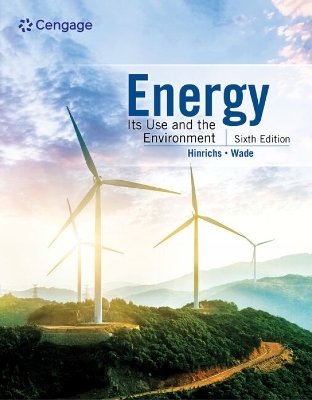
Energy
Brooks/Cole (Verlag)
978-0-357-71942-8 (ISBN)
Roger Hinrichs is presently a professor emeritus of physics at SUNY-Oswego. At SUNY-Oswego he was previously a professor of physics and department chair, and he taught energy-related courses for over 25 years. His training is in experimental nuclear physics, and his research involves studies of trace materials in environmental and biological samples using PIXE with Oswego's Van de Graaff particle accelerator. He has an interest in energy use in developing countries, and spent time in Kenya and India, as well as one year as a Fulbright Scholar in the sultanate of Oman. Additionally, he spent four years as a visiting professor at the Weill Cornell Medical College in Qatar. He co-directed the Institute in Energy Education, a program for secondary school science and technology teachers. In its 20 years, this program has impacted over 500,000 students and has won numerous awards. Dr. Hinrichs also supports active inquiry-based learning in the classroom; some of the activities in this text come from his course, "Physics for Elementary Education Majors." He has worked as a consultant at local, state and national levels on matters of energy policy and energy technologies. Dr. Rachel Wade is the department chair for physics and astronomy at Edmonds College in Lynnwood, Washington, where she teaches physics, weather and oceanography. Her scientific training is in physical oceanography with an emphasis on climate science. Dr. Wade holds a bachelor’s degree in physics from Whitman College. Her master’s degrees in physical oceanography and in science education, along with her doctorate in higher education, are from the University of Washington. Her research has focused on STEM education in two-year colleges to include integrating polar science into physics curriculum, identity and inclusion in STEM, and problem-based learning in physics. Dr. Wade serves as the faculty advisor for the Edmonds Math Science Engineering Achievement Community College Program. Outside of academia, she also has more than 25 years of service in the U.S. Navy Reserve, where she serves as a naval oceanographer.
1. Introduction.
2. Energy Mechanics.
3. Energy and Work.
4. Conservation of Energy.
5. Heat and Work.
6. Home Energy Conservation and Heat-Transfer Control.
7. Solar Energy: Characteristics and Heating.
8. Energy from Fossil Fuels.
9. The Greenhouse Effect and Climate Change.
10. Environmental Impacts of Energy Production.
11. Electricity: Circuits and Superconductors.
12. Electromagnetism and the Generation of Electricity.
13. Electricity from Solar, Wind, and Hydro.
14. Energy Storage: Batteries, Electric Vehicles and Fuel Cells.
15. The Building Blocks of Matter: The Atom and Its Nucleus.
16. Nuclear Power: Fission.
17. Effects and Uses of Radiation.
18. Future Energy Alternatives: Fusion.
19. Biomass: From Plants to Garbage.
20. Tapping the Earth's Heat: Geothermal Energy.
21. A National and Personal Commitment.
Appendix A: Units of Measurement and Powers of Ten Notation.
Appendix B: Conversions and Equivalencies.
Appendix C: Home Heating Analysis.
Appendix D: Insolation and Temperature Data for Selected U.S. Cities.
Appendix E: Additional Energy Data Resources
Glossary.
Index.
| Erscheinungsdatum | 28.04.2023 |
|---|---|
| Verlagsort | CA |
| Sprache | englisch |
| Maße | 73 x 11 mm |
| Gewicht | 1020 g |
| Themenwelt | Naturwissenschaften ► Biologie ► Ökologie / Naturschutz |
| Naturwissenschaften ► Physik / Astronomie | |
| ISBN-10 | 0-357-71942-5 / 0357719425 |
| ISBN-13 | 978-0-357-71942-8 / 9780357719428 |
| Zustand | Neuware |
| Informationen gemäß Produktsicherheitsverordnung (GPSR) | |
| Haben Sie eine Frage zum Produkt? |
aus dem Bereich