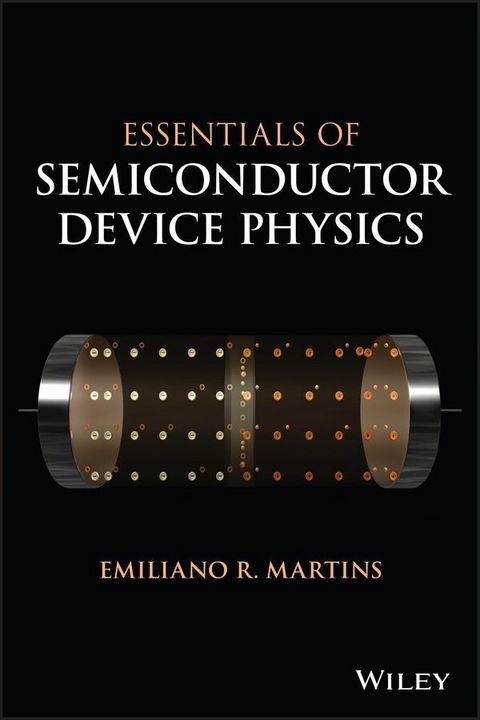
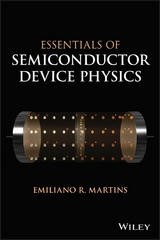
An introductory semiconductor device physics textbook that is accessible to readers without a background in statistical physics
The subject of this book is the physics of semiconductor devices, which is an important topic in engineering and physics because it forms the background for electronic and optoelectronic devices, including solar cells. The author aims to provide students and teachers with a concise text that focuses on semiconductor devices and covers the necessary background in statistical physics.
This text introduces the key prerequisite knowledge in a simple, clear, and friendly manner. It distills the key concepts of semiconductor devices down to their essentials, enabling students to master this key subject in engineering, physics, and materials. The subject matter treated in this book is directly connected to the physics of p-n junctions and solar cells, which has become a topic of intense interest in the last decade. Sample topics covered within the text include:
- Chemical potential, Fermi level, Fermi-Dirac distribution, drift current and diffusion current.
- The physics of semiconductors, band theory and intuitive derivations of the concentration of charge carriers.
- The p-n junction, with qualitative analysis preceding the mathematical descriptions.
- A derivation of the current vs voltage relation in p-n junctions (Shockley equation).
- Important applications of p-n junctions, including solar cells
- The two main types of transistors: Bipolar Junction Transistors (BJT) and Metal Oxide Semiconductor Field Effect Transistors (MOSFET)
For students and instructors, it may be used as a primary textbook for an introductory semiconductor device physics course and is suitable for a course of approximately 30-50 hours. Scientists studying and researching semiconductor devices in general, and solar cells in particular, will also benefit from the clear and intuitive explanations found in this book.
Emiliano R. Martins obtained his PhD in 2014 from the University of St. Andrews (UK) in the field of photonics, which deals with the interaction between light and matter in semiconductor devices. His research field involves solar cells and other optoelectronic devices and he has been teaching a course on semiconductor device physics since 2016 at the University of São Paulo in Brazil. He has written unpublished books for other undergraduate disciplines that he teaches, including signals and systems and digital signal processing.
Emiliano R. Martins obtained his PhD in 2014 from the University of St. Andrews (UK) in the field of photonics, which deals with the interaction between light and matter in semiconductor devices. His research field involves solar cells and other optoelectronic devices and he has been teaching a course on semiconductor device physics since 2016 at the University of São Paulo in Brazil. He has written unpublished books for other undergraduate disciplines that he teaches, including signals and systems and digital signal processing.
Preface
1 Concepts of Statistical Physics
1.1 Introduction
1.2 Thermal Equilibrium
1.3 Partition function - Part I
1.4 Diffusive equilibrium and the chemical potential
1.5 The partition function, Part II
1.6 Example of application: energy and number of elements of a system
1.7 The Fermi-Dirac distribution
1.8 Analogy between the systems "box" and "coins"
1.9 Concentration of electrons and Fermi level
1.10 Transport
1.11 Relationship between current and concentration of particles (continuity equation)
1.12 Suggestions for further reading
1.13 Exercises
2 - Semiconductors
2.1 Band Theory
2.2 Electrons and holes
2.3 Concentration of free electrons
2.4 Density of states
2.5 Concentration of holes and Fermi level
2.6 Extrinsic semiconductors (doping)
2. 7 Exercises
3 Introduction to semiconductor devices: the p-n junction
3.1 p-n junction in thermodynamic equilibrium - qualitative description
3.2 p-n junction in thermodynamic equilibrium - quantitative description
3.3 Systems outside thermodynamic equilibrium: the quasi-Fermi levels.
3.4 Qualitative description of the relationship between current and voltage in a p-n junction
3.5 The current vs voltage relationship in a p-n junction (Shockley's equation)
3.6 Suggestions for further reading
3.7 Exercises
4 Photovoltaic devices (mainly solar cells)
4.1 Solar cells and photodetectors
4.2 Physical principles
4.3 The equivalent circuit
4.4 The I x V curve and the fill-factor
4.5 Efficiency of solar cells and the theoretical limit
4.6 Connections of solar cells
4.7 Suggestions for further reading
4.8 Exercises
5 Transistors
5.1 The Bipolar Junction Transistor (BJT)
5.1.1 Physical principles of the BJT
5.1.2 The beta parameter and the relationship between emitter, collector and base currents
5.1.3 Relationship between IC and VCE and the Early effect
5.1.4 The BJT as an amplifier
5.2 The MOSFET
5.2.1 Physical principles
5.2.3 Examples of applications of MOSFETS: logic inverters and logic gates
5.3 Suggestions for further reading
5.4 Exercises
Appendix: Geometrical interpretation of the chemical potential and free energy
1
Concepts of statistical physics
Learning objectives
The two most important concepts of statistical physics pertaining to the physics of semiconductor devices are the electrochemical potential, also known as the Fermi level, and the Fermi–Dirac distribution. As soon as the electrochemical potential is introduced, I will show you a prototype of a p‐n junction, and emphasize the key role played by the electrochemical potential in establishing the equilibrium properties of p‐n junctions. The Fermi–Dirac distribution is another key concept treated in this chapter. It will be derived in a way that highlights its assumptions and domains of applicability, and it will be used in the next chapter to find the concentration of charges in semiconductors. This chapter also introduces two types of currents relevant to p‐n junctions: the drift current and the diffusion current.
1.1 Introduction
We begin our introduction to statistical physics with the following principle: the state property of a macroscopic system in equilibrium is always the most probable. Our first job is to make sense of this principle.
First, we need to understand the meaning of the key terms: system, state and equilibrium. We shall begin with the simplest term: system.
A system is just the group of stuff we are interested in, including the stuff that we are not directly interested in but that affects the stuff we are interested in. For example, if we are interested in studying the interaction between two gases, then the two gases will be part of our system. We might also need to consider the recipient where the gases are contained as part of our system. Furthermore, if the gases are not isolated from the external environment, then we also need to consider it as part of our system. So, “system” is just the technical term for the stuff we are interested in.
The idea of states, however, is more subtle. In physics, to specify the state of a system is to give the information one needs to predict the evolution of the system. As such, one can understand the state as being the initial condition of the system. In Newtonian physics for example, the state is given by the positions and momenta of all the particles in the system.
A state has a set of well‐defined properties. For example, if we specify the positions and momenta of all the particles, then we can know the energy, because from the positions we can work out the potential energy, and from the momenta we can work out the kinetic energy. So, the energy is a property of the state. Notice that more than one state can have the same property (for example, two different states can have the same energy).
There is, however, an important difference between classical and quantum states: in quantum mechanics, one often finds a discrete number of “allowed states”, whereas in classical physics the states form a continuum.
This difference can be illustrated using a simple example. Consider a classical system comprising a ball of mass m in a U‐shaped potential (a skate ramp), as illustrated in Figure 1.1. When the ball is dropped from a height h, it then accesses a continuum of states, i.e., the position and momenta are changed continually as the ball oscillates. Furthermore, there is no restriction on the energy of the ball, as the ball can be dropped, in principle, from any height.
Figure 1.1 A classical system comprising a ball of mass m oscillating on a frictionless ramp may acquire a continuum of states and energies.
In quantum physics, it often happens that only a discrete number of states, and hence of energies, can be accessed by the system. It is as though the ball could only sit on discrete shelves of specific heights, as loosely illustrated in Figure 1.2.
Figure 1.2 In a quantum system, it may happen that only discrete states are available, as if the ball could only sit at discrete heights, acquiring discrete levels of energy.
It is not difficult to understand the origin of this restriction on the available states of quantum systems. As a matter of fact, this phenomenon is not restricted to quantum physics; it is, in fact, a wave phenomenon, which arises when a wave is confined. An optical fibre, for example, is a system that confines electromagnetic waves; so, only a discrete set of states is allowed in an optical fibre. There are two types of optical fibres: monomode and multimode. Only one state of the electromagnetic field is allowed in a monomode fibre, whereas a multimode fibre admits more than one state, but still only a discrete number of states.
Figure 1.3 A confined wave can only exist if the phase accumulated in a round trip is a multiple of 2π.
To illustrate the origin of the discretization, consider a one‐dimensional cavity (i.e., a box) where a wave is confined, as shown in Figure 1.3. The wave can be of any nature, but to make the example more realistic, let us suppose that the cavity is formed by parallel mirrors and that the wave is electromagnetic.
When the wave propagates a full round trip, it returns upon itself. Therefore, to exist inside the cavity, it must accumulate a round‐trip phase equal to a multiple of 2π, otherwise it would “interfere destructively with itself”.
This restriction can easily be shown mathematically by considering a plane wave ψ, whose spatial dependence ψ(x) is described as:
where i is the imaginary number and k is the wave propagation constant (or wavenumber). Notice that the temporal dependence was omitted, as we are interested only in the phase accumulation due to spatial propagation.
Next, we need to determine the phase accumulated in a round trip. First, notice that the wave is reflected by a mirror twice. In each reflection, it picks up a π phase shift, adding up to a total phase due to reflection of 2π. Therefore, the two mirrors do not contribute to a phase difference. In addition to the phase picked up upon reflection, the wave accumulates a phase due to propagation. If the cavity length is L, then the wave propagates a distance of 2L in a round trip; thus:
As is apparent in Equation (1.2), the phase difference ∆φ between the wave at the point x and the wave at the point x + 2L is ∆φ = k2L. But since the wave returns upon itself after a round‐trip propagation, the positions x and x + 2L are, actually, the same position, i.e.:
The relation above is sometimes called the “self‐consistency relation”. As is evident in Equation (1.2), the self‐consistency relation can only be satisfied if ∆φ is a multiple of 2π. In other words, the cavity imposes a restriction on the propagation constant, which must satisfy the condition:
where c is a natural number.
In the language of quantum mechanics, Equation (1.3) is affirming that the “allowed states” of the systems are those whose propagation constants are multiples of π/L, that is:
The first state is given by c = 1, the second state is given by c = 2, and so on. Notice that we have an infinite number of states (as c can be any natural number), but that they are discrete (by the way, negative integers do not count because they describe the same state of their positive counterpart).
The imposition of the self‐consistency relation by a cavity is a general property of wave systems (see Box 1). As it turns out, quantum mechanics describes particles as waves (the famous particle wavefunctions), so these constraints on the propagation constants also apply to particles trapped in a cavity. The most common example is that of an electron trapped in a box. The fancy term for a box used to trap electrons is “quantum well”. So, a quantum well is a cavity in quantum mechanics.
Now we focus attention on the consequences of the imposition of the self‐consistency relation on an electron trapped in a 1D quantum well. For that, suppose that Equation (1.1) represents an electron wavefunction, and that this electron is trapped in a 1D quantum well. The quantum well imposes the self‐consistency relation, which means that Equation (1.4) is also valid for the electron’s propagation constant. However, according to the famous de Broglie’s equation, the electron’s mechanical momentum (call it p) is proportional to the propagation constant:
where h is the even more famous Planck’s constant (if you are wondering where Equation (1.5) came from, it is kind of embedded in the postulates of quantum mechanics). Expressing the self‐consistency relation (Equation (1.4)) in terms of the mechanical momentum, we get:
This equation expresses the fact that the mechanical momentum of an electron trapped in a quantum well is restricted to a discrete set of values. We can express this restriction in terms of the kinetic...
| Erscheint lt. Verlag | 24.6.2022 |
|---|---|
| Sprache | englisch |
| Themenwelt | Naturwissenschaften ► Physik / Astronomie ► Atom- / Kern- / Molekularphysik |
| Schlagworte | applications of p-n junctions • Bipolar Junction Transistors • BJT • Electrical & Electronics Engineering • Electronic materials • Elektronische Materialien • Elektrotechnik u. Elektronik • Fermi level • Halbleiter • Halbleiterphysik • Materials Science • Materialwissenschaften • Metal Oxide Semiconductor Transistors • MOSFET • optoelectronic devices • Photovoltaics • Physics • Physics of Semiconductor Devices • Physik • P-N junction • Semiconductor physics • semiconductors • Semiconductor textbook • Shockley’s equation • Solar cells • Statistical Physics • Statistical physics textbook |
| ISBN-13 | 9781119884132 / 9781119884132 |
| Informationen gemäß Produktsicherheitsverordnung (GPSR) | |
| Haben Sie eine Frage zum Produkt? |
 EPUB (Adobe DRM)
Kopierschutz: Adobe-DRM
Adobe-DRM ist ein Kopierschutz, der das eBook vor Mißbrauch schützen soll. Dabei wird das eBook bereits beim Download auf Ihre persönliche Adobe-ID autorisiert. Lesen können Sie das eBook dann nur auf den Geräten, welche ebenfalls auf Ihre Adobe-ID registriert sind.
Details zum Adobe-DRM
Dateiformat: EPUB (Electronic Publication)
EPUB ist ein offener Standard für eBooks und eignet sich besonders zur Darstellung von Belletristik und Sachbüchern. Der Fließtext wird dynamisch an die Display- und Schriftgröße angepasst. Auch für mobile Lesegeräte ist EPUB daher gut geeignet.
Systemvoraussetzungen:
PC/Mac: Mit einem PC oder Mac können Sie dieses eBook lesen. Sie benötigen eine
eReader: Dieses eBook kann mit (fast) allen eBook-Readern gelesen werden. Mit dem amazon-Kindle ist es aber nicht kompatibel.
Smartphone/Tablet: Egal ob Apple oder Android, dieses eBook können Sie lesen. Sie benötigen eine
Geräteliste und zusätzliche Hinweise
Buying eBooks from abroad
For tax law reasons we can sell eBooks just within Germany and Switzerland. Regrettably we cannot fulfill eBook-orders from other countries.
aus dem Bereich