Essential Statistics for Bioscientists (eBook)
John Wiley & Sons (Verlag)
978-1-119-71202-2 (ISBN)
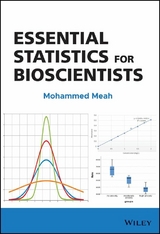
Dive into the most common statistical tests and software packages used for scientific data analysis and interpretation
In Essential Statistics For Bioscientists, experienced university and bioscientist Dr Mohammed Meah delivers easy access to statistical analysis and data presentation. It is a great resource for students in the field of life and health sciences to conceptualize, analyze, and present data. This book uses three popular and commonly used statistics softwares—Microsoft Excel, Graphpad Prism, and SPSS—and offers clear, step-by-step instructions for essential data analysis and graphical/tabular display of data.
Beginning with fundamental statistics terminology and concepts, including data types, descriptive statistics (central and spread of data), exploratory statistics (graphical display) and inferential statistics (hypothesis testing and correlation), the content gradually builds in complexity, explaining which statistical test is best suited and how to perform it.
- A thorough introduction to basic statistical terms and building up to an advanced level of statistical application- ideal for those new to study of statistics
- Extensive application of three popular software packages- Microsoft Excel, Graphpad Prism and SPSS
- Numerous hands-on examples of performing data analysis using Microsoft Excel, Graphpad Prism, and SPSS
- Considers the limitations and errors of statistical analysis
- Essential reading for those designing and planning a research project in Biosciences
Perfect for undergraduate students in the life and health sciences, Essential Statistics For Bioscientists will also earn a place in the libraries of anyone studying medicine, nursing, physiotherapy, pharmacy, and dentistry requiring a refresher or primer on statistical fundamentals.
Mohammed Meah, PhD, is Senior Lecturer and Programme Leader in Medical Physiology and Human Biology at the University of East London in London, UK.
Mohammed Meah, PhD, is Senior Lecturer and Programme Leader in Medical -Physiology and Human Biology at the University of East London in -London, UK.
Acknowledgements vi
List of Worked Examples of Statistical Tests vii
Introduction 1
1 Basic Statistics 4
2 Displaying and Exploring Sample Data Graphically 35
3 Choosing The Appropriate Statistical Test For Analysis 65
4 Inferential Statistics: Parametric Tests 79
5 Inferential Statistics: Non-parametric Tests 91
6 Using Excel: Descriptive and Inferential Statistics 101
7 Using Prism: Descriptive and Inferential Statistics 138
8 Using SPSS: Descriptive and Inferential Statistics 170
9 Misuse and Misinterpretations of Statistics 202
Appendix 1 Historical Landmarks in Statistics 208
Appendix 2 Common Statistical Terms 210
Appendix 3 Common Symbols Used in Statistics 214
Appendix 4 Standard Formulas 216
Appendix 5 How to Calculate Sample Size 218
Appendix 6 Familiarisation with GraphPad Prism 220
Appendix 7 Answers to Sample Problems 224
Appendix 8 Standard Critical Tables 229
References 243
Index 245
CHAPTER 1
Basic Statistics
“The word ‘statistic’ is derived from the Latin status, which, in the middle ages, had become to mean ‘state’ in the political sense. ‘Statistics’, therefore, originally denoted inquiries into the condition of a state.”
— Wynnard Hooper (1854–1935) - English author
Expected Learning Outcomes
- Explain the common terms used in statistics.
- Describe, interpret and calculate descriptive statistics.
- Distinguish the differences between confidence interval, standard error and standard deviation.
- Outline common study designs.
- Describe the parts of a research proposal.
Data
- Without data there would be no statistics!
- Data is Information that can be analysed, interpreted and presented statistically.
- Data can take many forms, digital data, personal data, sample data, laboratory experimental data, field data, population data.
- In statistics we categorize these into numerical and non-numerical data.
What is Statistics?
The earliest use of statistics came from rulers and governments, who wanted information (data), such as the number of people, resources (e.g. food, gold, land) in order to set taxes, fund infrastructure (building projects), raise and maintain armies, and go to war (Appendix 1). To make accurate decisions, ideally you would want to collect all the information or data available about a defined group or category. This is called the population (the entire group of individuals or observations).
The modern equivalent of this is called a census or survey of the population (usually every 10 years) of a country, which collects information such as the total number of people, ethnicity, age, and gender. The data obtained is called the population data. Some examples include, those with a disease or condition (e.g. diabetes or hypertension), smoking, animals, or plants.
However, it is not practical or possible to get the population data most of the time, so we take a random sample which can be representative of the population. The sample is a defined group of individuals or observations such as smoking habits taken from an identified and specific population. The sample should be representative of the population and is chosen by setting inclusion and exclusion criteria. These criteria define the characteristics or features of the sample. For example, inclusion criteria could be healthy, males, aged 20–30; exclusion criteria participants (or subjects) not suitable for selection might be smokers, not on any medication or have a medical condition.
“By a small sample, we may judge of the whole piece.”
Miguel de Cervantes (1547–1616), from his novel “Don Quixote”; Spanish novelist, poet and playwright
Statistics can also be defined as: a branch of mathematics which involves data collection, data presentation, data analysis, and interpretation of data which comes from a population or sample of the population. In statistics, we usually take data from population samples. A population sample consists of a certain proportion/percentage of the total population determined by the researcher. The bigger and more representative the sample size, the more valid would be the results of data analysis. For example, we take height measurements (an example of data collection) of 50 male and 50 female level 5 bioscience students. This sample of 100 students would be taken from a total population of 645 level 5 bioscience students, to determine the average (mean) height of both male and female students. We would then see whether this average height is representative of the average height of all the level 5 bioscience students.
Types of Statistical Methods
In statistics, we analyse sample data to make predictions and generalisations about the population data. The sample data collected is described according to the amount of data (total data), centre of data (average, middle and most commonly occurring) and spread of data (e.g. lowest value and highest value). These are described numerically and called descriptive statistics. The statistical terms used in descriptive statistics (e.g. mean, mode, median, standard deviations) are described below.
The statistical terms used in descriptive statistics using a variety of graphs (Chapter 2), this is called exploratory statistics. Further analysis to look for differences between sample data and population data, differences between two or more groups of sample data, or looking for associations or relationships between sample groups is called inferential statistics. The types of inferential statistical tests used will be determined by data size, data distribution, data type and number of groups of data. Inferential tests can be classified into two types: parametric or tests which are based on known probability distributions of the population (Chapters 3 and 4), and non-parametric which do not follow a distribution (Chapters 3 and 5). A distribution in statistics describes the possible values and likely occurrences of these values (e.g. in tossing a coin, getting a head or tail, and the likelihood of getting heads or tails with further attempts) in experiments (Chapter 2).
Types of Data
Data can be observations or measurements. Data can be classified into quantitative (numerical – numbers) or qualitative (categorical – non-numerical).
Quantitative Data
This numerical data is split into continuous (lots of data collected in very small steps), and discrete (number of specific events occurring). Discrete data take specific number values (e.g. number of pregnancies, number of vaccinations) and give less information. Continuous data (e.g. height, weight, cholesterol, cell counts, concentration of substances in fluids, decimals, percentages, ratios) – very small steps, give more information; this type of data are used mainly in parametric tests (Chapter 4).
Qualitative Data
This non-numerical data can be split into discontinuous data, such as whole numbers, ranks, scales, gender, colours, species, classes, position in a race, and blood groups. This is also called categorical data, which can also be divided into nominal data (data which cannot be ranked in size, e.g. blood groups, gender, ethnicity) and ordinal data (data which can be ranked, e.g. position in a race, anxiety scale, pain scale, intensity of exercise). This type is predominantly used in non-parametric tests (Chapter 5).
Both quantitative and qualitative data can be expressed by the term variable. A variable is a specific factor, property, or characteristic of a population or a sample. It is the name given to the data that is collected, e.g. height, weight, gender, colour, and size.
Collection of Data
Data can be collected from observations (e.g. epidemiological study), surveys (e.g. questionnaires and interviews) or experiments (e.g. clinical trials, pilot study).
Framingham Heart Study (1948)
This was a famous medically important long term epidemiological study, initiated by the National Institute of Health (NIH). It collected a large amount of data on the epidemiology and risk factors of cardiovascular disease in 5209 adults in 1948. They identified hypertension (elevated blood pressure), high cholesterol (fat) levels, and cigarette smoking, as major risk factors for cardiovascular disease (Mahmood et al. (2014)).
Clinical Trial
A clinical trial compares the effect of one treatment with another. It involves patients, healthy people, or both in four stages (Phase 1 to Phase 4).
The rapid increase in infections and mortality caused by the coronavirus (Covid-19) worldwide in 2019 led to the need to develop effective vaccines. The two most popular vaccines in the UK are the Oxford–AstraZeneca and the Pfizer Biontech. Both of these underwent clinical trials after ethical approval. Each trial involved two groups, in which half the volunteers were given the vaccine and the other half were given a placebo. The groups were randomly selected and were matched (e.g. for age and gender). Volunteers did not know whether they were receiving the vaccine or the placebo, nor did the researchers know (double blind). Prior to using human volunteers, the vaccines were tested on animals.
The Oxford–AstraZeneca trial sampled 23,848 people across the UK, Brazil and South Africa between April and November 2020.
The Pfizer Biontech trial sampled 46,331 people from 153 sites around the world between July and December 2020.
Surveys
Ask a series of questions where the answers are subjective (based on personal opinion). These can be non-numerical or numerical by adding a number scale to the responses
e.g. (i) anxiety or pain – could be classified into none, mild, moderate, or severe
(ii) Likert Scale – agree, disagree, neither agree or disagree, strongly agree, e.g. module evaluation or describing a product you have bought
(iii) Visual Analogue Scale – an increasing number scale (e.g. 1 is low and 10 is high). An example of this is the Borg Rate of Perceived Exertion which scales the intensity of exercise.
Observations, hypotheses, theories
Before the 20th century, science was based on induction from observations from which theories...
| Erscheint lt. Verlag | 16.6.2022 |
|---|---|
| Sprache | englisch |
| Themenwelt | Naturwissenschaften ► Biologie ► Allgemeines / Lexika |
| Schlagworte | Analysis of Variance • anova • ANOVA • beginning statistics • Biostatistics • Biostatistik • Biowissenschaften • Confidence interval • continuous data set • Correlation • Gaussian distribution • healthcare statistics • intro to stats </p> • Life Sciences • Life Sciences Statistics • <p>Statistics • Mann-Whitney • Mathematics • Mathematics Special Topics • Mathematik • mean • Median • Microsoft Excel • Mode • nominal data set • non-parametric test • Normal distribution • parametric test • Plots • Prism • Regression • Spezialthemen Mathematik • SPSS • standard deviation • statistical test • Statistics • statistics basics • Statistics For Beginners • statistics guide • statistics intro • Statistik • student T-test • undergraduate statistics • Variance • Wilcoxon U-test |
| ISBN-10 | 1-119-71202-5 / 1119712025 |
| ISBN-13 | 978-1-119-71202-2 / 9781119712022 |
| Informationen gemäß Produktsicherheitsverordnung (GPSR) | |
| Haben Sie eine Frage zum Produkt? |
 EPUB (Adobe DRM)
Kopierschutz: Adobe-DRM
Adobe-DRM ist ein Kopierschutz, der das eBook vor Mißbrauch schützen soll. Dabei wird das eBook bereits beim Download auf Ihre persönliche Adobe-ID autorisiert. Lesen können Sie das eBook dann nur auf den Geräten, welche ebenfalls auf Ihre Adobe-ID registriert sind.
Details zum Adobe-DRM
Dateiformat: EPUB (Electronic Publication)
EPUB ist ein offener Standard für eBooks und eignet sich besonders zur Darstellung von Belletristik und Sachbüchern. Der Fließtext wird dynamisch an die Display- und Schriftgröße angepasst. Auch für mobile Lesegeräte ist EPUB daher gut geeignet.
Systemvoraussetzungen:
PC/Mac: Mit einem PC oder Mac können Sie dieses eBook lesen. Sie benötigen eine
eReader: Dieses eBook kann mit (fast) allen eBook-Readern gelesen werden. Mit dem amazon-Kindle ist es aber nicht kompatibel.
Smartphone/Tablet: Egal ob Apple oder Android, dieses eBook können Sie lesen. Sie benötigen eine
Geräteliste und zusätzliche Hinweise
Buying eBooks from abroad
For tax law reasons we can sell eBooks just within Germany and Switzerland. Regrettably we cannot fulfill eBook-orders from other countries.
aus dem Bereich