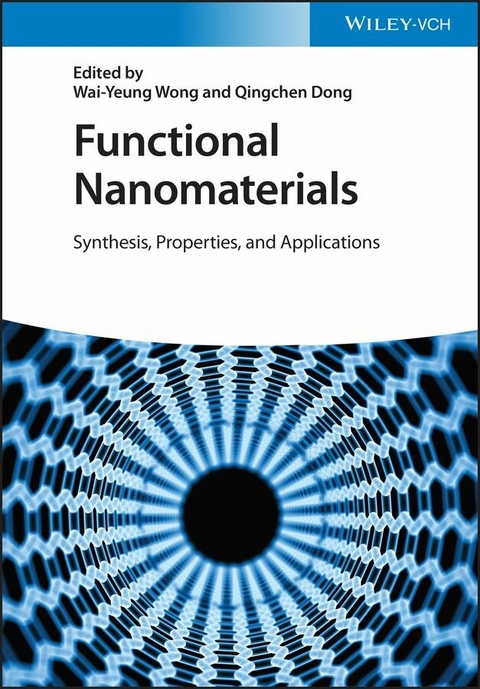
Presents the most recent advances in the production and application of various functional nanomaterials
As new synthetic methods, characterization technologies, and nanomaterials (NMs) with novel physical and chemical properties are developed, researchers and scientists across disciplines need to keep pace with advancements in the dynamic field. Functional Nanomaterials: Synthesis, Properties and Applications provides comprehensive coverage of fundamental concepts, synthetic methods, characterization technologies, device fabrication, performance evaluation, and both current and emerging applications.
Contributions from leading scientists in academia and industry present research developments of novel functional nanomaterials including metal nanoparticles, two-dimensional nanomaterials, perovskite-based nanomaterials, and polymer-based nanomaterials and nanocomposites. Topics include metal-based nanomaterials for electrochemical water splitting, cerium-based nanostructure materials for electrocatalysis, applications of rare earth luminescent nanomaterials, metal complex nanosheets, and methods for synthesizing polymer nanocomposites.
- Provides readers with timely and accurate information on the development of functional nanomaterials in nanoscience and nanotechnology
- Presents a critical perspective of the design strategy, synthesis, and characterization of advanced functional nanomaterials
- Focuses on recent research developments in emerging areas with emphasis on fundamental concepts and applications
- Explores functional nanomaterials for applications in areas such as electrocatalysis, bioengineering, optoelectronics, and electrochemistry
- Covers a diverse range of nanomaterials, including carbonaceous nanomaterials, metal-based nanomaterials, transition metal dichalcogenides-based nanomaterials, semiconducting molecules, and magnetic nanoparticles
Functional Nanomaterials: Synthesis, Properties and Applications is an invaluable resource for chemists, materials scientists, electronics engineers, bioengineers, and others in the scientific community working with nanomaterials in the fields of energy, electronics, and biomedicine.
Wai-Yeung Wong is Chair Professor of Chemical Technology and Dean of Faculty of Applied Science and Textiles at The Hong Kong Polytechnic University (PolyU), Hong Kong, China. Professor Wong is currently Editor-in-Chief of Topics in Current Chemistry, Associate Editor of Journal of Materials Chemistry C and Editor of Journal of Organometallic Chemistry.
Qingchen Dong is Full Professor at Shanghai University (SHU), Shanghai, China.
Wai-Yeung Wong is Chair Professor of Chemical Technology and Dean of Faculty of Applied Science and Textiles at The Hong Kong Polytechnic University (PolyU), Hong Kong, China. He is also Professor of PolyU Shenzhen Research Institute, Shenzhen, China. Having obtained his academic degrees from The University of Hong Kong, he spent most of his career working for Hong Kong Baptist University before taking up his present appointment at PolyU. Professor Wong has received numerous scientific awards, including the State Natural Science Award (second class) from State Council, China, Ho Leung Ho Lee Foundation Prize, Asian Rising Stars Award, Thomson Reuters Highly Cited Researcher Award, etc. His main research focuses on functional metal-organic materials and metallopolymers, metal-based nanomaterials and their technologies. Qingchen Dong is Full Professor at Shanghai University (SHU), Shanghai, China. She obtained her Ph.D. degree at Hong Kong Baptist University working with Prof. Wai-Yeung Wong in 2012. She also worked at Caltech with Prof. Harry B. Gray from 2010 to 2011. In 2012, she joined Taiyuan University of Technology. Her current research involves synthesis of functional metallopolymers and organic/inorganic hybrid nanomaterials for applications in data storage, catalysis, optoelectronics and biomedicine, etc.
Chapter 1 Earth-Abundant Metal-Based Nanomaterials for Electrochemical Water Splitting
Chapter 2 Perspectives of Cerium-Based Nanostructure Materials for Electrocatalysis
Chapter 3 Metal-free Carbon-Based Nanomaterials: Fuel Cell Applications as Electrocatalysts
Chapter 4 Rare Earth Luminescent Nanomaterials and Their Applications
Chapter 5 Metal Complex Nanosheets: Preparation, Property and Application
Chapter 6 Synthesis, Properties and Application of Metal Halide Perovskite-Based Nanomaterials
Chapter 7 Progress in Piezo-Phototronic Effect on 2D Nanomaterial Based Heterostructure Photodetectors
Chapter 8 Synthesis and Properties of Conducting Polymer Nanomaterials
Chapter 9 Conducting Polymer Nanomaterials for Electrochemistry
Chapter 10 Conducting Polymer Nanomaterials for Bioengineering Applications
Chapter 11 Methods for Synthesizing of Polymers Nanocomposites and Their Applications
Chapter 12 Spin Related Electrode Reactions in Nanomaterials
| Erscheint lt. Verlag | 6.6.2022 |
|---|---|
| Sprache | englisch |
| Themenwelt | Naturwissenschaften ► Chemie ► Anorganische Chemie |
| Schlagworte | Anorganische Chemie • Carbon Nanomaterials • Chemie • Chemistry • Electrochemistry • Elektrochemie • Functional nanomaterials synthesis methods • Inorganic Chemistry • Luminescent nanomaterials • Metal Nanomaterials • Nanocomposites applications • Nanomaterial • Nanomaterialien • nanomaterials • nanomaterials applications • Nanomaterials properties • Nanomedizin • Nanotechnologie • nanotechnology • perovskite nanomaterials • Polymer Nanomaterials • Two-dimensional nanomaterials • Werkstoffprüfung |
| ISBN-10 | 3-527-82854-0 / 3527828540 |
| ISBN-13 | 978-3-527-82854-8 / 9783527828548 |
| Informationen gemäß Produktsicherheitsverordnung (GPSR) | |
| Haben Sie eine Frage zum Produkt? |
 PDF (Adobe DRM)
Kopierschutz: Adobe-DRM
Adobe-DRM ist ein Kopierschutz, der das eBook vor Mißbrauch schützen soll. Dabei wird das eBook bereits beim Download auf Ihre persönliche Adobe-ID autorisiert. Lesen können Sie das eBook dann nur auf den Geräten, welche ebenfalls auf Ihre Adobe-ID registriert sind.
Details zum Adobe-DRM
Dateiformat: PDF (Portable Document Format)
Mit einem festen Seitenlayout eignet sich die PDF besonders für Fachbücher mit Spalten, Tabellen und Abbildungen. Eine PDF kann auf fast allen Geräten angezeigt werden, ist aber für kleine Displays (Smartphone, eReader) nur eingeschränkt geeignet.
Systemvoraussetzungen:
PC/Mac: Mit einem PC oder Mac können Sie dieses eBook lesen. Sie benötigen eine
eReader: Dieses eBook kann mit (fast) allen eBook-Readern gelesen werden. Mit dem amazon-Kindle ist es aber nicht kompatibel.
Smartphone/Tablet: Egal ob Apple oder Android, dieses eBook können Sie lesen. Sie benötigen eine
Geräteliste und zusätzliche Hinweise
Buying eBooks from abroad
For tax law reasons we can sell eBooks just within Germany and Switzerland. Regrettably we cannot fulfill eBook-orders from other countries.
aus dem Bereich