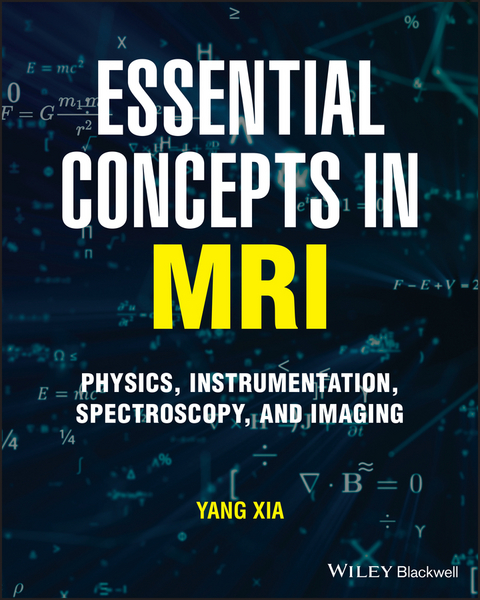
Essential Concepts in MRI (eBook)
John Wiley & Sons (Verlag)
978-1-119-79824-8 (ISBN)
A concise and complete introductory treatment of NMR and MRI
Essential Concepts in MRI delivers the first comprehensive look at magnetic resonance imaging with a practical focus on nuclear magnetic resonance spectroscopy applications. The book includes the essential components of MRI and NMR and is written for anyone new to the field of MRI who seeks to gain a complete understanding of all four essential components of MRI: physics theory, instrumentation, spectroscopy, and imaging.
Highly visual and including numerous full color figures that provide crucial graphical descriptions of key concepts discussed in the book, Essential Concepts in MRI includes discussions of quantitative and creative MRI, as well as spatial mapping in MRI and the effects of the field gradient and k-space imaging. The book also covers:
- A thorough introduction to essential concepts in nuclear magnetic resonance, including classical descriptions of NMR and quantum mechanical descriptions of NMR
- Comprehensive explorations of essential concepts in NMR instrumentation, including magnets, radio-frequency coils, transmitters, and receivers
- Practical discussions of essential concepts in NMR spectroscopy, including simple 1D spectroscopy, double resonance, and dipolar interactions in two-spin systems
- In-depth examinations of essential concepts in MRI, including the design of MRI pulse sequences and the elements of MRI instrumentation, with a special focus on quantitative MRI
Essential Concepts in MRI is a must-read reference for upper-level undergraduate and postgraduate students in the physical and medical sciences, especially radiology, MRI, and imaging courses. It is also essential for students and researchers in the biomedical sciences and engineering.
Yang Xia, PhD, is Distinguished Professor of Physics in the Department of Physics at Oakland University, USA. Dr. Xia is a Fellow of the American Physical Society, the International Society for Magnetic Resonance in Medicine, and the American Institute for Medical and Biological Engineering.
Yang Xia, PhD, is Distinguished Professor of Physics in the Department of Physics at Oakland University, USA. Dr. Xia is a Fellow of the American Physical Society, the International Society for Magnetic Resonance in Medicine, and the American Institute for Medical and Biological Engineering.
1
Introduction
1.1 INTRODUCTION
This book explores the physics phenomenon that provides the foundation for and the engineering architectures that facilitate the widespread applications of nuclear magnetic resonance (NMR) spectroscopy and magnetic resonance imaging (MRI). NMR is the physics phenomenon at the basis of every MRI experiment. The first word, “nuclear,” refers to the core player of this phenomenon – stable atomic nuclei. The protons in a common water molecule are the most useful nuclei because of their high sensitivity and simplicity. Please make a note that when we say proton in NMR and MRI literature and in this book, we mean hydrogen atom, not the nucleon. Since these nuclei are stable, there is never any radioactivity in NMR. The second word, “magnetic,” refers to the environment that these nuclei must have – the nuclei need to be immersed in a magnetic field, which can be generated in several ways including the use of a permanent magnet. The third word, “resonance,” refers to a concept in physics where a system has the tendency to oscillate at the maximum amplitude at a certain frequency f (Figure 1.1). This resonance system can be mechanical (e.g., the pendulum studied by Galileo Galilei in 1602, and the collapse of several suspension bridges in Europe in the 1800s by marching soldiers), acoustic (e.g., many musical instruments), and electromagnetic (e.g., an electronic receiver in your radio and television). To receive the signal from a particular channel or station among the tens or hundreds of channels and stations available, the resonant frequency of a receiver in a radio or television set is adjusted either manually by turning a knob/dial in an analog circuit of a classical (i.e., pre-digital) radio or TV, or by scanning automatically over a range of frequencies in digital receivers. When the right frequency is met, the signal can reach the maximum.
Figure 1.1 The resonance phenomenon, where the signal amplitude reaches a maximum at a particular frequency f0.
Let us clarify the terminology of the NMR phenomenon, since it has several acronyms as well as sub-fields. NMR is the original and full name of the phenomenon, which now commonly refers to its physical principles. NMR spectroscopy is the spectroscopic application of NMR, which seeks the chemical information in the process; this term is used commonly in basic science and in particular in physics and chemistry. NMR imaging is the imaging application of NMR, which mainly seeks the spatial information in the process; this term is used mainly by the non-medical imaging community. MRI is identical in content to NMR imaging, which is the term that is commonly used in the medical community (and by everyone else who is not in basic science). Microscopic MRI (µMRI) and NMR microscopy are the high-resolution versions of MRI.
1.2 MAJOR STEPS IN AN NMR OR MRI EXPERIMENT, AND TWO CONVENTIONS IN DIRECTION
The description of NMR and MRI theory would become easier if we first briefly overview what is involved in an NMR experiment. In general, an NMR or MRI experiment consists of three sequential “stages”: preparation, excitation, and detection. In the first stage, a sample is placed in an externally applied magnetic field B0, which allows the nuclear ensemble in the sample (e.g., water molecules in humans or animals or plants or test tubes) to reach the thermal equilibrium state. This preparation stage results in a net macroscopic magnetization in the sample. In the second stage, a perturbation is applied to the sample in order to force the net magnetization away from the thermal equilibrium into a non-equilibrium state. Finally, the response of the net magnetization to this perturbation is recorded via the detector, where the recording is termed as the NMR or MRI signal. Final post-acquisition signal processing generates an NMR spectrum or an MRI image. These three sequential stages in an NMR or MRI experiment are controlled by a list of individual commands, and each occurs at a different time. This list of commands is called a pulse sequence. Chapter 5, Chapter 6, and Chapter 13 will discuss the details of these instrumentational and experimental aspects.
A convention in NMR and MRI is that the externally applied magnetic field that is used to establish the net magnetization is always named as the B0 field, which is a vector field and has a direction always along the z axis (Figure 1.2), that is, B0 = B0k, where k in this expression is the usual unit vector along the z direction in a 3-dimensional (3D) Cartesian coordinate system. The direction of this z axis in Cartesian coordinates, however, can be either in the vertical direction (for vertical-bore superconducting magnets, which are common in research labs, or “open” MRI scanners, which reduce claustrophobia for some patients) or in the horizontal direction (for the electromagnets in research labs, the “vertical donut” magnet MRI, or the horizontal-bore superconducting magnets in common clinical MRI scanners).
Figure 1.2 The B0 direction in NMR and MRI. (a) Vertical-bore superconducting magnet, which is common for NMR spectrometers in science and industry laboratories. (b) “Horizontal double-donut” magnet for “open” MRI. (c) Electromagnet or magnet in “vertical double-donut” MRI. (d) Horizontal-bore superconducting magnet, which is common for whole-body imagers for humans or animals.
In addition, this book adapts the convention that the clockwise rotation is positive when one looks into the arrowhead of any axis, shown in Figure 1.3. Among the NMR and MRI literature, this convention for rotation is not consistently adapted (i.e., some authors use the counterclockwise rotation as the positive rotation). This inconsistency can lead to either a + or – sign in some equations that describe the motion of the macroscopic magnetization. The notation used in this book is consistent with many books; for example, those by Fukushima and Roeder [1], Callaghan [2], Canet [3], and Haacke et al. [4]. We will comment on this issue at several places in Chapter 2.
Figure 1.3 The positive directions of rotations in a 3D Cartesian coordinate system, (a) when one looks into the +z axis, and (b) when one looks into the +x axis.
1.3 MAJOR MILESTONES IN THE HISTORY OF NMR AND MRI
The physics of NMR started in 1924 when Wolfgang Pauli suggested that hydrogen nuclei might possess a magnetic moment. Pauli made this suggestion based on the observation of optical spectroscopy hyperfine splitting. The first observation of a nuclear magnetic moment was made in 1938 by Isidor I. Rabi, who used molecular-beam magnetic resonance to measure the signs of nuclear magnetic moments in individual atoms and molecules. In 1946, the phenomenon of NMR in liquids and solids was first reported simultaneously by two groups of scientists: Purcell, Torrey, and Pound at Harvard using paraffin as the specimen [5]; and Bloch, Hansen, and Packard at Stanford using water as the specimen [6]. The practical usefulness of NMR was noticed in 1950 by Proctor and Yu [7] and by Dickinson [8], who found that in ammonium nitrate and a variety of fluorine compounds, some kind of chemical effect caused the compounds to have multiple resonant lines. With the publication of the first ethanol spectrum where the three groups of protons in the same ethanol molecules resonated at three different frequencies (Figure 1.4) [9], the power of the NMR technique, being able to measure different chemical environments inside the same molecule (later termed “chemical shift”), initiated the widespread application of NMR in chemistry.
Figure 1.4 The first NMR spectrum of ethanol (CH3CH2OH), which demonstrated the huge potential of NMR spectroscopy by identifying three sets of non-equivalent 1H nuclei in the same molecule. Three separate peaks corresponded to the resonant frequencies of the 1H nuclei in the OH, CH2, and CH3 groups, respectively. Furthermore, the relative areas under the three peaks corresponded to the number of protons in each different chemical environment. Source: Reproduced with permission from Arnold et al. [9].
In 1950, Erwin L. Hahn developed a practical way to form a spin echo by using two radio-frequency (rf) pulses [10], which has had a long-lasting influence on NMR experiments, both spectroscopy and imaging. This was significant since once you knew how to use two (or more) pulses to manipulate the spin system, you could truly control the motion of the nuclear spins in the sample to gain insight into the molecular environment. In 1957, Irving Lowe and Richard Norberg demonstrated that the NMR spectrum in the frequency domain is mathematically equivalent to the Fourier transform (FT) of the NMR signal (called the free induction decay, FID) obtained in the time domain [11]. In 1966, Richard R. Ernst and Weston A. Anderson demonstrated the concept of FT NMR [12], which offers several orders of magnitude improvement in the signal-to-noise ratio (SNR) per unit time for a typical proton NMR spectroscopy experiment. Coupled with the then-new development of personal...
| Erscheint lt. Verlag | 16.5.2022 |
|---|---|
| Sprache | englisch |
| Themenwelt | Medizin / Pharmazie ► Gesundheitsfachberufe |
| Medizinische Fachgebiete ► Radiologie / Bildgebende Verfahren ► Radiologie | |
| Naturwissenschaften ► Chemie | |
| Schlagworte | Chemie • Chemistry • Computertomographie • Computertomographie (MRI) • introductory mri • introductory nmr • Magnetic Resonance Imaging • Medical Science • Medizin • MRI • MRI basics • mri essentials • mri guide • mri handbook • MRI Instrumentation • mri introduction • MRI textbook • MRI theory • NMR • nmr and mri • nmr basics • NMR Spectroscopy / MRI / Imaging • NMR-Spektroskopie • NMR-Spektroskopie / MRT / Bildgebende Verfahren • Nuclear Magnetic Resonance • Quantitative MRI • Radiologie • Radiologie u. Bildgebende Verfahren • Radiology & Imaging |
| ISBN-10 | 1-119-79824-8 / 1119798248 |
| ISBN-13 | 978-1-119-79824-8 / 9781119798248 |
| Informationen gemäß Produktsicherheitsverordnung (GPSR) | |
| Haben Sie eine Frage zum Produkt? |
 EPUB (Adobe DRM)
Kopierschutz: Adobe-DRM
Adobe-DRM ist ein Kopierschutz, der das eBook vor Mißbrauch schützen soll. Dabei wird das eBook bereits beim Download auf Ihre persönliche Adobe-ID autorisiert. Lesen können Sie das eBook dann nur auf den Geräten, welche ebenfalls auf Ihre Adobe-ID registriert sind.
Details zum Adobe-DRM
Dateiformat: EPUB (Electronic Publication)
EPUB ist ein offener Standard für eBooks und eignet sich besonders zur Darstellung von Belletristik und Sachbüchern. Der Fließtext wird dynamisch an die Display- und Schriftgröße angepasst. Auch für mobile Lesegeräte ist EPUB daher gut geeignet.
Systemvoraussetzungen:
PC/Mac: Mit einem PC oder Mac können Sie dieses eBook lesen. Sie benötigen eine
eReader: Dieses eBook kann mit (fast) allen eBook-Readern gelesen werden. Mit dem amazon-Kindle ist es aber nicht kompatibel.
Smartphone/Tablet: Egal ob Apple oder Android, dieses eBook können Sie lesen. Sie benötigen eine
Geräteliste und zusätzliche Hinweise
Buying eBooks from abroad
For tax law reasons we can sell eBooks just within Germany and Switzerland. Regrettably we cannot fulfill eBook-orders from other countries.
aus dem Bereich