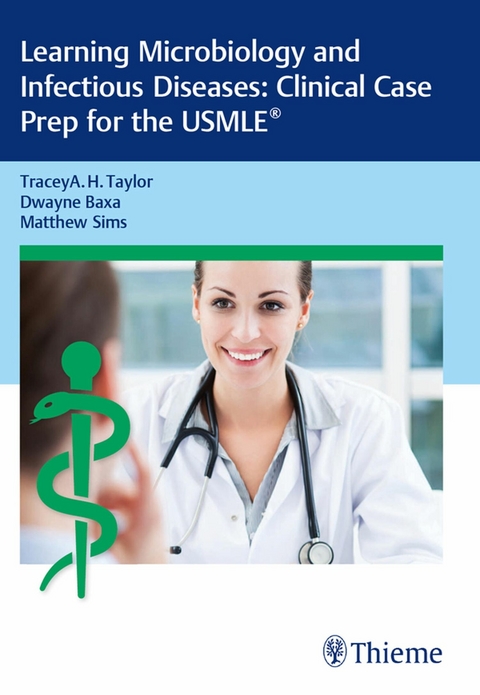
Learning Microbiology and Infectious Diseases: Clinical Case Prep for the USMLE® (eBook)
236 Seiten
Thieme Medical Publishers (Verlag)
978-1-63853-466-2 (ISBN)
High-yield microbiology cases help students apply knowledge and prepare for board examsLearning Microbiology and Infectious Diseases: Clinical Case Prep for the USMLE(R) by Tracey A. H. Taylor, Dwayne Baxa, and Matthew Sims presents diverse cases that encourage problem-based learning, which is key to building diagnostic skills. Each case portrays a real-life scenario, promoting a bridge from foundational knowledge to its application. A series of USMLE-style questions with thorough explanations provide an understanding of microbiology and infectious diseases, an ability to differentiate between infections and viruses, and identify bacteria, fungi, and parasites. Questions cover causative agents, disease transmission, mechanism of pathogenesis action, and pharmacotherapy.Key Features50 case studies with images mirror situations seen in everyday practiceAn intermingling of bacteriology, virology, mycology, parasitology cases, and organ systems reflect real-world patient scenarios and encourage critical thinkingComprehensive cases encompass symptoms and duration, medical and family history, physical exam and lab findings, differential diagnosis, and treatment and preventionThis essential, highly practical resource will help medical students build problem-solving skills, assess microbiology and infectious disease knowledge, and fully prepare for the boards.
Case 1 | Adult with a Cough of a Long Duration |
A 36-year-old male presents to his primary care physician with a cough of 4 weeks duration. The cough is paroxysmal, and he sometimes vomits after coughing. Two other people with whom he works have a similar cough. The patient works at a local automobile assembly plant; he is married with a 2-year-old child; and he has no history of cigarette smoking.
On physical examination, the patient initially appears in no acute distress, then experiences a severe coughing attack, which leaves him weak and out of breath. Examination of the head, eyes, ears, nose, and throat (HEENT) revealed a small conjunctival hemorrhage on the left, and several petechiae were noted on the face. Lungs were clear to auscultation. The remainder of the physical examination was benign.
Laboratory studies were obtained, and the complete blood count (CBC) with differential showed a white blood cell (WBC) count of 8,000/ul with a normal differential. Posterior–anterior (PA) and lateral chest X-rays were also obtained and found to be normal.
The physician obtains a nasopharyngeal aspirate that was sent to the microbiology laboratory for Gram stain and culture. An organism not typical for oral-pharyngeal flora and presumed to be the causative pathogen grew on Regan–Lowe agar after overnight incubation at 37°C. The Gram stain is shown in the following figure. A confirmatory direct fluorescent antibody (DFA) staining of the organism isolated from the aspirate was also positive.
Questions
1. Which of the following organisms is the most likely causative agent?
A. Bordetella pertussis
B. Haemophilus influenzae
C. Klebsiella pneumoniae
D. Legionella pneumophila
E. Pseudomonas aeruginosa
2. How was this infection most likely acquired?
A. Aerosol person to person
B. Arthropod bite
C. Ingestion of food
D. Ingestion of water
E. Sexual transmission
3. For the most likely causative agent, which of the following best describes the pathogenic mechanism leading to the clinical symptoms?
A. Activation of adenylate cyclase by disabling Gi
B. Cleavage of circulating immunoglobulin A (IgA)
C. Inactivation of the 60S ribosome by cleavage of ribosomal RNA (rRNA)
D. Inactivation of host elongation factor 2
E. Prevention of the release of inhibitory neurotransmitter
4. Which of the following best describes the vaccine currently available for prevention of this infection?
A. DNA vaccine
B. Killed whole cell vaccine
C. Live attenuated vaccine
D. Recombinant vector vaccine
E. Subunit vaccine
5. The physician recommends a 5-day course of azithromycin, and the patient takes it appropriately. He returns to the office after completing the course of therapy complaining that his cough is unchanged. Which of the following is the best explanation that the physician can give for the lack of resolution of the cough?
A. Azithromycin is not expected to clear this infection, but it was given because patients expect an antibiotic
B. Coinfection with a second organism is common in this disease, and it is likely that administration of a second antibiotic is warranted
C. It is likely that the infection was resistant to azithromycin, and therapy will need to be altered
D. The purpose of the antibiotic was not to treat the symptoms of the disease but to reduce transmission of the organism
E. The standard dose of azithromycin was too low for this patient’s disease, and the dose will need to be doubled
Answers and Explanations
1. Correct: Bordetella pertussis (A)
This case describes whooping cough, or Bordetella pertussis infection. B. pertussis is a fastidious gram-negative coccobacillus that primarily infects children and unvaccinated susceptible individuals. The presentation of pertussis is separated into three stages: the catarrhal phase, which appears as a typical upper respiratory tract infection; the paroxysmal phase, which presents with intense coughing jags and frequently the classic whooping sound of inspiration against a partially closed airway, post-tussive emesis is often seen; and the convalescent phase, which has a chronic cough that can last for weeks. In adults, particularly those who were previously immunized, the classic symptoms such as coughing paroxysms, the whooping sound, and post-tussive emesis may not be seen. The presence of the classic symptoms typically indicates an unvaccinated or undervaccinated individual. In children, a high WBC count (often > 20,000) is seen with a lymphocytosis frequently over 50%. Seeing a young child with a cough and high WBC with significant lymphocytosis is often a diagnostic clue for pertussis. In adults, however, the elevated WBC is rare, and lymphocytosis is generally not seen.
B Haemophilus influenzae is incorrect because infections do not present with a paroxysmal cough, and H. influenzae are gram-negative bacilli.
C Klebsiella pneumoniae is incorrect because infections do not present with a paroxysmal cough, and K. pneumoniae are gram-negative bacilli.
D Legionella pneumophila is incorrect because they are rarely able to be visualized by Gram stain, and infections do not present with a paroxysmal cough.
E Pseudomonas aeruginosa is incorrect because these infections are more often nosocomial or related to cystic fibrosis, which this patient does not have. Also, P. aeruginosa are gram-negative bacilli.
2. Correct: Aerosol person to person (A)
Transmission of B. pertussis from person-to-person occurs via aerosolized respiratory droplets. There are no identified animal or environmental reservoirs for this pathogen. Humans are the reservoir for B. pertussis. The incubation period is 7 to 10 days on average with a maximum of up to 20 days.
B Arthropod bite is incorrect because pertussis is not vector-borne.
C Ingestion of food is incorrect because pertussis is not food-borne.
D Ingestion of water is incorrect because pertussis is not water-borne.
E Sexual transmission is incorrect because pertussis is not sexually transmitted.
3. Correct: Activation of adenylate cyclase by disabling Gi (A)
The virulence factors produced by B. pertussis include adherence to ciliated epithelial cells of the trachea and bronchi via pili and filamentous hemagglutinin, endotoxin, pertussis toxin, hemolysin, adenylate cyclase toxin, and tracheal cytotoxin. Pertussis toxin is an A-B5 exotoxin that is secreted by a type IV secretion system and binds to the G-alpha inhibitory subunit inhibiting signal transduction, resulting in increased cyclic adenosine monophosphate (cAMP) and a subsequent increase in mucus production and death of the host cell. This mechanism of action of the pertussis toxin mimics adenylate cyclase activity.
B Cleavage of circulating IgA is incorrect. The cleavage of IgA by bacterial proteases, such as in the case of H. influenzae, results in the impairment of antibody-induced entrapment of microbes in mucus secretions.
C Inactivation of the 60S ribosome by cleavage of rRNA is incorrect. This describes the mechanism of action of Shiga toxin.
D Toxin causing inactivation of host elongation factor 2 is incorrect. This describes the mechanism of action of P. aeruginosa exotoxin A.
E Toxin that prevents the release of inhibitory neurotransmitter is incorrect. This describes the mechanism of action of Clostridium botulinum.
4. Correct: Subunit vaccine (E)
Prevention of infection is primarily by routine vaccination of infants, children, and adults. Though it was not mentioned explicitly, the patient was likely either unvaccinated or undervaccinated. Appropriate vaccination may have protected him from infection. The diphtheria, tetanus, and pertussis (DTap) vaccine in full strength is given to infants and children, while the reduced dose tetanus-diphtheria-pertussis (Tdap) vaccine is offered to teens and adults. The current vaccine for pertussis is an acellular subunit vaccine, consisting of inactivated pertussis toxin ± filamentous hemagglutinin (FHA), fimbriae, and pertactin (adhesin). The current vaccine does not give lifelong immunity, and boosting in adults is recommended by the Centers for Disease...
| Erscheint lt. Verlag | 27.1.2020 |
|---|---|
| Reihe/Serie | Clinical Case Prep for the USMLE® | Clinical Case Prep for the USMLE® |
| Verlagsort | Stuttgart |
| Sprache | englisch |
| Themenwelt | Medizin / Pharmazie ► Allgemeines / Lexika |
| Medizin / Pharmazie ► Medizinische Fachgebiete ► Mikrobiologie / Infektologie / Reisemedizin | |
| Studium ► Querschnittsbereiche ► Infektiologie / Immunologie | |
| Naturwissenschaften ► Biologie | |
| Schlagworte | Diseases • Med prep • Microbiology |
| ISBN-10 | 1-63853-466-7 / 1638534667 |
| ISBN-13 | 978-1-63853-466-2 / 9781638534662 |
| Informationen gemäß Produktsicherheitsverordnung (GPSR) | |
| Haben Sie eine Frage zum Produkt? |
 EPUB (Wasserzeichen)
DRM: Digitales Wasserzeichen
Dieses eBook enthält ein digitales Wasserzeichen und ist damit für Sie personalisiert. Bei einer missbräuchlichen Weitergabe des eBooks an Dritte ist eine Rückverfolgung an die Quelle möglich.
Dateiformat: EPUB (Electronic Publication)
EPUB ist ein offener Standard für eBooks und eignet sich besonders zur Darstellung von Belletristik und Sachbüchern. Der Fließtext wird dynamisch an die Display- und Schriftgröße angepasst. Auch für mobile Lesegeräte ist EPUB daher gut geeignet.
Systemvoraussetzungen:
PC/Mac: Mit einem PC oder Mac können Sie dieses eBook lesen. Sie benötigen dafür die kostenlose Software Adobe Digital Editions.
eReader: Dieses eBook kann mit (fast) allen eBook-Readern gelesen werden. Mit dem amazon-Kindle ist es aber nicht kompatibel.
Smartphone/Tablet: Egal ob Apple oder Android, dieses eBook können Sie lesen. Sie benötigen dafür eine kostenlose App.
Geräteliste und zusätzliche Hinweise
Buying eBooks from abroad
For tax law reasons we can sell eBooks just within Germany and Switzerland. Regrettably we cannot fulfill eBook-orders from other countries.
aus dem Bereich