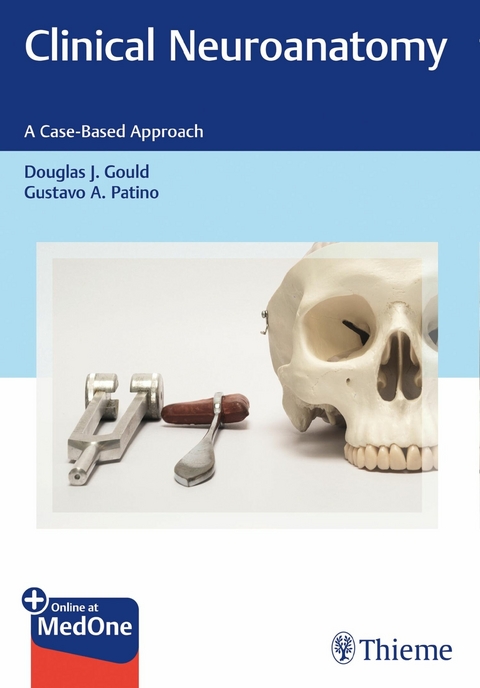
Clinical Neuroanatomy (eBook)
168 Seiten
Georg Thieme Verlag KG
978-1-63853-604-8 (ISBN)
4 Generalized Loss of Strength (chronic)
Case Presentation
A 47-year-old woman presents to her primary care physician to address what she describes as weakness in her arms and legs, which she states is getting worse each day. Her husband, who has accompanied her on the visit, indicates that the weakness in the legs started almost a year ago and has progressed to the point where she needs help standing from a seated position. He adds that her arms seem to be weakening as well; she used to be able to use her arms to help push herself up from a chair, but now needs assistance. They indicate that they have noticed “twitching” in her legs, particularly in the evening when trying to relax to watch television.
During the interview, the physician learns that the patient has been experiencing hoarseness and has been choking frequently during meals over the past couple of months.
Physical examination demonstrates food residue on the cheeks and gums on the right side of the face. Cranial nerve testing indicates a diminished gag reflex and tongue wasting on the left side, with involuntary fasciculations evident when stroked with a tongue blade. Muscle examination shows a strength of 3/5 in the distal hands and right arm, while it is 4-/5 in the left arm. There is foot drop of the right lower limb, with a strength of 4-/5 in the rest of the ipsilateral musculature. The left lower limb demonstrates a 4-/5 strength in the distal muscles but 3/5 on knee extension and hip flexion. The left upper limb demonstrates spasticity with bicipital and tricipital hyperreflexia along with Hoffman sign. The right upper limb shows flaccidity, marked thenar atrophy, bicipital fasciculations, and abolished reflexes. There is spasticity with hyperreflexia in both proximal lower limbs and the left foot (where there is a positive Babinski sign and clonus). The ankle reflex is abolished in the right foot, where there is also hypotonia and marked muscular atrophy. There are no sensory deficits evident and coordination testing is limited by the muscle weakness.
Lesion Localization
The patient presents with chronic muscle weakness of a progressive nature that involves all four limbs and cranial musculature, but there are no sensory symptoms. In examining muscle weakness, a key point is determining if the patient presents signs of upper or lower motor neuron damage (Table A.1, Fig. A.2a). Generally, upper motor neuron signs suggest a CNS lesion, while lower motor neuron symptoms point towards a PNS lesion; the presence of both types interspersed throughout the body suggest a motor neuron disease. The bilateral and relatively symmetrical nature of the symptoms that affect both sets of limbs resembles the pattern of a peripheral neuropathy (Fig. A.5), but the lack of sensory or autonomic symptoms and the presence of upper motor neuron signs argue against this possibility. The latter finding also points away from a muscular disease. Neuromuscular junction disorders present with muscle weakness, but they tend to be characterized by fluctuating symptoms and commonly involve the eye musculature. A lesion in the spinal cord (Fig. A.2d) could produce lower motor neuron signs at the spinal level of the injury, but below that level the signs would be upper motor neuron, unlike the patchy pattern seen in the current patient. Furthermore, spinal injuries would be accompanied by sensory and autonomic symptoms and would not cause cranial symptoms. A brainstem lesion could cause lower motor neuron signs in the targets of the cranial nerves, but the limbs would exhibit only upper motor neuron symptoms. While cortical lesions could produce paraparesis, the signs in that case would be of upper motor neuron loss. Cerebral hemispheric lesions that cause bilateral weakness of the upper limbs or cranial muscles would have to be very extensive, and by necessity would produce sensory symptoms or even altered consciousness.
Motor neuron diseases may compromise upper, lower, or both motor neuron types. When chronic and progressive muscle weakness is the predominant deficit, and there are signs of both upper and lower motor neuron damage in a patchy distribution, the most likely diagnosis is amyotrophic lateral sclerosis (ALS). ALS is a motor neuron disease in which there is progressive degeneration of both upper and lower motor neurons. The diagnosis can be confirmed with nerve conduction studies and electromyography. Because lesions of the spinal cord and brainstem can result in upper motor neuron signs at the level of the lesion and lower motor neuron signs below, MRI is sometimes indicated to rule out a CNS lesion.
Section I Questions
1. A 32-year-old woman visits her primary care physician for a 6-month history of occasional diplopia, difficulty holding her head up, and loss of strength in her hands (e.g. when opening jars or holding shopping bags). The symptoms present multiple times per week, usually in the afternoon. They are worse during the summer and after exercising or taking hot baths. Physical examination is normal, but after 45 seconds of sustained upward gaze she develops bilateral ptosis that recovers after a few minutes of rest. Where would you localize the abnormality in this patient?
a. Brainstem
b. Muscles
c. Neuromuscular junction
d. Peripheral nerves
e. Spinal cord
Correct answer: c
Explanation: The history of fluctuating weakness (broadly defined as symptoms that appear and improve multiple times in the day) and their elicitation with sustained upward gaze is highly suggestive of neuromuscular junction disorders. Diseases in the other structures mentioned would commonly result in fixed or progressive deficits. With the brainstem, peripheral nerves or spinal cord lesions other neurological symptoms would also be expected (e.g. sensory or autonomic).
2. A 22-year-old man visits his physician’s office for difficulty walking and standing from a seated position. The patient indicates that in the past year-and-a-half his gait has become progressively slower, and it has become very hard to climb stairs, mostly because he is unable to raise his legs high enough. In the last year, he has also noticed progressive difficulty with writing. Review of systems is negative. On examination there is generalized weakness 4-/5 in all four limbs, with muscle atrophy, hypotonia, hyporeflexia, and fasciculations. The rest of the examination is normal. Where would you localize the lesion?
a. Internal capsule
b. Lower motor neuron
c. Muscle
d. Neuromuscular junction
e. Upper motor neuron
Correct answer: b
Explanation: The presence of only motor signs and symptoms with a generalized distribution make focal lesions of the CNS unlikely, as they would be accompanied by other findings and distributions (usually unilateral). The presence of hyporeflexia, hypotonia, and fasciculations rule out an upper motor neuron lesion and point to lower motor neuron pathology. The latter finding also makes a myopathy less likely, but this would need to be confirmed with the use of electro-diagnostic tests. Finally, the relenting progression of the symptoms points away from neuromuscular junction disease, which is usually characterized by fluctuating weakness.
3. A 35-year-old woman presents to the clinic with a complaint of muscle weakness. She states that in the past 6 months she has progressively lost the ability to carry objects in her arms, including her children. She also had to quit her favorite hobby, rock climbing, because it was getting very difficult to push herself up with either her arms or her legs. During the review of systems, she indicates myalgias in her arms, hips, and thighs. She also reports two episodes of her urine being dark-colored in the past months. Examination only reveals a 4-/5 paresis of both the deltoid and hip flexors, with normal tone and reflexes. Which of the following tests would you expect to be elevated in this patient?
a. Antibodies against acetyl-choline receptors
b. Botulism toxin
c. Serum creatine kinase
d. CSF protein:cells ratio
Correct answer: c
Explanation: The history of progressive proximal weakness, especially with preserved tone and reflexes, associated with myalgias and episodes of dark urine (suggestive of myoglobinuria), suggest a myopathy. Such diseases are usually associated with the elevation of muscle enzymes, mainly creatine kinase. The lack of fluctuating symptoms argues against myasthenia gravis (caused by antibodies against acetyl-choline receptors). The absence of autonomic symptoms also points away from botulism (botulism toxin) or Guillain-Barre syndrome (cytoalbuminologic dissociation in the CSF); both of these disorders have an acute onset with descending or ascending weakness, respectively.
4. A 78-year-old man is brought to the emergency department by EMS because of the sudden onset of left hemiparesis 40 minutes prior. The patient has a history of diabetes mellitus and hypertension, currently treated with metformin, hydrochlorothiazide, and lisinopril. On examination his blood pressure is 190/105, he is dysarthric, there is right deviation of the tongue, and 1/5 left hemiparesis with ipsilateral spasticity, hyperreflexia, and positive Babinski sign. Where would you localize the...
| Erscheint lt. Verlag | 10.7.2019 |
|---|---|
| Verlagsort | Stuttgart |
| Sprache | englisch |
| Themenwelt | Medizin / Pharmazie ► Medizinische Fachgebiete ► Chirurgie |
| Medizin / Pharmazie ► Medizinische Fachgebiete ► Neurologie | |
| Studium ► 1. Studienabschnitt (Vorklinik) ► Anatomie / Neuroanatomie | |
| Naturwissenschaften ► Biologie ► Humanbiologie | |
| Naturwissenschaften ► Biologie ► Zoologie | |
| Schlagworte | nervous system anatomy • Neuroanatomy • students |
| ISBN-10 | 1-63853-604-X / 163853604X |
| ISBN-13 | 978-1-63853-604-8 / 9781638536048 |
| Informationen gemäß Produktsicherheitsverordnung (GPSR) | |
| Haben Sie eine Frage zum Produkt? |
 EPUB (Wasserzeichen)
DRM: Digitales Wasserzeichen
Dieses eBook enthält ein digitales Wasserzeichen und ist damit für Sie personalisiert. Bei einer missbräuchlichen Weitergabe des eBooks an Dritte ist eine Rückverfolgung an die Quelle möglich.
Dateiformat: EPUB (Electronic Publication)
EPUB ist ein offener Standard für eBooks und eignet sich besonders zur Darstellung von Belletristik und Sachbüchern. Der Fließtext wird dynamisch an die Display- und Schriftgröße angepasst. Auch für mobile Lesegeräte ist EPUB daher gut geeignet.
Systemvoraussetzungen:
PC/Mac: Mit einem PC oder Mac können Sie dieses eBook lesen. Sie benötigen dafür die kostenlose Software Adobe Digital Editions.
eReader: Dieses eBook kann mit (fast) allen eBook-Readern gelesen werden. Mit dem amazon-Kindle ist es aber nicht kompatibel.
Smartphone/Tablet: Egal ob Apple oder Android, dieses eBook können Sie lesen. Sie benötigen dafür eine kostenlose App.
Geräteliste und zusätzliche Hinweise
Buying eBooks from abroad
For tax law reasons we can sell eBooks just within Germany and Switzerland. Regrettably we cannot fulfill eBook-orders from other countries.
aus dem Bereich