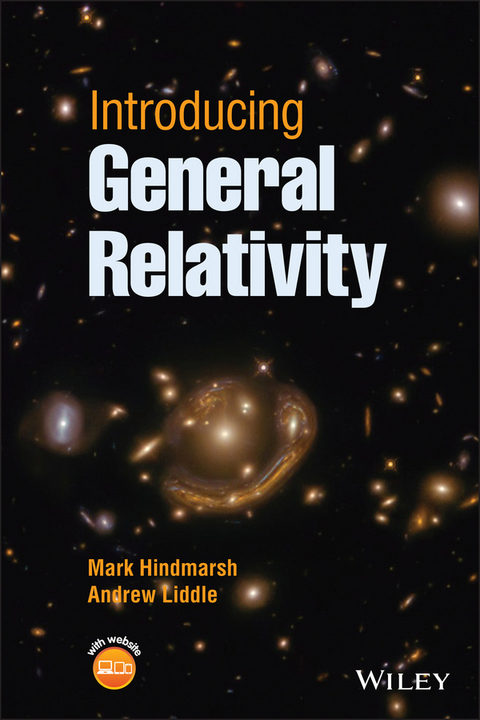
Introducing General Relativity (eBook)
John Wiley & Sons (Verlag)
978-1-118-69824-2 (ISBN)
An accessible and engaging introduction to general relativity for undergraduates
In Introducing General Relativity, the authors deliver a structured introduction to the core concepts and applications of General Relativity. The book leads readers from the basic ideas of relativity-including the Equivalence Principle and curved space-time-to more advanced topics, like Solar System tests and gravitational wave detection.
Each chapter contains practice problems designed to engage undergraduate students of mechanics, electrodynamics, and special relativity. A wide range of classical and modern topics are covered in detail, from exploring observational successes and astrophysical implications to explaining many popular principles, like space-time, redshift, black holes, gravitational waves and cosmology. Advanced topic sections introduce the reader to more detailed mathematical approaches and complex ideas, and prepare them for the exploration of more specialized and sophisticated texts.
Introducing General Relativity also offers:
- Structured outlines to the concepts of General Relativity and a wide variety of its applications
- Comprehensive explorations of foundational ideas in General Relativity, including space-time curvature and tensor calculus
- Practical discussions of classical and modern topics in relativity, from space-time to redshift, gravity, black holes, and gravitational waves
- Optional, in-depth sections covering the mathematical approaches to more advanced ideas
Perfect for undergraduate physics students who have studied mechanics, dynamics, and Special Relativity, Introducing General Relativity is an essential resource for those seeking an intermediate level discussion of General Relativity placed between the more qualitative books and graduate-level textbooks.
Mark Hindmarsh is Professor of Theoretical Physics with joint appointments at the University of Sussex, UK and the University of Helsinki, Finland. His research is focused on the physics of the Big Bang, and he is a member of the LISA consortium with particular expertise in the cosmological production of gravitational waves. He has taught at all levels of the undergraduate and postgraduate curriculum.
Andrew Liddle is a Principal Researcher at the University of Lisbon in Portugal, with joint affiliations at the University of Edinburgh, UK, and the Perimeter Institute for Theoretical Physics, Waterloo, Canada. He researches the properties of our Universe and how these relate to fundamental physical laws, especially through understanding astronomical observations. He is involved in several international projects, including the Planck Satellite and the Dark Energy Survey.
Mark Hindmarsh is Professor of Theoretical Physics with joint appointments at the University of Sussex, UK and the University of Helsinki, Finland. His research is focused on the physics of the Big Bang, and he is a member of the LISA consortium with particular expertise in the cosmological production of gravitational waves. He has taught at all levels of the undergraduate and postgraduate curriculum. Andrew Liddle is a Principal Researcher at the University of Lisbon in Portugal, with joint affiliations at the University of Edinburgh, UK, and the Perimeter Institute for Theoretical Physics, Waterloo, Canada. He researches the properties of our Universe and how these relate to fundamental physical laws, especially through understanding astronomical observations. He is involved in several international projects, including the Planck Satellite and the Dark Energy Survey.
Chapter 2
A Special Relativity Reminder
The Special Theory unites space and time shorter lengths and longer times seeing it with diagrams
Before launching into our account of General Relativity, we give a brief reminder of the main characteristics of its predecessor theory, the Special Theory of Relativity. This was introduced by Einstein in 1905, and is usually referred to by the shorthand Special Relativity. These theories have a rather different status to traditional physics topics, such as electromagnetism or atomic physics, which seek to understand phenomena of a particular type or within a certain domain. Instead, the relativity theories set down principles which apply to all physical laws and restrict the ways in which they can be put together. Whether those principles are actually true is something that needs to be tested against experiment and observation, but the assumption that they do hold has far‐reaching implications for how physical laws can be constructed. In particular, the role of symmetries of Nature is highlighted, which is a defining feature of how modern physics is constructed; as such the relativity theories often give students the first glimpse of how contemporary theoretical physics is done.
Both the theories focus on how physical phenomena are viewed in different coordinate systems, with the underlying principle that the outcome of physical processes should not depend on the choice of coordinates that we use to describe them. Special Relativity restricts us to so‐called inertial frames, where the term frame means a set of coordinates to be used for describing physical laws. As we will see, this restricts us to coordinate transformations which are linear in the coordinates, corresponding to coordinate systems moving relative to one another with constant velocity, and/or rotated with respect to one another. This turns out to be a suitable framework for considering all known physical laws except for those corresponding to gravity.
Einstein's remarkable insight, leading to the General Theory of Relativity, was that allowing arbitrary non‐linear coordinate transformations would allow gravity to be incorporated. Indeed, if we want to allow non‐linear transformations, we have to include gravity. Understanding the motivations for, and implications of, this extraordinary statement is the purpose of this book. But for now, we place the focus on Special Relativity, emphasising those features that will later generalise.
2.1 The need for Special Relativity
In Newtonian dynamics, the equations are invariant under the Galilean transformation which takes us from one set of coordinates to another according to the rule
where is the relative speed between the two coordinate systems, which have been aligned so that the velocity is entirely along the direction. [NB primes are not derivatives!] Each coordinate frame is idealised as extending throughout space and time, providing the scaffolding that lets us locate physical processes in space and time. We introduce an event as something which happens at a specific location in space and at a specific time, such as the collision of two particles.
Typically any observer will want to choose a coordinate system to describe events, and will be located somewhere within the coordinate system. Commonly, though not always, observers will decide to choose coordinate frames that move along with them as a natural way to describe the phenomena as they see them, and so it can be useful to sometimes think of a coordinate system as being associated to a particular observer who carries the coordinate system along with them. For instance, we might consider two different observers moving at a constant velocity with respect to one another, and ask how they would describe the same physical process from their differing points of view.
When we refer to invariance of a physical quantity, we mean that a physical quantity expressed in the new coordinates is identical to the same quantity expressed in the old ones. That means that observers in relative motion agree on its value.
In particular, acceleration is invariant in Newtonian dynamics; it depends on second time derivatives of the coordinates of, for example, a moving particle, and the second time derivatives of and of are equal. An everyday example is that an object dropped in a train moving at constant velocity appears, to an observer in the carriage, to follow exactly the same trajectory as it would were the train stationary.
The Galilean transformation is characterised by a single universal time coordinate that all observers agree upon. Combining relative velocities in each of the coordinate directions means that generally , , and , but always remains equal to . The idea of a universal time sits in good agreement with our everyday experience. However, our own direct perceptions of physical laws probe only a very restrictive set of circumstances. For example, we are unaware of quantum mechanics in our day‐to‐day life, because quantum laws such as Heisenberg's Uncertainty Principle are significant only on scales far smaller than we can personally witness. Hence, we cannot immediately conclude that invariance under the Galilean transformation should apply to all physical laws.
Indeed, it was already known in Einstein's time that Maxwell's equations, describing electromagnetic phenomena including the propagation of light waves, are not consistent with Galilean invariance. For example, they state that the speed of light is independent of the motion of a source, whereas the Galilean transformation would predict that light would emerge more rapidly from a torch if its holder were running towards you. In a famous thought experiment (i.e. an experiment carried out only in the mind, not in the laboratory), Einstein tried to envisage what would happen if one tried to catch up with a light wave by matching its velocity, knowing that Maxwell's equations would not permit a stationary wave.
One possible resolution of this would be if there were special frame of reference in which Maxwell's equations were valid, a frame that came to be known as the aether. However, since the Earth revolves around the Sun, it cannot always be stationary with respect to this aether. In the late 1880s, Albert Michelson and Edward Morley sought to detect the motion of the Earth relative to this aether, using an interferometer experiment. It should have had the sensitivity to easily see the effect, given the known properties of the Earth's orbit, yet no signal was found, putting the existence of the aether in doubt.
From the viewpoint of wanting a unified view of physical laws, it makes little sense that different types of physical laws should respect different invariance properties. After all, electromagnetic phenomena lead to dynamical motions. This incompatibility posed a stark problem for physics.
Einstein's 1905 paper resolved this seeming paradox decisively in favour of electromagnetism. Based on his thought experiments, he demanded that physical laws satisfied two postulates:
- 1. The laws of physicsare the same in all inertial frames.
- 2. The speed of light, denoted ,is the same in all inertial frames and independent of the motion of the source.
As remarked above, inertial frames are those which move with a constant velocity with respect to one another. The requirement that the laws of physics be the same in each is inherited from the Galilean transformation, which also requires it. Another way of expressing this first postulate is to say that there is no possible experiment an observer can carry out to measure their absolute velocity.
But the second postulate then requires that the coordinate transformation between frames must mix space and time, as we are about to see. It is inconsistent with the notion of a universal time coordinate, and requires that invariance under the Galilean transformation be abandoned. If Nature's laws are to be invariant under coordinate transformations, the invariance must be of another type.
2.2 The Lorentz transformation
Hendrik Lorentz, in 1904, had already discovered a transformation that left Maxwell's equations invariant, and it now bears his name. We will derive it under the assumption that the transformation is linear, like a Galilean transformation, and reduces to a Galilean transformation in the limit of relative velocities much less than that of light.
Consider a frame, which we call , moving relative to the original frame with velocity along the ‐axis, so that we can assume and .1 This is shown in Figure 2.1. Linearity lets us write
where , , , and are constants. Now, the origin of is moving relative to at velocity , so corresponds to , implying . So the second of the above equations becomes
By symmetry, the same equation must hold for transforming back from to , exchanging , so
Figure 2.1 A frame moving relative to another frame , with velocity along the ‐axis. Demanding that the transformation relating the coordinates to is linear and preserves the speed of light , uniquely fixes it to be the Lorentz boost, equation (2.7).
Now, we use the assumption of a constant speed of light. At the instant when the two coordinate systems agree, send out a pulse of light along the...
| Erscheint lt. Verlag | 14.4.2022 |
|---|---|
| Sprache | englisch |
| Themenwelt | Naturwissenschaften ► Physik / Astronomie ► Astronomie / Astrophysik |
| Schlagworte | allgemeine Relativitätstheorie • Astronomie • Astronomie u. Astrophysik • Astronomy & Astrophysics • Black Holes • Cosmology • Dark Matter • Friedmann Equation • General relativity • gravitational waves • Gravity • intro to relativity • Physics • Physik • Redshift • relativistic mathematics • relativistic phenomena • relativity introduction • relativity math • Schwarzschild Geometry • Space-time • theoretical physics • Theoretische Physik |
| ISBN-10 | 1-118-69824-X / 111869824X |
| ISBN-13 | 978-1-118-69824-2 / 9781118698242 |
| Informationen gemäß Produktsicherheitsverordnung (GPSR) | |
| Haben Sie eine Frage zum Produkt? |
 EPUB (Adobe DRM)
Kopierschutz: Adobe-DRM
Adobe-DRM ist ein Kopierschutz, der das eBook vor Mißbrauch schützen soll. Dabei wird das eBook bereits beim Download auf Ihre persönliche Adobe-ID autorisiert. Lesen können Sie das eBook dann nur auf den Geräten, welche ebenfalls auf Ihre Adobe-ID registriert sind.
Details zum Adobe-DRM
Dateiformat: EPUB (Electronic Publication)
EPUB ist ein offener Standard für eBooks und eignet sich besonders zur Darstellung von Belletristik und Sachbüchern. Der Fließtext wird dynamisch an die Display- und Schriftgröße angepasst. Auch für mobile Lesegeräte ist EPUB daher gut geeignet.
Systemvoraussetzungen:
PC/Mac: Mit einem PC oder Mac können Sie dieses eBook lesen. Sie benötigen eine
eReader: Dieses eBook kann mit (fast) allen eBook-Readern gelesen werden. Mit dem amazon-Kindle ist es aber nicht kompatibel.
Smartphone/Tablet: Egal ob Apple oder Android, dieses eBook können Sie lesen. Sie benötigen eine
Geräteliste und zusätzliche Hinweise
Buying eBooks from abroad
For tax law reasons we can sell eBooks just within Germany and Switzerland. Regrettably we cannot fulfill eBook-orders from other countries.
aus dem Bereich