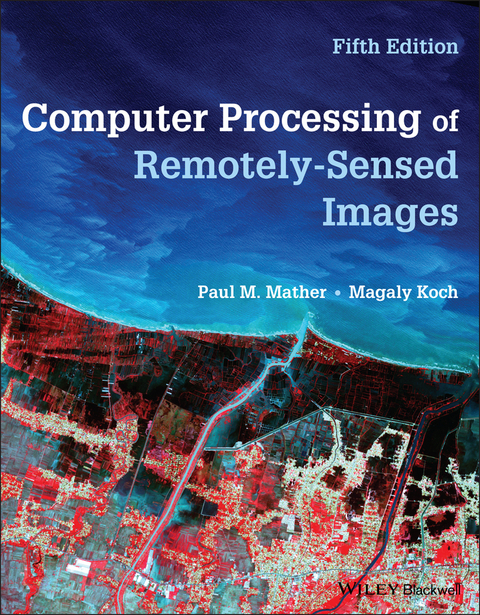
Computer Processing of Remotely-Sensed Images (eBook)
John Wiley & Sons (Verlag)
978-1-119-50297-5 (ISBN)
A thorough introduction to computer processing of remotely-sensed images, processing methods, and applications
Remote sensing is a crucial form of measurement that allows for the gauging of an object or space without direct physical contact, allowing for the assessment and recording of a target under conditions which would normally render access difficult or impossible. This is done through the analysis and interpretation of electromagnetic radiation (EMR) that is reflected or emitted by an object, surveyed and recorded by an observer or instrument that is not in contact with the target. This methodology is particularly of importance in Earth observation by remote sensing, wherein airborne or satellite-borne instruments of EMR provide data on the planet's land, seas, ice, and atmosphere. This permits scientists to establish relationships between the measurements and the nature and distribution of phenomena on the Earth's surface or within the atmosphere.
Still relying on a visual and conceptual approach to the material, the fifth edition of this successful textbook provides students with methods of computer processing of remotely sensed data and introduces them to environmental applications which make use of remotely-sensed images. The new edition's content has been rearranged to be more clearly focused on image processing methods and applications in remote sensing with new examples, including material on the Copernicus missions, microsatellites and recently launched SAR satellites, as well as time series analysis methods.
The fifth edition of Computer Processing of Remotely-Sensed Images also contains:
- A cohesive presentation of the fundamental components of Earth observation remote sensing that is easy to understand and highly digestible
- Largely non-technical language providing insights into more advanced topics that may be too difficult for a non-mathematician to understand
- Illustrations and example boxes throughout the book to illustrate concepts, as well as revised examples that reflect the latest information
- References and links to the most up-to-date online and open access sources used by students
Computer Processing of Remotely-Sensed Images is a highly insightful textbook for advanced undergraduates and postgraduate students taking courses in remote sensing and GIS in Geography, Geology, and Earth & Environmental Science departments.
Paul M. Mather, PhD, now deceased, was Professor Emeritus at the University of Nottingham, UK.
Magaly Koch, PhD, is a Professor at Boston University, USA.
Paul M. Mather, PhD, now deceased, was Professor Emeritus at the University of Nottingham, UK. Magaly Koch, PhD, is a Professor at Boston University, USA.
Preface to the Second Edition
Many things have changed since the first edition of this book was written, more than ten years ago. The increasing emphasis on scientific rigour in remote sensing (or Earth observation by remote sensing, as it is now known), the rise of interest in global monitoring and large‐scale climate modelling, the increasing number of satellite‐borne sensors in orbit, the development of Geographical Information Systems (GIS) technology, and the expansion in the number of taught Masters courses in GIS and remote sensing are all noteworthy developments. Perhaps the most significant single change in the world of remote sensing over the past decade has been the rapid increase in and the significantly reduced cost of computing power and software available to students and researchers alike, which allows them to deal with growing volumes of data and more sophisticated and demanding processing tools. In 1987, the level of computing power available to researchers was minute in comparison with that, which is readily available today. I wrote the first edition of this book using a BBC Model B computer, which had 32 Kb of memory, 100 Kb diskettes, and a processor that would barely run a modern refrigerator. Now I am using a 266 Mz Pentium II with 64 Mb of memory and a 2.1 Gb disc. It has a word processor that corrects my spelling mistakes (though its grammar checking can be infuriating). I can connect from my home to the University of Nottingham computers by optic fibre cable and run advanced software packages. The cost of this computer is about one percent of that of the VAX 11/730 that is mentioned in the preface to the first edition of this book.
Although the basic structure of the book remains largely unaltered, I have taken the opportunity to revise all of the chapters to bring them up to date, as well as to add some new material, to delete obsolescent and uninteresting paragraphs, and to revise some infelicitous and unintelligible passages. For example, Chapter 4 now contains new sections covering sensor calibration, plus radiometric and topographic correction. The use of artificial neural networks in image classification has grown considerably in the years since 1987, and a new section on this topic is added to Chapter 8, which also covers other recent developments in pattern recognition and methods of estimating Earth surface properties. Chapter 3, which provides a survey of computer hardware and software, has been almost completely re‐written. In Chapter 2, I have tried to give a brief overview of a range of present and past sensor systems but have not attempted to give a full summary of every sensor, because details of new developments are now readily available via the World Wide Web. I doubt whether anyone would read this book simply because of its coverage of details of individual sensors.
Other chapters are less significantly affected by recent research as they are concerned with the basics of image processing (filtering, enhancement, and image transforms), details of which have not changed much since 1987, though I have added new references and attempted to improve the presentation. I have, however, resisted the temptation to write a new chapter on GIS, largely because there are several good books on this topic that are widely accessible (for example Bonham‐Carter 1994; McGuire et al. 1991), but also because I feel that this book is primarily about image processing. The addition of a chapter on GIS would neither do justice to that subject nor enhance the reader's understanding of digital processing techniques. However, I have made reference to GIS and spatial databases at a number of appropriate points in the text. My omission of a survey of GIS techniques does not imply that I consider digital image processing to be a ‘stand‐alone’ topic. Clearly, there are significant benefits to be derived from the use of spatial data of all kinds within an integrated environment, and this point is emphasised in a number of places in this book. I have added a significant number of new references to each of the chapters, in the hope that readers might be encouraged to enjoy the comforts of his or her local library.
I have added a number of ‘self‐assessment’ questions at the end of each chapter. These questions are not intended to constitute a sample examination paper, nor do they provide a checklist of ‘important’ topics (the implication being that the other topics covered in the book are unimportant). They are simply a random set of questions – if you can answer them, then you probably understand the contents of the chapter. Readers should use the MIPS software described in Appendices A and B to try out the methods mentioned in these questions. Data sets are also available on the accompanying CD and are described in Appendix C.
Perhaps the most significant innovation that this book offers is the provision of a CD containing software and images. I am not a mathematician, and so I learn by trying out ideas rather than exclusively by reading or listening. I learn new methods by writing computer programs and applying them to various data sets. I am including a small selection of the many programs that I have produced over the past 30 years, in the hope that others may find them useful. These programs are described in Appendix B. I have been teaching a course on remote sensing for the last 14 years. When this course began, there were no software packages available, so I wrote my own (my students will remember NIPS, the Nottingham Image Processing System, with varying degrees of hostility). I have completely re‐written and extended NIPS so that it now runs under Microsoft Windows 95. I have renamed it to Mather's Image Processing System (MIPS), which is rather an unimaginative name, but is nevertheless pithy. It is described in Appendix A. Many of the procedures described in this book are implemented in MIPS, and I encourage readers to try out the methods discussed in each chapter. It is only by experimenting with these methods, using a range of images, that you will learn how they work in practice. MIPS was developed on an old 486‐based machine with 12 Mb of RAM and a 200 Mb disc, so it should run on most PCs available in today's impoverished universities and colleges. MIPS is not a commercial system and should be used only for familiarisation before the reader moves on to the software behemoths that are so readily available for both PCs and UNIX workstations. Comments and suggestions for improving MIPS are welcome (preferably by email) though I warn readers that I cannot offer an advisory service nor assist in research planning!
Appendix C contains a number of Landsat, SPOT, AVHRR, and RADARSAT images, mainly extracts of size 512 × 512 pixels. I am grateful to the copyright owners for permission to use these data sets. The images can be used by the reader to gain practical knowledge and experience of image processing operations. Many university libraries contain map collections, and I have given sufficient details of each image to allow the reader to locate appropriate maps and other back‐up material that will help in the interpretation of the features shown on the images.
The audience for this book is seen to be advanced undergraduate and Masters students, as was the case in 1987. It is very easy to forget that today's student of remote sensing and image processing is starting from the same level of background knowledge as his or her predecessors in the 1980s. Consequently, I have tried to restrain myself from including details of every technique that is mentioned in the literature. This is not a research monograph or a literature survey, nor it is primarily an exercise in self‐indulgence, and so some restriction on the level and scope of the coverage provided is essential if the reader is not to be overwhelmed with detail and thus discouraged from investigating further. Nevertheless, I have tried to provide references on more advanced subjects for the interested reader to follow up. The volume of published material in the field of remote sensing is now very considerable, and a full survey of the literature of the last 20 years or so would be both unrewarding and tedious. In any case, online searches of library catalogues and databases are now available from networked computers. Readers should, however, note that this book provides them only with a background introduction – successful project work will require a few visits to the library to peruse recent publications, as well as practical experience of image processing.
I am most grateful for comments from readers, a number of whom have written to me, mainly to offer useful suggestions. The new edition has, I hope, benefited from these ideas. Over the past years, I have been fortunate enough to act as supervisor to a number of postgraduate research students from various countries around the world. Their enthusiasm and commitment to research have always been a factor in maintaining my own level of interest, and I take this opportunity to express my gratitude to all of them. My friends and colleagues in the Remote Sensing Society, especially Jim Young, Robin Vaughan, Arthur Cracknell, Don Hardy and Karen Korzeniewski, have always been helpful and supportive. Discussions with many people, including Mike Barnsley, Giles Foody and Robert Gurney, have added to my knowledge and awareness of key issues in remote sensing. I also acknowledge with gratitude the help given by Dr Magaly Koch, Remote Sensing Center, Boston University, who has tested several of the procedures reported in this book and...
| Erscheint lt. Verlag | 6.4.2022 |
|---|---|
| Sprache | englisch |
| Themenwelt | Naturwissenschaften ► Geowissenschaften ► Geografie / Kartografie |
| Naturwissenschaften ► Geowissenschaften ► Geologie | |
| Technik ► Elektrotechnik / Energietechnik | |
| Schlagworte | digital imagine processing • earth sciences • Electrical & Electronics Engineering • Elektrotechnik u. Elektronik • environmental geographical information system • Fernerkundung • Filtering techniques • Geographie • Geography • Geowissenschaften • GIS & Remote Sensing • GIS, Fernerkundung u. Kartographie • GIS, Remote Sensing & Cartography • GIS u. Fernerkundung • image enhancement techniques • Image transforms • preprocessing of remotely-sensed data • Remote Sensing • remote sensing platform • remote sensing sensor |
| ISBN-10 | 1-119-50297-7 / 1119502977 |
| ISBN-13 | 978-1-119-50297-5 / 9781119502975 |
| Informationen gemäß Produktsicherheitsverordnung (GPSR) | |
| Haben Sie eine Frage zum Produkt? |
 EPUB (Adobe DRM)
Kopierschutz: Adobe-DRM
Adobe-DRM ist ein Kopierschutz, der das eBook vor Mißbrauch schützen soll. Dabei wird das eBook bereits beim Download auf Ihre persönliche Adobe-ID autorisiert. Lesen können Sie das eBook dann nur auf den Geräten, welche ebenfalls auf Ihre Adobe-ID registriert sind.
Details zum Adobe-DRM
Dateiformat: EPUB (Electronic Publication)
EPUB ist ein offener Standard für eBooks und eignet sich besonders zur Darstellung von Belletristik und Sachbüchern. Der Fließtext wird dynamisch an die Display- und Schriftgröße angepasst. Auch für mobile Lesegeräte ist EPUB daher gut geeignet.
Systemvoraussetzungen:
PC/Mac: Mit einem PC oder Mac können Sie dieses eBook lesen. Sie benötigen eine
eReader: Dieses eBook kann mit (fast) allen eBook-Readern gelesen werden. Mit dem amazon-Kindle ist es aber nicht kompatibel.
Smartphone/Tablet: Egal ob Apple oder Android, dieses eBook können Sie lesen. Sie benötigen eine
Geräteliste und zusätzliche Hinweise
Buying eBooks from abroad
For tax law reasons we can sell eBooks just within Germany and Switzerland. Regrettably we cannot fulfill eBook-orders from other countries.
aus dem Bereich