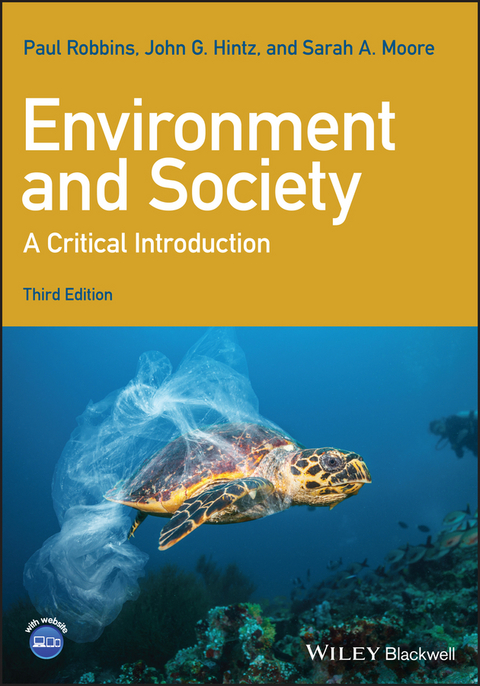
Environment and Society (eBook)
John Wiley & Sons (Verlag)
978-1-119-40826-0 (ISBN)
A comprehensive yet accessible introduction to the conceptual tools used to explore real-world environmental problems
Environment and Society: A Critical Introduction, Third Edition demonstrates how theoretical approaches such as environmental ethics, political economy, and social construction work as conceptual tools to identify and clarify contemporary environmental issues. Assuming no background knowledge in the subject, this reader-friendly textbook uses clear language and engaging examples to first describe nine key conceptual tools, and then apply them to a variety of familiar objects-from bottled water and French fries to trees, wolves, and carbon dioxide. Throughout the text, highly accessible chapters provide insight into the relationship between the environment and present-day society.
Divided into two parts, the text begins by explaining major theoretical approaches for interpreting the environment-society relationship and discussing different perspectives about environmental problems. Part II examines a series of objects, each viewed through a sample of the theoretical tools from Part I, helping readers think critically about critical environmental topics such as deforestation, climate change, the global water supply, and hazardous e-waste. This fully revised third edition stresses a wider range of competing ways of thinking about environmental issues and features additional cases studies, up-to-date conceptual understandings, and new chapters in Part I on racializd environments and feminist approaches. Environment and Society: A Critical Introduction, Third Edition:
- Covers theoretical lenses such as commodities, environmental ethics, and risks and hazards, and applies them to touchstone environment-society objects like wolves, tuna, trees, and carbon dioxide
- Uses a conversational narrative to explain key historical events, topical issues and policies, and scientific concepts
- Features substantial revisions and updates, including new chapters on feminism and race, and improved maps and illustrations
- Includes a wealth of in-book and online resources, including exercises and boxed discussions, chapter summaries, review questions, references, suggested readings, an online test bank, and internet links
- Provides additional instructor support such as suggested teaching models, full-color PowerPoint slides, and supplementary teaching material
Retaining the innovative approach of its predecessors, Environment and Society: A Critical Introduction, Third Edition remains the ideal textbook for courses in environmental issues, environmental science, and nature and society theory.
Paul Robbins is Professor and Dean of the Nelson Institute for Environmental Studies at the University of Wisconsin-Madison, USA. His research interests focus on understanding human-environment systems, the influence non-humans have on human behavior and organization, and the implications these interactions hold for ecosystem health, local communities, and social justice. He is also author of Political Ecology: A Critical Introduction, now in its third edition (Wiley Blackwell, 2019).
John G. Hintz is Professor of Environmental, Geographical, and Geological Sciences at Bloomsburg University of Pennsylvania, USA. His research interests include the politics of public lands management, mapping protected areas, and sustainable agriculture. He has published in several journals, including Capitalism Nature Socialism and Ethics, Place & Environment.
Sarah A. Moore is Associate Professor of Geography at the University of Wisconsin-Madison, USA. Her research investigates the political, economic, and social dimensions of waste management at several scales. Her publications include articles in numerous journals including Progress in Human Geography, The Professional Geographer, and Society and Natural Resources.
A comprehensive yet accessible introduction to the conceptual tools used to explore real-world environmental problems Environment and Society: A Critical Introduction, Third Edition demonstrates how theoretical approaches such as environmental ethics, political economy, and social construction work as conceptual tools to identify and clarify contemporary environmental issues. Assuming no background knowledge in the subject, this reader-friendly textbook uses clear language and engaging examples to first describe nine key conceptual tools, and then apply them to a variety of familiar objects from bottled water and French fries to trees, wolves, and carbon dioxide. Throughout the text, highly accessible chapters provide insight into the relationship between the environment and present-day society. Divided into two parts, the text begins by explaining major theoretical approaches for interpreting the environment-society relationship and discussing different perspectives about environmental problems. Part II examines a series of objects, each viewed through a sample of the theoretical tools from Part I, helping readers think critically about critical environmental topics such as deforestation, climate change, the global water supply, and hazardous e-waste. This fully revised third edition stresses a wider range of competing ways of thinking about environmental issues and features additional cases studies, up-to-date conceptual understandings, and new chapters in Part I on racializd environments and feminist approaches. Environment and Society: A Critical Introduction, Third Edition: Covers theoretical lenses such as commodities, environmental ethics, and risks and hazards, and applies them to touchstone environment-society objects like wolves, tuna, trees, and carbon dioxide Uses a conversational narrative to explain key historical events, topical issues and policies, and scientific concepts Features substantial revisions and updates, including new chapters on feminism and race, and improved maps and illustrations Includes a wealth of in-book and online resources, including exercises and boxed discussions, chapter summaries, review questions, references, suggested readings, an online test bank, and internet links Provides additional instructor support such as suggested teaching models, full-color PowerPoint slides, and supplementary teaching material Retaining the innovative approach of its predecessors, Environment and Society: A Critical Introduction, Third Edition remains the ideal textbook for courses in environmental issues, environmental science, and nature and society theory.
Paul Robbins is Professor and Dean of the Nelson Institute for Environmental Studies at the University of Wisconsin-Madison, USA. His research interests focus on understanding human-environment systems, the influence non-humans have on human behavior and organization, and the implications these interactions hold for ecosystem health, local communities, and social justice. He is also author of Political Ecology: A Critical Introduction, now in its third edition (Wiley Blackwell, 2019). John G. Hintz is Professor of Environmental, Geographical, and Geological Sciences at Bloomsburg University of Pennsylvania, USA. His research interests include the politics of public lands management, mapping protected areas, and sustainable agriculture. He has published in several journals, including Capitalism Nature Socialism and Ethics, Place & Environment. Sarah A. Moore is Associate Professor of Geography at the University of Wisconsin-Madison, USA. Her research investigates the political, economic, and social dimensions of waste management at several scales. Her publications include articles in numerous journals including Progress in Human Geography, The Professional Geographer, and Society and Natural Resources.
???????????????????????????????????????????????????????????????????????????????????????Environment and Society? 2
Contents 6
List of Figures 11
List of Tables 16
List of Boxes 17
Acknowledgments 18
About the Companion Website 19
1 Introduction: The View from a Human-Made Wild 20
What is This Book? 25
The Authors’ Points of View 28
Part I Approaches and Perspectives 32
2 Population and Scarcity 34
A Booming China or a Busting One? 35
The Problem of Exponential Growth 36
Population, Development, and Environment Impact 38
The Other Side of the Coin: Population and Innovation 42
Limits to Population: An Effect Rather than a Cause? 43
Thinking with Population 48
3 Markets and Commodities 52
The Bet 53
Managing Environmental Bads: The Coase Theorem 56
Market Failure 58
Market-Based Solutions to Environmental Problems 59
Beyond Market Failure: Gaps between Nature and Economy 64
Thinking with Markets 67
4 Institutions and “The Commons” 70
Controlling Carbon? 71
The Prisoner’s Dilemma 71
The Tragedy of the Commons 73
The Evidence and Logic of Collective Action 75
Crafting Sustainable Environmental Institutions 77
Are All Commoners Equal? Does Scale Matter? 81
Thinking with Institutions 83
5 Environmental Ethics 86
The Price of Cheap Meat 87
Improving Nature: From Biblical Tradition to John Locke 89
Gifford Pinchot vs. John Muir in Yosemite, California 91
Aldo Leopold and “The Land Ethic” 93
Liberation for Animals! 95
CAFOs and Climate Change: Now that You Know, What Should You Do? 97
Holism and Other Pitfalls 97
Thinking with Ethics 99
6 Risks and Technology 102
The Bt Cotton Revolution 103
Environments as Hazard 104
The Problem of Risk Perception 106
Risk as Culture 109
Beyond Risk: The Political Economy of Hazards 111
Thinking with Risk and Technology 114
7 Political Economy 118
The Contradictions of COVID-19 119
Labor, Accumulation, and Crisis 120
Production of Nature 127
Global Capitalism and the Ecology of Uneven Development 129
Social Reproduction and Nature 131
Environments and Economism 133
Thinking with Political Economy 133
8 Social Construction of Nature 137
The Blank Spot on the Map 138
So You Say It’s “Natural?” 139
Environmental Discourse 143
The Limits of Constructivism: Science, Relativism, and the Very Material World 148
Thinking with Construction 151
9 Feminism and the Environment 155
Gender and Environment 157
From Earth as Woman to Ecofeminism 159
Feminist Approaches to Economies and Nature 161
Feminist Approaches to Knowledge and the Environment 165
Thinking with Feminism and the Environment 171
10 Racialized Environments 175
Structural Environmental Racism 177
Environmental Justice 178
Settler Colonialism 182
Whiteness and Nature 188
Thinking with Racialized Environments 189
Part II Objects of Concern 194
11 Carbon Dioxide 196
Stuck in Pittsburgh Traffic 197
A Short History of CO2 197
Institutions: Climate Free-Riders and Carbon Cooperation 203
Markets: Trading More Gases, Buying Less Carbon 209
Political Economy: Who Killed the Atmosphere? 212
The Carbon Puzzle 215
12 Trees 219
Chained to a Tree in Berkeley, California 220
A Short History of Trees 220
Population and Markets: The Forest Transition Theory 228
Political Economy: Accumulation and Deforestation 231
Gender, Trees, and Power: Feminist Insights into Forests 233
Ethics, Justice, and Equity: Should Trees Have Standing? 235
The Tree Puzzle 237
13 Wolves 241
Wolves, Be Wary Where You Tread 242
A Short History of Wolves 243
Ethics: Rewilding and Wolves 248
Institutions: Stakeholder Management 251
Feminism: Of Wolves and Masculinity 254
The Wolf Puzzle 257
14 Uranium 261
Promise and Peril in Post-Nuclear Worlds 262
A Short History of Uranium 263
Risk and Hazards: Debating the Fate of High-Level Radioactive Waste 269
Race: Environmental Justice and the Navajo Nation 272
Social Construction: Discourses at Work in Australia 275
The Uranium Puzzle 279
15 Tuna 283
Big Trouble for Big Tuna 284
A Short History of Tuna 284
Markets and Commodities: Eco-Labels to the Rescue? 289
Political Economy: Re-regulating Fishery Economies 292
Ethics: Saving Animals, Conserving Species 295
The Tuna Puzzle 298
16 Lawns 302
How Much Do People Love Lawns? 303
A Short History of Lawns 303
Risk and Chemical Decision-Making 307
Social Construction: Good Lawns Mean Good People 310
Political Economy: The Chemical Tail Wags the Turfgrass Dog 311
The Lawn Puzzle 314
17 Bottled Water 317
A Tale of Two Bottles 318
A Short History of Bottled Water 319
Population: Bottling for Scarcity? 324
Risk and Technology: Health and Safety in a Bottle? 326
Political Economy: Manufacturing Demand on an Enclosed Commons 328
Racialized Environments: The Burden of Bottled Water in the United States 331
The Bottled Water Puzzle 333
18 French Fries 337
Getting Your French Fry Fix 338
A Short History of the Fry 338
Feminist Approaches: The Body Politics of French Fries 344
Political Economy and Racialized Environments: Have it Your Way? 347
Ethics: Protecting or Engineering Potato Heritage? 352
The French Fry Puzzle 356
19 E-Waste 360
Digital Divides 361
A Short History of E-Waste 362
E-Waste and Markets: From Externality to Commodity 367
The Political Economy of E-Waste 370
E-Waste and Racialized Environments 374
The E-Waste Puzzle 378
Glossary 381
Index 391
EULA 400
| Erscheint lt. Verlag | 18.3.2022 |
|---|---|
| Reihe/Serie | Critical Introductions to Geography |
| Critical Introductions to Geography | Critical Introductions to Geography |
| Sprache | englisch |
| Themenwelt | Naturwissenschaften ► Biologie ► Ökologie / Naturschutz |
| Naturwissenschaften ► Geowissenschaften ► Geografie / Kartografie | |
| Schlagworte | critical environmental studies • Environmental Geography • environmental problem critical approaches • Environmental Science • Environmental Sociology • Environmental Studies • environmental theory textbook </p> <p> </p> <p> </p> • environment and society concepts • environment and society introduction • environment and society theory • Geographie • Geography • <p>environment and society textbook • Sociology • Soziologie • Umweltforschung • Umweltgeographie • Umweltsoziologie • Umweltwissenschaften |
| ISBN-10 | 1-119-40826-1 / 1119408261 |
| ISBN-13 | 978-1-119-40826-0 / 9781119408260 |
| Informationen gemäß Produktsicherheitsverordnung (GPSR) | |
| Haben Sie eine Frage zum Produkt? |
 PDF (Adobe DRM)
Kopierschutz: Adobe-DRM
Adobe-DRM ist ein Kopierschutz, der das eBook vor Mißbrauch schützen soll. Dabei wird das eBook bereits beim Download auf Ihre persönliche Adobe-ID autorisiert. Lesen können Sie das eBook dann nur auf den Geräten, welche ebenfalls auf Ihre Adobe-ID registriert sind.
Details zum Adobe-DRM
Dateiformat: PDF (Portable Document Format)
Mit einem festen Seitenlayout eignet sich die PDF besonders für Fachbücher mit Spalten, Tabellen und Abbildungen. Eine PDF kann auf fast allen Geräten angezeigt werden, ist aber für kleine Displays (Smartphone, eReader) nur eingeschränkt geeignet.
Systemvoraussetzungen:
PC/Mac: Mit einem PC oder Mac können Sie dieses eBook lesen. Sie benötigen eine
eReader: Dieses eBook kann mit (fast) allen eBook-Readern gelesen werden. Mit dem amazon-Kindle ist es aber nicht kompatibel.
Smartphone/Tablet: Egal ob Apple oder Android, dieses eBook können Sie lesen. Sie benötigen eine
Geräteliste und zusätzliche Hinweise
Buying eBooks from abroad
For tax law reasons we can sell eBooks just within Germany and Switzerland. Regrettably we cannot fulfill eBook-orders from other countries.
aus dem Bereich