


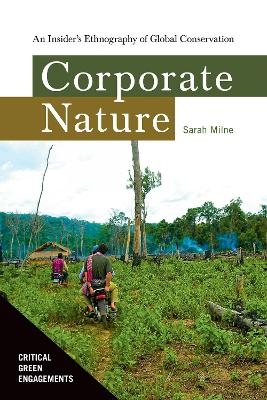
Corporate Nature
An Insider's Ethnography of Global Conservation
Seiten
2022
University of Arizona Press (Verlag)
978-0-8165-4700-5 (ISBN)
University of Arizona Press (Verlag)
978-0-8165-4700-5 (ISBN)
Sarah Milne spent more than a decade working for and observing global conservation projects in Cambodia. In Corporate Nature, she delves inside the black box of mainstream global conservation, and reveals how big international NGOs struggle in the face of complexity - especially in settings where corruption and political violence prevail.
In 2012, Cambodia’s most prominent environmental activist was brutally murdered in a high-profile conservation area in the Cardamom Mountains. Tragic and terrible, this event also magnifies a crisis in humanity’s efforts to save nature: failure of the very tools and systems at hand for advancing global environmental action.
Sarah Milne spent more than a decade working for and observing global conservation projects in Cambodia. During this time, she saw how big environmental NGOs can operate rather like corporations. Their core practice involves rolling out appealing and deceptively simple policy ideas, like Payments for Ecosystem Services (PES). Yet, as policy ideas prove hard to implement, NGOs must also carefully curate evidence from the field to give the impression of success and effectiveness.
In Corporate Nature, Milne delves inside the black box of mainstream global conservation. She reveals how big international NGOs struggle in the face of complexity—especially in settings where corruption and political violence prevail. She uses the case of Conservation International’s work in Cambodia to illustrate how apparently powerful NGOs can stumble in practice: policy ideas are transformed on the ground, while perverse side effects arise, like augmented authoritarian power, illegal logging, and Indigenous dispossession.
The real power of global conservation NGOs is therefore not in their capacity to control what happens in the field but in their capacity to ignore or conceal failings. Milne argues that this produces an undesirable form of socionature, called corporate nature, that values organizational success over diverse knowledges and ethical conduct.
In 2012, Cambodia’s most prominent environmental activist was brutally murdered in a high-profile conservation area in the Cardamom Mountains. Tragic and terrible, this event also magnifies a crisis in humanity’s efforts to save nature: failure of the very tools and systems at hand for advancing global environmental action.
Sarah Milne spent more than a decade working for and observing global conservation projects in Cambodia. During this time, she saw how big environmental NGOs can operate rather like corporations. Their core practice involves rolling out appealing and deceptively simple policy ideas, like Payments for Ecosystem Services (PES). Yet, as policy ideas prove hard to implement, NGOs must also carefully curate evidence from the field to give the impression of success and effectiveness.
In Corporate Nature, Milne delves inside the black box of mainstream global conservation. She reveals how big international NGOs struggle in the face of complexity—especially in settings where corruption and political violence prevail. She uses the case of Conservation International’s work in Cambodia to illustrate how apparently powerful NGOs can stumble in practice: policy ideas are transformed on the ground, while perverse side effects arise, like augmented authoritarian power, illegal logging, and Indigenous dispossession.
The real power of global conservation NGOs is therefore not in their capacity to control what happens in the field but in their capacity to ignore or conceal failings. Milne argues that this produces an undesirable form of socionature, called corporate nature, that values organizational success over diverse knowledges and ethical conduct.
Sarah Milne is a senior lecturer in environment and development at the Australian National University. She earned her doctorate in geography from the University of Cambridge. Milne is co-author of Conservation and Development in Cambodia: Exploring Frontiers of Change in Nature, State and Society. Milne has combined research and practice for more than twenty years in the fields of community development and nature conservation, mainly in Cambodia.
| Erscheinungsdatum | 01.12.2022 |
|---|---|
| Reihe/Serie | Critical Green Engagements: Investigating the Green Economy and Its Alternatives |
| Zusatzinfo | 2 b&w figures, 2 maps, 2 tables |
| Verlagsort | Tucson |
| Sprache | englisch |
| Maße | 151 x 230 mm |
| Gewicht | 363 g |
| Themenwelt | Naturwissenschaften ► Biologie ► Ökologie / Naturschutz |
| Sozialwissenschaften ► Ethnologie | |
| Sozialwissenschaften ► Politik / Verwaltung | |
| Sozialwissenschaften ► Soziologie | |
| ISBN-10 | 0-8165-4700-9 / 0816547009 |
| ISBN-13 | 978-0-8165-4700-5 / 9780816547005 |
| Zustand | Neuware |
| Informationen gemäß Produktsicherheitsverordnung (GPSR) | |
| Haben Sie eine Frage zum Produkt? |
Mehr entdecken
aus dem Bereich

aus dem Bereich
Gewinnung - Aufbereitung - Speicherung - Verteilung
Buch | Softcover (2022)
Springer Vieweg (Verlag)
CHF 55,95
Methoden – Lösungen – Anwendungen
Buch | Hardcover (2025)
Hanser (Verlag)
CHF 69,95


