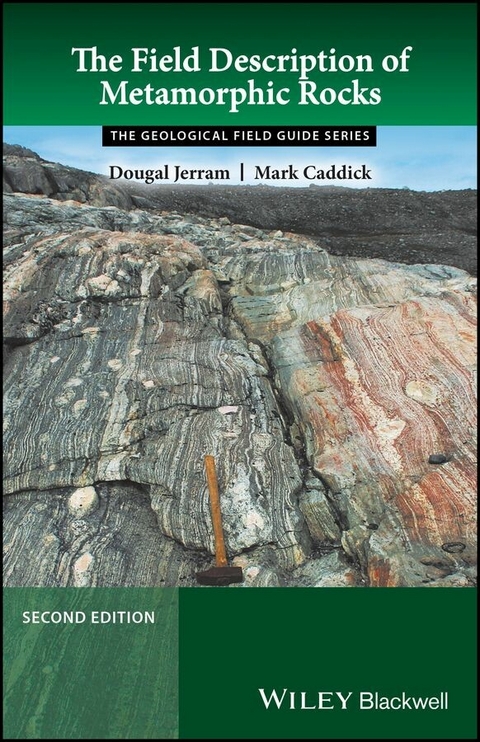
Field Description of Metamorphic Rocks (eBook)
192 Seiten
Wiley (Verlag)
978-1-118-61867-7 (ISBN)
The Field Description of Metamorphic Rocks, Second Edition
This pocket-sized field guide describes how metamorphic rocks and rock masses may be observed, recorded and mapped in the field. Written at a level suitable for Earth Science undergraduate students, this book is an essential tool for any geologist - student, professional or amateur - faced with the task of making a general description of an area of metamorphic rocks. A clear, systematic framework, together with numerous colour diagrams, illustrations and checklists, enables readers with different backgrounds to produce useful descriptions, despite possible differences of background or specialist interest. Additional information is also provided to aid those who are undertaking field mapping courses or must compile field evidence into reports on the metamorphic evolution of a region. This book:
- Shows the reader how to observe metamorphic rocks in the field, from the outcrop to the hand specimen scale
- Is fully revised and updated to incorporate new developments in the field
- Offers a user-friendly and accessible writing style including a revised format with tabbed sections for easy navigation
- Covers key topics including classification and mapping of metamorphic rocks, understanding key textures and fabrics, and details on contacts and fault zones
Dougal Jerram
University of Oslo, Norway and DougalEARTH Ltd, Solihull, UK
Mark Caddick
Virginia Tech, Blacksburg, VA, USA
The Field Description of Metamorphic Rocks The Field Description of Metamorphic Rocks, Second Edition This pocket-sized field guide describes how metamorphic rocks and rock masses may be observed, recorded and mapped in the field. Written at a level suitable for Earth Science undergraduate students, this book is an essential tool for any geologist student, professional or amateur faced with the task of making a general description of an area of metamorphic rocks. A clear, systematic framework, together with numerous colour diagrams, illustrations and checklists, enables readers with different backgrounds to produce useful descriptions, despite possible differences of background or specialist interest. Additional information is also provided to aid those who are undertaking field mapping courses or must compile field evidence into reports on the metamorphic evolution of a region. This book: Shows the reader how to observe metamorphic rocks in the field, from the outcrop to the hand specimen scale Is fully revised and updated to incorporate new developments in the field Offers a user-friendly and accessible writing style including a revised format with tabbed sections for easy navigation Covers key topics including classification and mapping of metamorphic rocks, understanding key textures and fabrics, and details on contacts and fault zones
Dougal Jerram, University of Oslo, Norway and DougalEARTH Ltd, Solihull, UK. Mark Caddick, Virginia Tech, Blacksburg, VA, USA.
Preface vii
Acknowledgments ix
1 Introduction and Occurrence 1
1.1 The Importance of Fieldwork in Metamorphic Terrains 1
1.2 Understanding Metamorphism; Pressure/Temperature Relationships 4
1.3 Mode of Occurrence of Metamorphic Bodies 4
1.4 Summary 13
2 Field Skills and Mapping Outcrop Structures 17
2.1 Equipment 17
2.2 Preparing Maps and Basic Mapping 19
2.3 Notebooks and Data Recording 20
2.4 Digital 3D Outcrop Mapping 33
3 Metamorphic Minerals, Rock Types, and Classification 37
3.1 Minerals 37
3.2 The Basic Classification of Metamorphic Rocks in P-T 46
3.3 Metamorphic Rock Names 48
3.4 Reporting Rock Types 50
3.5 Compositional Category and Metamorphic Grade 54
4 Understanding Textures and Fabrics 1: Banding, Cleavage, Schistosity, and Lineations 67
4.1 General Terminology 67
4.2 Rocks without a Metamorphic Directional Fabric 71
4.3 Banding 71
4.4 The Development of Fabric, Cleavage, Schistosity, and Lineations 79
4.5 Refraction, Kinking, and Shearing of Fabrics 88
4.6 Deformation Fabrics and Folds 89
5 Understanding Textures and Fabrics 2: Metamorphic Crystals, Pseudomorphs, and Scattered Entities 95
5.1 Recording Metamorphic Textures 95
5.2 Metamorphic Crystal Growth and Porphyroblasts 97
5.3 Boudins, Shear Pods, and Knockers 109
6 Contacts, Reaction Zones, and Veins 115
6.1 Igneous Contacts - Aureoles and Metasomatism 115
6.2 Veins and Pegmatites 124
6.3 Reaction Zones and Chemical Changes at Contacts 130
7 Faults, Mylonites, and Cataclasites 137
7.1 Fault and Shear Zone Types 137
7.2 Faults and Fault Breccias 138
7.3 Cataclasites and Pseudotachylites 141
7.4 Mylonites and Shear Zones 144
8 Summary Tables, Checklists, and Mapping Report Advice 151
8.1 Compositional Categories and Their Grade Indicators 151
8.2 Minerals 157
8.3 Further Mapping Advice; Formations, Markers, and a Final Report 164
Checklist of Rock Features 171
Further Reading Suggestions 173
Index 175
1
INTRODUCTION AND OCCURRENCE
A classic old metamorphic map, the 1833 map of the geology of Massachusetts, from maps associated with Edward Hitchcock's ‘Report on the Geology, Mineralogy, Botany, and Zoology of Massachusetts’ (Amherst, Mass.: Press of J. S. and C. Adams, 1833).
Metamorphic rocks form a substantial proportion of the material that makes up the Earth's crust, and metamorphic processes have been almost continually occurring throughout geological time since the origin of that crust. Metamorphism can be defined simply as the process by which sedimentary or igneous rocks are transformed (metamorphosed) by re‐crystallisation due to changes in pressure, temperature, or fluid conditions. To complicate matters somewhat, metamorphism can of course also act on rocks that have already been metamorphosed previously, building layer upon layer of complexity into those rocks that record field evidence of some of Earth's most dynamic processes. Our understanding of metamorphism is somewhat limited by the fact that we are unable to directly observe it happening to the rocks. As you read this, metamorphism is in action all around the planet, in all aspects of the Earth's plate tectonic system (e.g. Figure 1.1), but we cannot directly see it (generally because it happens at depth and very slowly). In order to understand the processes and products of metamorphism and alteration in rocks, detailed fieldwork, petrography, experimental studies, and numerical modelling are required. It is important to note, however, that the very origin of metamorphic petrology (the science of understanding the distribution, structure, and origin of metamorphic rocks) is rooted in a tradition of careful and systematic field observation, and that this remains an absolute cornerstone of the discipline today. Since the late nineteenth century, Earth scientists have strived to develop an understanding of metamorphic processes by identifying the different types of key minerals, mineral assemblages, and structures present in the metamorphic rocks. Using these observations and knowledge of some fundamental principles, mineral reactions can be calculated and/or experimentally derived to help explain and understand the process by which the original rock was metamorphosed into its current state. These rocks often encode evolving conditions at tectonic plate boundaries, so deciphering their mineralogical history may be thought of as a window into the crustal‐scale processes that form, modify, and stabilise Earth's crust. Underpinning all of this is the petrologist's ability to identify, describe, relate, and collect metamorphic rocks in the field, and it is these skills which this book aims to explore and impart, by its use in the field description of metamorphic rocks.
1.1 The Importance of Fieldwork in Metamorphic Terrains
In many ways, metamorphic geology requires you to be skilful in most aspects of the Earth sciences. As metamorphic rocks can be formed from any original rock (the parent rock henceforth being called the protolith), an ability to identify and be familiar with the wide variety of minerals and textures of sedimentary and igneous rocks is a general requirement for any budding metamorphic geologist. Additionally, as the very processes involved in metamorphism are commonly associated with deformation, a keen understanding of structural geology and tectonics is also needed. In many ways, the metamorphic scientist needs to be a jack of all trades and a master of one!
Due to the potential complexity within metamorphic rocks, the importance of careful fieldwork cannot be overstated. The different types of observation that can be made at various scales in metamorphic terrains allow the student/researcher to build up a list of clues, like in a forensic study, which can be used to help derive the type of metamorphic rock, its protolith, and the range of processes that it has undergone to reach its present state. The map‐scale distribution of metamorphic rocks can reveal the processes that formed them, but as we discuss in the following chapters, the correct interpretation of even the smallest parts of a field area are rooted in good field observations. This book aims to help build you skills in this area! Careful identification of rocks and structures is all the more important when taking samples from the field back to the laboratory for further study and analysis. The record of structures within and around the rock mass may ultimately help you to better interpret features you subsequently see down the microscope or the data that you receive from laboratory analysis.
Figure 1.1 Schematic of the plate tectonic settings where metamorphism is occurring around the world (see also Figure 1.2).
Describable features which can be observed in metamorphic rock masses include:
- Pre‐metamorphic – e.g. bedding and other sedimentary features, contact relationships between batches of melt, or even fossils (though in most cases the features may be altered beyond normal recognition).
- Metamorphic – relating to local mineral changes due primarily to changing temperature and pressure.
- Metasomatic – involving the chemical transport and mineral change associated with fluids.
- Structural – relating to and recording the rock's deformation at any point in its history.
Limitations exist as to how much information one can record regarding any of these features without the need for microscopic and chemical measurements, which is the realm of specialist study that will be touched upon within this book but is not our major theme. With good field observations of mineralogy, texture, and structure, one should still be able to adequately describe the rock masses in terms of their types and occurrence, hopefully also being able to build up an inference of the evolving conditions of their formation. Such description is particularly appropriate for the production of geological maps, logs, and recordings of outcrop structures, which will be covered in more detail in Chapter 2.
This book forms a companion to the other texts in the geological field guide series, e.g. The Field Description of Igneous Rocks, Sedimentary Rocks in the Field, and The Mapping of Geological Structures, and as such does not cover in detail the pre‐metamorphic features of sediments and igneous bodies that may sometimes be preserved in metamorphic rocks. We do, however, show many examples of these in cases where they can either be shown to help in the identification of the protolith rock or reveal something fundamental about the metamorphism itself (e.g. that it happened in the presence or absence of deformation). There is substantial overlap between the skills required to be a metamorphic geologist in the field and those considered to be the realm of a structural geology, at least in terms of fieldwork measurements/observations, and particularly when mapping in metamorphic terrains. As such, this text will aim to provide as much help in terms of structural description, as will be necessary to get the most out of your metamorphic rocks. The reader will need to make an assessment as to what level of understanding of sedimentary, igneous, and structural geology might be best suited for the problem at hand, and where needed can supplement this guide with an appropriate partner guide. For example, if you are mapping a metamorphically altered igneous region, then additional help from The Field Description of Igneous Rocks may be useful. In a thrust zone, the structural guide may provide some vital additional assistance, and so on. However, we have tried, wherever possible, for this book to be a stand‐alone guide to achieve success in the field description of metamorphic rocks. Ultimately, we aim for this handbook to provide the required information on how to observe metamorphic rocks in the field, from the outcrop to the hand specimen scale, and to tie these observations into basic interpretations of how the metamorphic rocks formed. This also necessitates comments on sampling strategies for projects in which fieldwork is the start of a wide‐reaching study. As such, before we take on metamorphic rocks in the field it is useful to consider how metamorphism relates to regional and global tectonics and the main occurrence of metamorphic rocks.
1.2 Understanding Metamorphism; Pressure/Temperature Relationships
Rocks undergo metamorphic and metasomatic changes as they are subjected to different pressure and temperature conditions, or are infiltrated by chemically reactive fluids. Indeed, a fundamental building block to a deeper understanding of metamorphism is a good grasp of pressure, temperature, and time (it takes time for metamorphic reactions to take place, evidence of which may be preserved in the field in the form of incomplete reactions). In this sense, it is very useful from the onset of your training as a metamorphic Earth scientist to become familiar with the ranges of pressure and temperature experienced in the Earth and the key metamorphic mineral associations (assemblages) that are found within these ranges. One of the main ways in which we consider this is through what is known as a P/T diagram, in which changing aspects of a rock are plotted as a function of pressure (P) and temperature (T). This allows one to highlight various aspects of metamorphism and question how they might be represented in the...
| Erscheint lt. Verlag | 1.3.2022 |
|---|---|
| Reihe/Serie | Geological Field Guide |
| The Geological Field Guide Series | The Geological Field Guide Series |
| Sprache | englisch |
| Themenwelt | Naturwissenschaften ► Geowissenschaften ► Geologie |
| Schlagworte | earth sciences • Geologie • Geologie u. Geophysik • Geology & Geophysics • Geowissenschaften • Metamorphit |
| ISBN-10 | 1-118-61867-X / 111861867X |
| ISBN-13 | 978-1-118-61867-7 / 9781118618677 |
| Informationen gemäß Produktsicherheitsverordnung (GPSR) | |
| Haben Sie eine Frage zum Produkt? |
 EPUB (Adobe DRM)
Kopierschutz: Adobe-DRM
Adobe-DRM ist ein Kopierschutz, der das eBook vor Mißbrauch schützen soll. Dabei wird das eBook bereits beim Download auf Ihre persönliche Adobe-ID autorisiert. Lesen können Sie das eBook dann nur auf den Geräten, welche ebenfalls auf Ihre Adobe-ID registriert sind.
Details zum Adobe-DRM
Dateiformat: EPUB (Electronic Publication)
EPUB ist ein offener Standard für eBooks und eignet sich besonders zur Darstellung von Belletristik und Sachbüchern. Der Fließtext wird dynamisch an die Display- und Schriftgröße angepasst. Auch für mobile Lesegeräte ist EPUB daher gut geeignet.
Systemvoraussetzungen:
PC/Mac: Mit einem PC oder Mac können Sie dieses eBook lesen. Sie benötigen eine
eReader: Dieses eBook kann mit (fast) allen eBook-Readern gelesen werden. Mit dem amazon-Kindle ist es aber nicht kompatibel.
Smartphone/Tablet: Egal ob Apple oder Android, dieses eBook können Sie lesen. Sie benötigen eine
Geräteliste und zusätzliche Hinweise
Buying eBooks from abroad
For tax law reasons we can sell eBooks just within Germany and Switzerland. Regrettably we cannot fulfill eBook-orders from other countries.
aus dem Bereich