


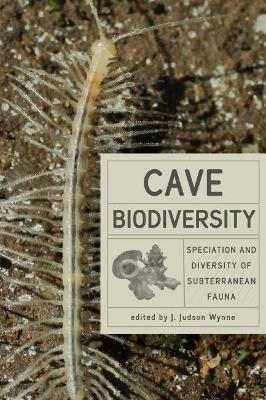
Cave Biodiversity
Speciation and Diversity of Subterranean Fauna
Seiten
2023
Johns Hopkins University Press (Verlag)
978-1-4214-4457-4 (ISBN)
Johns Hopkins University Press (Verlag)
978-1-4214-4457-4 (ISBN)
A deep-dive into the evolutionary biology, biogeography, and conservation of the most elusive subterranean creatures in the world.
Far from the austere, sparsely populated ecosystems often conjured in the imagination, caves host some of the most mysterious and biodiverse natural systems in the world. Subterranean environments, however, are the least explored terrestrial habitats, contributing to misconceptions about their inhabitants. Edited by cave scientist and conservation ecologist Dr. J. Judson Wynne, Cave Biodiversity explores both the evolution and the conservation of subterrestrial-dwelling fauna.
Covering both vertebrates and invertebrates, including mollusks, fishes, amphibians, arthropods, and other troglobionts, this volume brings together ichthyologists, entomologists, ecologists, herpetologists, and conservationists to provide a nuanced picture of life beneath the earth's surface. Broad chapters covering biotic and abiotic factors that influence evolution and support biodiversity precede chapters dedicated to specific taxa, highlighting phylogenetics and morphology, and delving into zoogeography, habitat, ecology, and dispersal mechanisms for each. Considerations for conservation of these fascinating, often bizarre, and often highly sensitive subterranean creatures are emphasized throughout.
Cave Biodiversity aims to synthesize the principles of subterranean evolutionary biology and diversity through in-depth case studies of some of the most captivating and imperiled taxonomic groups in the world. Employing a multidisciplinary approach involving systematics, genetics, ecology, biogeography, evolutionary biology, and conservation science, Cave Biodiversity will be of keen interest to evolutionary biologists, ecologists, conservation biologists, and cave scientists, as well as advanced undergraduate and graduate students.
Contributors: Maria E. Bichuette, Evin T. Carter, Prosanta Chakrabarty, Kenneth James Chapin, Danté B. Fenolio, Andrew G. Gluesenkamp, Jozef Grego, Francis G. Howarth, Leonardo Latella, Matthew L. Niemiller, Karen A. Ober, T. Keith Philips, John G. Phillips, Stuart Pimm, Daphne Soares, J. Judson Wynne, and Yahui Zhao.
Far from the austere, sparsely populated ecosystems often conjured in the imagination, caves host some of the most mysterious and biodiverse natural systems in the world. Subterranean environments, however, are the least explored terrestrial habitats, contributing to misconceptions about their inhabitants. Edited by cave scientist and conservation ecologist Dr. J. Judson Wynne, Cave Biodiversity explores both the evolution and the conservation of subterrestrial-dwelling fauna.
Covering both vertebrates and invertebrates, including mollusks, fishes, amphibians, arthropods, and other troglobionts, this volume brings together ichthyologists, entomologists, ecologists, herpetologists, and conservationists to provide a nuanced picture of life beneath the earth's surface. Broad chapters covering biotic and abiotic factors that influence evolution and support biodiversity precede chapters dedicated to specific taxa, highlighting phylogenetics and morphology, and delving into zoogeography, habitat, ecology, and dispersal mechanisms for each. Considerations for conservation of these fascinating, often bizarre, and often highly sensitive subterranean creatures are emphasized throughout.
Cave Biodiversity aims to synthesize the principles of subterranean evolutionary biology and diversity through in-depth case studies of some of the most captivating and imperiled taxonomic groups in the world. Employing a multidisciplinary approach involving systematics, genetics, ecology, biogeography, evolutionary biology, and conservation science, Cave Biodiversity will be of keen interest to evolutionary biologists, ecologists, conservation biologists, and cave scientists, as well as advanced undergraduate and graduate students.
Contributors: Maria E. Bichuette, Evin T. Carter, Prosanta Chakrabarty, Kenneth James Chapin, Danté B. Fenolio, Andrew G. Gluesenkamp, Jozef Grego, Francis G. Howarth, Leonardo Latella, Matthew L. Niemiller, Karen A. Ober, T. Keith Philips, John G. Phillips, Stuart Pimm, Daphne Soares, J. Judson Wynne, and Yahui Zhao.
J. Judson Wynne (FLAGSTAFF, AZ) is an assistant research professor of cave ecology at Northern Arizona University.
List of Contributors
Foreword
Preface
Acknowledgements
Chapter 1. Influence of the Physical Environment on Terrestrial Cave Diversity
Chapter 2. Evolutionary Models Influencing Subterranean Speciation
Chapter 3. Biology and Ecology of Subterranean Mollusca
Chapter 4. The Subterranean Cholevinae of Italy
Chapter 5. Cave Trechine (Coleoptera: Carabidae) Radiation and Biogeography in Eastern North America,
Chapter 6. Subterranean Colonization and Diversification of Cave-dwelling Salamanders
Chapter 7. Diversity, Distribution, and Conservation of Cavefishes in China
Index
| Erscheinungsdatum | 20.12.2022 |
|---|---|
| Zusatzinfo | 18 Illustrations, black and white; 16 Illustrations, color; 29 Illustrations, black and white |
| Verlagsort | Baltimore, MD |
| Sprache | englisch |
| Maße | 152 x 229 mm |
| Gewicht | 680 g |
| Themenwelt | Naturwissenschaften ► Biologie ► Evolution |
| ISBN-10 | 1-4214-4457-7 / 1421444577 |
| ISBN-13 | 978-1-4214-4457-4 / 9781421444574 |
| Zustand | Neuware |
| Informationen gemäß Produktsicherheitsverordnung (GPSR) | |
| Haben Sie eine Frage zum Produkt? |
Mehr entdecken
aus dem Bereich



aus dem Bereich
die Evolution des Seins, die Menschwerdung des Menschen und die Frage …
Buch | Softcover (2025)
Büchner-Verlag
CHF 41,90


