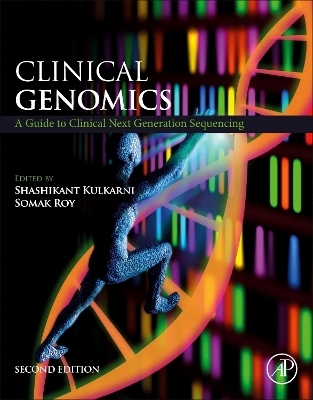
Clinical Genomics
Academic Press Inc (Verlag)
978-0-323-90024-9 (ISBN)
- Noch nicht erschienen (ca. Juli 2026)
- Versandkostenfrei
- Auch auf Rechnung
- Artikel merken
Structured for ease of reference, this book covers targeted gene sequencing methods, whole exome/genome approaches, emerging technologies such as long-read sequencing, and critical considerations for assay validation. Detailed sections address bioinformatics workflows, variant detection and interpretation methodologies, integration with clinical informatics systems, and essential IT infrastructure, including cloud-based solutions.
This book also thoroughly addresses practical topics essential to laboratory management, such as regulatory compliance, ethical frameworks, billing strategies, and reimbursement paradigms, helping directors navigate the evolving landscape of genomic diagnostics.
Dr. Shashikant Kulkarni is the Head of Clinical Genomics, Genomics and Pathology Services and also the Director of Cytogenomics and Molecular Pathology at Washington University School of Medicine. In addition, he is Associate Professor of Pathology and Immunology, Pediatrics, and Genetics. His lab's principle research interest is delineation of novel genomic structural and single nucleotide variants in cancer. Dr. Somak Roy is an Assistant Professor, in the division of Molecular and Genomic Pathology, at the University of Pittsburgh Medical Center, in Pittsburgh, PA. He is also Director of Molecular Informatics and the Director of the MGP Fellowship Program, and Associate Laboratory Director of the Division of Molecular and Genomic Pathology. Dr. Roy's research is focused on understanding mechanisms of urothelial carcinogenesis and metastasis using next generation sequencing and microarray technologies. He also develops biomedical informatics solutions for optimizing clinical laboratory operations and quality management.
Section I: Methods
1. Overview of Technical Aspects and Chemistries of Next-Generation Sequencing
2. Targeted Hybrid Capture Methods
3. Amplification-Based Methods
4. Emerging DNA Sequencing Technologies
5. Transcriptomics, RNA-Sequencing and Methylome Analysis
Section II: Bioinformatics
6. Base Calling, Read Mapping, and Coverage Analysis
7. Single Nucleotide Variant Detection Using Next Generation Sequencing
8. Insertions and Deletions (Indels)
9. Translocation Detection Using Next-Generation Sequencing
10. Copy Number Variant Detection Using Next-Generation Sequencing
11. Reference Databases for Disease Associations
12. Reporting of Clinical Genomics Test Results
13. Reporting Software
14. Constitutional Diseases: Target enrichment strategies for Targeted gene sequencing panels
15. Targeted Hybrid Capture for Inherited Disease Panels
16. Constitutional Disorders: Whole Exome and Whole Genome Sequencing
17. Somatic Diseases (Cancer): Amplification-Based Next-Generation Sequencing
18. Targeted Hybrid-Capture for Somatic Mutation Detection in the Clinic
19. Somatic Diseases (Cancer): Whole Exome and Whole Genome Sequencing
20. Assay Validation
21. Regulatory Considerations Related to Clinical Next Generation Sequencing
22. Genomic Reference Materials for Clinical Applications
23. Ethical Challenges in Clinical Genomics
24. Legal Issues
25. Billing and Reimbursement
Section III: Clinical Informatics and IT Infrastructure
26. Cloud Computing for Clinical NGS Testing
Section III: Interpretation
27. Bioinformatics of Long Read Sequencing
Section IV: Regulation, Reimbursement, and Legal Issues
28. Business aspect of Precision Genomic Medicine
29. Driving precision medicine through genomics-EHR integration
| Erscheint lt. Verlag | 13.7.2026 |
|---|---|
| Verlagsort | Oxford |
| Sprache | englisch |
| Maße | 216 x 276 mm |
| Themenwelt | Studium ► 2. Studienabschnitt (Klinik) ► Humangenetik |
| Naturwissenschaften ► Biologie ► Genetik / Molekularbiologie | |
| ISBN-10 | 0-323-90024-0 / 0323900240 |
| ISBN-13 | 978-0-323-90024-9 / 9780323900249 |
| Zustand | Neuware |
| Informationen gemäß Produktsicherheitsverordnung (GPSR) | |
| Haben Sie eine Frage zum Produkt? |
aus dem Bereich