


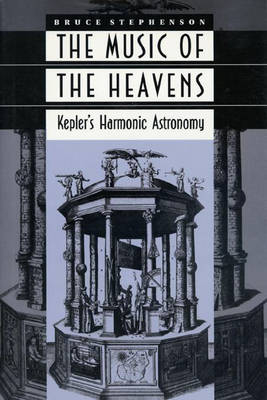
The Music of the Heavens
Kepler's Harmonic Astronomy
Seiten
1994
Princeton University Press (Verlag)
978-0-691-03439-3 (ISBN)
Princeton University Press (Verlag)
978-0-691-03439-3 (ISBN)
- Titel ist leider vergriffen;
keine Neuauflage - Artikel merken
Challenging those who characterized Johann Kepler's theories of harmonic astronomy as "mystical," this is a technical analysis of the music the astronomer thought the heavens made, which describes the logical steps that led Kepler to find musical patterns in his data.
Valued today for its development of the Third Law of Planetary Motion, "Harmonice mundi" (1619) was intended by Kepler to expand on ancient efforts to discern a Creator's plan for the planetary system - an arrangement thought to be based on harmonic relationships. Challenging critics who characterize Kepler's theories of harmonic astronomy as "mystical," Bruce Stephenson offers a thorough technical analysis of the music the astronomer thought the heavens made, and the logic that led him to find musical patterns in his data. In so doing, Stephenson illuminates crucial aspects of Kepler's intellectual development, particularly his ways of classifying and drawing inferences. Beginning with a survey of similar theories associating music with the cyclic motions of planets, from Plato to Boethius, the author highlights Ptolemy's "Harmonics", a source of inspiration for Kepler's later work. Turning to Kepler himself, Stephenson gives an account of his polyhedral theory, which explains the number and sizes of the planetary orbits in terms of the five regular polyhedral.
He then examines in detail an early theory that relates the planets' velocities to a musical chord, and analyzes Kepler's unpublished commentary on Ptolemy's "Harmonics".
Valued today for its development of the Third Law of Planetary Motion, "Harmonice mundi" (1619) was intended by Kepler to expand on ancient efforts to discern a Creator's plan for the planetary system - an arrangement thought to be based on harmonic relationships. Challenging critics who characterize Kepler's theories of harmonic astronomy as "mystical," Bruce Stephenson offers a thorough technical analysis of the music the astronomer thought the heavens made, and the logic that led him to find musical patterns in his data. In so doing, Stephenson illuminates crucial aspects of Kepler's intellectual development, particularly his ways of classifying and drawing inferences. Beginning with a survey of similar theories associating music with the cyclic motions of planets, from Plato to Boethius, the author highlights Ptolemy's "Harmonics", a source of inspiration for Kepler's later work. Turning to Kepler himself, Stephenson gives an account of his polyhedral theory, which explains the number and sizes of the planetary orbits in terms of the five regular polyhedral.
He then examines in detail an early theory that relates the planets' velocities to a musical chord, and analyzes Kepler's unpublished commentary on Ptolemy's "Harmonics".
| Reihe/Serie | Princeton Legacy Library |
|---|---|
| Zusatzinfo | 21 line illus. |
| Verlagsort | New Jersey |
| Sprache | englisch |
| Maße | 197 x 254 mm |
| Gewicht | 539 g |
| Themenwelt | Naturwissenschaften ► Physik / Astronomie ► Astronomie / Astrophysik |
| ISBN-10 | 0-691-03439-7 / 0691034397 |
| ISBN-13 | 978-0-691-03439-3 / 9780691034393 |
| Zustand | Neuware |
| Informationen gemäß Produktsicherheitsverordnung (GPSR) | |
| Haben Sie eine Frage zum Produkt? |
Mehr entdecken
aus dem Bereich



aus dem Bereich
Grundlagen, Anwendungen in Astrophysik und Kosmologie sowie …
Buch | Softcover (2022)
Springer Spektrum (Verlag)
CHF 69,95
Kompendium & Nachschlagewerk in 3 Bänden
Buch | Hardcover (2025)
Eigenverlag Dr. Erik Wischnewski
CHF 179,95


