


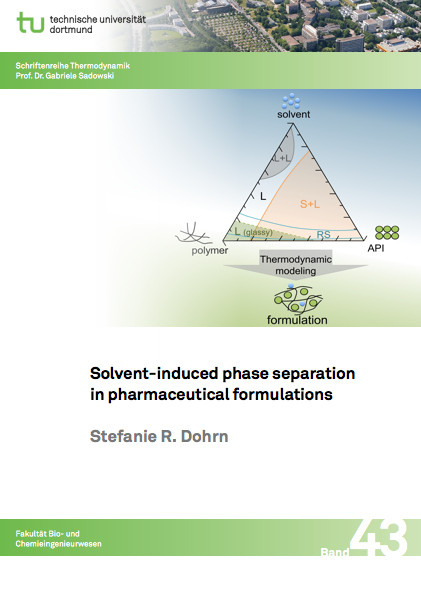
Solvent-induced phase separation in pharmaceutical formulations
Seiten
2021
Dr. Hut (Verlag)
978-3-8439-4931-6 (ISBN)
Dr. Hut (Verlag)
978-3-8439-4931-6 (ISBN)
- Keine Verlagsinformationen verfügbar
- Artikel merken
An established strategy to overcome the low aqueous solubility of an active pharmaceutical ingredient (API) is incorporating it in a polymer, generating so-called amorphous solid dispersions (ASDs). The ASD development requires a fundamental understanding of the physical stability of the ASD, also during all interim steps of the manufacturing process. ASDs can be produced via solvent-based processes, dissolving the API and polymer in a solvent or solvent mixture, followed by evaporative drying. Unwanted, solvent-induced liquid-liquid phase separation (LLPS) or crystallization might occur at any manufacturing step.
In this work, the thermodynamic phase behavior of API/polymer/solvent(s) was determined using the Perturbed-Chain Statistical Associating Fluid Theory (PC-SAFT), the glass transition with the Gordon-Taylor Equation, and experimentally validated using dynamic vapor sorption (DVS), differential scanning calorimetry (DSC), and Raman spectroscopy. Solvents and solvent mixtures were identified, accounting for the API solubility, avoidance of phase separation at all process steps, and low residual solvent content. Residual solvent affects the glass transition of the ASD (wet Tg), which is particularly relevant for ASDs with API loadings that exceed the API solubility in the polymer. Inhomogeneous ASDs are inevitably obtained when LLPS regions are passed during drying. Phase-separated ASDs show a heterogeneous API distribution in the polymer and might recrystallize faster due to local API supersaturation. The temperature, molar mass of the polymer, and the API thereby influence the occurrence of phase separation. Further, ASD spray-drying conditions were determined, combining the thermodynamic phase behavior with spray-dryer mass and energy balances.
This work showed the identification of appropriate solvents for ASD manufacturing at the early stages of formulation using thermodynamic modeling.
In this work, the thermodynamic phase behavior of API/polymer/solvent(s) was determined using the Perturbed-Chain Statistical Associating Fluid Theory (PC-SAFT), the glass transition with the Gordon-Taylor Equation, and experimentally validated using dynamic vapor sorption (DVS), differential scanning calorimetry (DSC), and Raman spectroscopy. Solvents and solvent mixtures were identified, accounting for the API solubility, avoidance of phase separation at all process steps, and low residual solvent content. Residual solvent affects the glass transition of the ASD (wet Tg), which is particularly relevant for ASDs with API loadings that exceed the API solubility in the polymer. Inhomogeneous ASDs are inevitably obtained when LLPS regions are passed during drying. Phase-separated ASDs show a heterogeneous API distribution in the polymer and might recrystallize faster due to local API supersaturation. The temperature, molar mass of the polymer, and the API thereby influence the occurrence of phase separation. Further, ASD spray-drying conditions were determined, combining the thermodynamic phase behavior with spray-dryer mass and energy balances.
This work showed the identification of appropriate solvents for ASD manufacturing at the early stages of formulation using thermodynamic modeling.
| Erscheinungsdatum | 09.12.2021 |
|---|---|
| Reihe/Serie | Thermodynamik |
| Verlagsort | München |
| Sprache | englisch |
| Maße | 148 x 210 mm |
| Gewicht | 287 g |
| Themenwelt | Naturwissenschaften ► Physik / Astronomie ► Thermodynamik |
| Technik | |
| Schlagworte | amorphous solid dispersion • PC-SAFT • Solvent selection |
| ISBN-10 | 3-8439-4931-X / 384394931X |
| ISBN-13 | 978-3-8439-4931-6 / 9783843949316 |
| Zustand | Neuware |
| Informationen gemäß Produktsicherheitsverordnung (GPSR) | |
| Haben Sie eine Frage zum Produkt? |
Mehr entdecken
aus dem Bereich
aus dem Bereich
zur Materialproblematik der modernen Elektronik
Buch | Hardcover (2025)
Alfred Kröner Verlag
CHF 27,85
Von Energie und Entropie zu Wärmeübertragung und Phasenübergängen
Buch | Softcover (2023)
De Gruyter Oldenbourg (Verlag)
CHF 83,90


