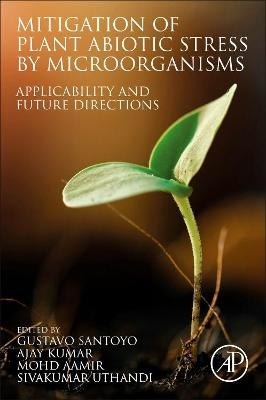
Mitigation of Plant Abiotic Stress by Microorganisms
Academic Press Inc (Verlag)
978-0-323-90568-8 (ISBN)
Mitigation of Plant Abiotic Stress by Microorganisms: Applicability and Future Directions is a comprehensive review of the different strategies available to improve the plant microbiome. Chapters include key topics such as: harnessing endophytic microbial diversity, microbial genes for improving abiotic stress tolerance, and microbial bioformulations. Putting these strategies into practice can have varying success in the field, so it is crucial that scientists are equipped with the knowledge of which microorganisms are needed, as well as the use and suitability of delivery approaches and formulations.
This title will be an essential read for researchers and students interested in plant microbial technologies and plant bio stimulants, plant pathology, biocontrol, agronomy, and environmental mediation.
Gustavo Santoyo is a Professor of Agrogenomics at the Institute of Chemical and Biological Research, Universidad Michoacana de San Nicolás de Hidalgo, Mexico. He holds two BSc degrees, one in Biology and the other in Psychology. He earned his PhD in Biomedical Sciences from the National Autonomous University of Mexico (UNAM). Dr. Santoyo conducted postdoctoral studies at the Center for Cancer Research, The National Institutes of Health, USA, and was a visiting professor at Wilfrid Laurier University, Canada. His current research focuses on elucidating plant–soil–microbe interactions and on investigations in agrogenomics. He is a prolific book author/editor and journal reviewer. He serves as a Special Content Editor for Microbiological Research (Elsevier) and as an Associate Editor for Frontiers in Plant Sciences (Frontiers), Journal of Advanced Research (Elsevier), and Antonie van Leeuwenhoek (Springer). He is a member of the Mexican Academy of Sciences and holds the Nivel III distinction in the Sistema Nacional de Investigadores of Mexico. In 2024, he received the State Award for Science, Technology, and Innovation, granted by the Government of the State of Michoacán. Dr. Ajay Kumar is currently working as an assistant professor at Amity Institute of Biotechnology, Amity University, Noida, India. Dr. Kumar completed his tenure (2018-2022) as a visiting scientist from Agriculture Research Organization, Volcani Center, Israel and doctoral research from Department of Botany, Institute of Science, Banaras Hindu University, Varanasi, India on the theme "Plant microbe interaction". In his research tenures, Dr. Kumar has published more than 235 scientific contributions in the form of research and review articles, books or book chapters with the leading International Journals or Publishers. He has wide area of research experience, especially in the field of Plant-Microbe Interactions, Microbial biocontrol, Postharvest management of fruits, Microbial endophytes related with the medicinal plants and cyanobacteria-pesticides interactions. Dr. Kumar actively engaged in editing book with the leading publisher like Elsevier, Springer, CRC Press, Willey and edited more than 48 books and currently serving as an Associate editor in Frontier in Microbiology, BMC Microbiology and special guest editor in Microorganisms or Plants MDPI, Journal. Mohd Aamir holds a PhD in Biotechnology from Banaras Hindu University and has undertaken extensive postdoctoral training at the Indian Agricultural Research Institute (IARI), New Delhi. He is a leading researcher in plant pathology, microbial biotechnology, and genomics, with a focus on biocontrol agents, host–pathogen interactions, and the molecular mechanisms of plant defense. Dr. Aamir has authored and co-authored numerous high-impact publications in reputable journals, including Frontiers in Plant Science, BMC Plant Biology, and Physiologia Plantarum, contributing chapters to several books and edited volumes too. He is the recipient of prestigious fellowships, including the DST‑SERB National Post‑Doctoral Fellowship and CSIR JRF, and has led major research projects funded by national agencies. His work has been recognized with awards such as the Young Scientist Associate Award and Best Poster Presentation Awards at national conferences. Prof. Sivakumar Uthandi is a Professor and Head at the Department of Agricultural Microbiology, Tamil Nadu Agricultural University (TNAU), Coimbatore. He has contributed 32 years of service at various levels from Assistant Professor to Dean (Post Graduate Studies). He had his graduation, and Doctorate from Tamil Nadu Agricultural University and obtained his post-doctoral training at the University of Florida USA, the University of Warwick UK, Borskeva Institute of Catalysis Russia, and Wageningen University, The Netherlands. He was recognized as Visiting Associate Professor at the University of Florida, USA. He is also holding the honorary position of Adjunct Professor at the University of Tokyo, Japan since 2019 to till-date (2024). He is a Fellow of Royal Society of Biology, London, Academy of Microbiological Sciences, India, and received 4 international 13 national and 9 state awards. He has contributed a lot on biocatalysts mediated biomass conversion, more particularly, lignin biotransformation leading to lignin derived renewable aromatics. So far, he has published 171 peer-reviewed research papers including 4 patents (1-US, 3-Indian) and 7 books. To his laurel, he has mobilized funds to the tune of INR 1171 lakhs and offered 35 fellowships to students which include 21 Masters, 6 Doctoral candidates and 8 PDFs.lakhs through various funding agencies ICAR, DBT, DST, Indo-Russia, Indo-US, SERB and MHRD-FAST. He is the Editor of Springe Nature’s Indian Journal Microbiology for the past 3 years.
1. Abiotic Stress and Plant Response: Adaptive Mechanisms of Plants Against Multiple Stresses
2. Plant Microbiome: Modulation of Plant Defense and Ecological Dynamics Under Stressed Environment
3. The role of ACC deaminase and Trehalose as bacterial mechanism to increase salt and draught tolerance in plants
4. Endophytic microbes approaches in abiotic stress management
5. Microbial elicitors: A positive or negative modulator of plant defense
6. Microbial Behaviour, responses towards salinity stresses, mechanism of microbe mediated remediation for sustainable crop production
7. Microbe mediated alleviation of Heat Stress in Plant: Current Trends and Applications
8. Harnessing Endophytic Microbial Diversity for Stress Alleviation: Current Perspectives for Crop Improvement
9. Microbial Consortia Development for Abiotic Stress Tolerance: Potential Advantages, Applicability and Future Directions
10. Molecular Events and Defense Mechanism against Abiotic stresses at Pre stage Bio-primed Condition: A Biocontrol Perspectives
11. Microbial genes for improving abiotic stress tolerance: Transgenic Approaches for Stress Tolerance
12. Functional Genomics Tools for Studying Microbe mediated Stress Tolerance
13. Microbial Bioformulations and nano formulations for Crop Improvement
14. Role of Microbes in Plant Health, Disease Management, and Abiotic Stress Management
15. Soil Salinization and bioremediation using halophiles and halotolerant micro-organisms
16. Beneficial microbes in Plant growth promotion and Stress Management
17. Phytohormone modulation imparting moisture deficit stress tolerance in plants
18. An insight on nanofoulatiom of beneficial microorganisms for the crop plants under stress
19. How bacteria enhance salt tolerance in plants: OMIC and molecular studies
20. Abiotic stress mediated modulation of chromatin landscape in Arabidopsis thaliana
21. Microbial Management of Crop Abiotic Stress: Current Trends and Prospects
22. Relevance of Harnessing Microbial Diversity for Stress Alleviation in Changing Climatic Scenario
| Erscheinungsdatum | 12.05.2022 |
|---|---|
| Verlagsort | Oxford |
| Sprache | englisch |
| Maße | 191 x 235 mm |
| Gewicht | 450 g |
| Themenwelt | Naturwissenschaften ► Biologie ► Botanik |
| ISBN-10 | 0-323-90568-4 / 0323905684 |
| ISBN-13 | 978-0-323-90568-8 / 9780323905688 |
| Zustand | Neuware |
| Informationen gemäß Produktsicherheitsverordnung (GPSR) | |
| Haben Sie eine Frage zum Produkt? |
aus dem Bereich