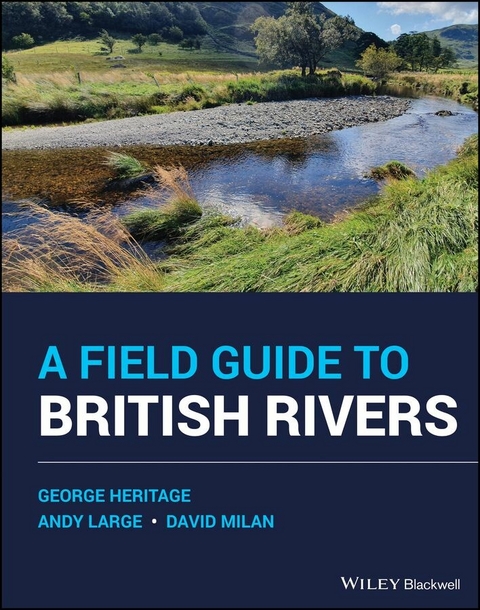
A Field Guide to British Rivers (eBook)
John Wiley & Sons (Verlag)
978-1-118-48802-7 (ISBN)
Temperate rivers are influenced by many factors including geology, climate, soils, sediment type, flow, as well as human activity. The complex interactions of the non-anthropogenic controlling factors have led to a wonderful diversity of river type throughout the British Isles. Sadly, almost all rivers in the UK have suffered significant and long-lasting modification by unsympathetic management, that has all but destroyed this variety, creating watercourses that are simplified conduits for water and sediment, designed primarily to drain the land and reduce flood risk. This volume aims to help reverse this, illustrating using over 200 images and descriptions, this variety of rivers in Britain, highlighting the many forms that temperate river systems take and providing an accessible summary of the underlying river science knowledge base.
A Field Guide to British Rivers covers the full range of upland and lowland channel types and describes the full variety of substrate conditions from bedrock through boulder, cobble and gravel, to silt dominated systems. The authors describe examples gathered from their extensive research and practical experience working with rivers throughout mainland Britain and set those examples in their wider landscape context to exemplify the natural functioning of temperate river types. This book offers a practical and contextualised guide to contribute to efforts towards the sympathetic and sustainable restoration and re-naturalisation of degraded channels in the UK. Offering a unique viewpoint of both the underpinning science and the practicalities of river management, A Field Guide to British Rivers is an essential a stand-alone guide for anyone involved in river restoration and management as well as for those simply interested in rivers in general.
Written as a field guide to demonstrate practical examples of river types, and to highlight the pressures they experience and their often-parlous condition, this book is intended to better inform both river management approaches and the policy necessary to achieve this. Fundamentally, the authors seek to demonstrate how the hydrological, geomorphological, and ecological functions of rivers and their catchments are inexorably intertwined, and together how they generate and maintain rivers as dynamic entities.
Dr. George Heritage is a Director of the applied environmental consultancy Dynamic Rivers.
Dr. Andy Large is Professor in River Science at the University of Newcastle.
Dr. David Milan is Senior Lecturer in Physical Geography at the University of Hull.
Temperate rivers are influenced by many factors including geology, climate, soils, sediment type, flow, as well as human activity. The complex interactions of the non-anthropogenic controlling factors have led to a wonderful diversity of river type throughout the British Isles. Sadly, almost all rivers in the UK have suffered significant and long-lasting modification by unsympathetic management, that has all but destroyed this variety, creating watercourses that are simplified conduits for water and sediment, designed primarily to drain the land and reduce flood risk. This volume aims to help reverse this, illustrating using over 200 images and descriptions, this variety of rivers in Britain, highlighting the many forms that temperate river systems take and providing an accessible summary of the underlying river science knowledge base. A Field Guide to British Rivers covers the full range of upland and lowland channel types and describes the full variety of substrate conditions from bedrock through boulder, cobble and gravel, to silt dominated systems. The authors describe examples gathered from their extensive research and practical experience working with rivers throughout mainland Britain and set those examples in their wider landscape context to exemplify the natural functioning of temperate river types. This book offers a practical and contextualised guide to contribute to efforts towards the sympathetic and sustainable restoration and re-naturalisation of degraded channels in the UK. Offering a unique viewpoint of both the underpinning science and the practicalities of river management, A Field Guide to British Rivers is an essential a stand-alone guide for anyone involved in river restoration and management as well as for those simply interested in rivers in general. Written as a field guide to demonstrate practical examples of river types, and to highlight the pressures they experience and their often-parlous condition, this book is intended to better inform both river management approaches and the policy necessary to achieve this. Fundamentally, the authors seek to demonstrate how the hydrological, geomorphological, and ecological functions of rivers and their catchments are inexorably intertwined, and together how they generate and maintain rivers as dynamic entities.
About the Authors Dr George Heritage is a Director of the applied environmental consultancy Dynamic Rivers. Dr Andy Large is Professor in River Science at the University of Newcastle. Dr David Milan is Senior Lecturer in Physical Geography at the University of Hull.
Foreword ix
1 British Rivers: Status and Condition 1
2 River Types: A Brief Overview 9
3 River Types: Observations and Theory 19
4 "Reading" Rivers 123
5 Towards Sensitive and Appropriate Management 159
References 167
Place and River Index 187
Subject Index 189
1
British Rivers: Status and Condition
1.1 Introduction
Rivers in the United Kingdom are an important component of the natural and social environment. Humans have long influenced valley bottom ecosystems, with impacts recorded consistently across Europe since the Bronze Age (Brown et al. 2018). Through the historic period, there has been a near‐consistent alteration of system character and functionality with ecosystem dynamics suppressed to facilitate human exploitation of watercourses and valley bottoms. Landscape‐scale disturbance across regimes that sustain habitats and biotic communities have resulted in a permanent loss of environmental heterogeneity and biodiversity (Warren and Liss 1980).
1.2 The Importance of River and Floodplains
Dynamic landscapes exhibit high spatial and temporal environmental heterogeneity and strong speciosity (Connell 1978) and naturally functioning fluvial systems represent some of the most dynamic landscapes on the planet. This is reflected in their very high conservation value (Ratcliffe 1977). They also display some of the highest biological productivity and ecosystem diversity on Earth (Tockner and Stanford 2002), principally due to their dynamic behaviour and their transitional nature as they form an ecotone, or transitional boundary, between terrestrial and aquatic environments. Mitsch and Gosselink (2000) estimated that, globally, floodplains cover approximately 1.4% of the planet’s land surface (0.8 × 10⁶ km2 to 2 × 10⁶ km2); however, they contribute around 25% of all terrestrial ecosystem services (Tockner and Stanford 2002). When the natural dynamics of river and floodplain systems are subdued or lost; however, the system becomes dysfunctional and the loss of dynamism results in environmental homogeneity and stasis. Diversity is reduced under such conditions with the landscape becoming dominated by a few key species best adapted to the imposed conditions (Stanford et al. 1996). Flood‐controlled disturbances, occurring as part of the natural flow regime, stimulate geomorphic processes and promote vegetative succession (Amoros and Roux 1988; Junk et al. 1989). As a result, natural floodplains display complex dynamic spatial vegetation mosaics controlled by the morphology and the associated surface and subsurface hydrological regime (Thoms 2003). The features and vegetation present are often also a reflection of both present and past geomorphological activity associated with the fluvial system (Nanson and Croke, 1992) with features developing ecologically as connectivity with the main river alters over time.
The preponderance of a near homogenous fluvial landscape, where natural processes are almost completely suppressed and continue to be suppressed through active management, offers little hope of any return to a more natural, dynamic, and diverse system unless current agricultural practices, not just on floodplains but also across the wider catchment, are fundamentally altered. Small‐scale restoration may partially restore some river and floodplain features and processes, but suppression elsewhere will mean that ecological gains remain highly localised and fundamentally unsustainable into the long term.
Longitudinal and lateral fragmentation of large river systems, linked principally to human activities, has also contributed to severe and widespread floodplain degradation, and this is fundamentally threatening the integrity of running water ecosystems (Dynesius and Nilsson 1994; Schiemer 1999). This degradation is closely linked to a rapid decline in freshwater biodiversity, principally due to habitat alteration through altered land use and flow patterns, flood control, pollution and to invasive species. Tockner and Stanford (2002) provide the stark statistic that in Europe and North America, up to 90% of floodplains are already “cultivated” and therefore functionally extinct.
1.3 River and Floodplain Degradation
In England and Wales, watercourse and, to a lesser degree, floodplain alteration and degradation has been quantified as part of the European Water Framework Directive (WFD) with water bodies classified based on their degree of alteration; labelled as artificial, heavily modified and near natural (non‐designated). Statistics provided by the UK Joint Nature Conservation Committee (Figure 1.1) illustrate the generally poor state of UK rivers, with only around 30% of water bodies achieving the required good ecological status/potential and experiencing virtually no improvement in status level throughout the period of operation of the EU Directive.
This generally poor state of river system form and function was noted by Seager et al. (2012) who conducted a stratified random sample of 4849 River Habitat Survey sites across England and Wales in 1995–1996 and again in 2007–2008 to assess the general physical character of rivers and streams. From these data, they estimated that only 11% of river length had a “near‐natural” channel form, with a further 14% classed as predominantly unmodified. A single river study by Bentley et al. (2016) found a similar picture of hydromorphic diversity reduction along an engineered reach of the River Wharfe, suggesting that engineering‐driven changes to morphology, which are common on UK watercourses, result in severely degraded system form and function. Both studies paint an overly positive picture of fluvial system health as they fail to consider floodplain character and its almost ubiquitously degraded condition.
Newbold (1998) estimated there were originally some 2 000 000 ha of lowland floodplain in the United Kingdom; this had been reduced by 86% to 274 000 ha by the turn of the century. This degradation was aided by post–World War II land drainage grants which saw 84 000 ha drained with no measurable increase in agricultural yield (Purseglove 1988). Further insight into wider modification to floodplain areas was reported by Heritage et al. (2016) in their analysis of floodplain connectivity and land use on eight SSSI rivers in England and Wales. They found that even these high‐value watercourses have been significantly impacted by current and former engineering and management of the river and valley bottom. Floodplains along all eight watercourses exhibited a loss of geomorphic functionality and natural habitat due to farming. Publication of the 2015 land cover mapping for England allowed Entwistle et al. (2019a) to further investigate floodplain habitat change in England, analysing floodplain habitat composition over time to chart recent historic degradation. Data from 1990 showed that intensive agriculture occupied around 38% of floodplain zones expanding to 53% by 2000 before the rate of expansion slowed slightly to cover 62% in 2007. Between 2007 and 2015, this statistic remained relatively static (64%) with some suggestion that arable areas were being transformed to pasture. Wetland areas in the form of fen, marsh, swamp, and bog are key indicators of natural floodplain functioning, and these have been devastated over recent historic time with data sets indicating that these fundamental floodplain units have been all but lost. Upland and lowland areas are both severely impacted with a near ubiquitous loss of natural floodplain functioning.
Figure 1.1 Water Framework Directive status summary for UK Rivers (2008–2015).
Such statistics relating to river and floodplain degradation are repeated across other temperate areas. In Europe, fifteen years after the Water Framework Directive came into force, achieving its objectives remains a challenge; in 2012, the European Commission predicted that 47% of EU surface waters would not attain Good Ecological Status by the first cycle census date of 2015 (European Commission 2012). During the first WFD cycle, which operated from 2009 to 2015, the number of surface water bodies in “Good” state only increased by 10% (van Rijswick and Backes 2015). Interestingly, of the natural systems failing to achieve good ecological status, the primary reason in 40% of cases was hydromorphological pressure. The UK government statistics associated with the assessment of hydromorphological degradation suggest that the primary reason for in‐channel issues is engineering modification (Figure 1.2). These figures deserve further consideration as they only reflect what has been audited. Diffuse catchment pressures are also significantly impacting watercourse form and function but were simply not considered in the Water Framework Directive assessment process.
These statistics, although stark, should not come as a surprise. From a snap‐shot baseline sample of more than 5600 RHS reference sites across the United Kingdom and Isle of Man, Purseglove (1988) noted the following key points about the physical state of the 85 000 km of rivers and streams:
- Very few pristine lowland channels flowing through semi‐natural landscapes remain;
- Only 13.6% of lowland sites in England and Wales, 28% in Scotland, and 10.1% in Northern Ireland have an entirely unaltered channel;
- 3.7% of lowland sites in England and Wales, 1.7% in Scotland, and 5% in Northern Ireland can be classified as having severely modified channels;
- Land drainage, flood defence, intensive...
| Erscheint lt. Verlag | 13.10.2021 |
|---|---|
| Sprache | englisch |
| Themenwelt | Naturwissenschaften ► Geowissenschaften ► Geologie |
| Naturwissenschaften ► Geowissenschaften ► Hydrologie / Ozeanografie | |
| Technik | |
| Schlagworte | Biowissenschaften • British Isles • diversity river type • earth sciences • Fluss • Fluvial Hydrology & Limnology • Freshwater Ecology • Geomorphologie • geomorphology • Geowissenschaften • Grossbritannien /Geologie • hydrological, geomorphological, and ecological functions • Hydrologie • Hydrologie der Flüsse u. Binnengewässer • Life Sciences • non-anthropogenic controlling factors • Ökologie • Ökologie / Süßwasser • practical examples river types • River Management • river restoration management • sustainable restoration of degraded channels • Temperate rivers influence factors |
| ISBN-10 | 1-118-48802-4 / 1118488024 |
| ISBN-13 | 978-1-118-48802-7 / 9781118488027 |
| Informationen gemäß Produktsicherheitsverordnung (GPSR) | |
| Haben Sie eine Frage zum Produkt? |
 EPUB (Adobe DRM)
Kopierschutz: Adobe-DRM
Adobe-DRM ist ein Kopierschutz, der das eBook vor Mißbrauch schützen soll. Dabei wird das eBook bereits beim Download auf Ihre persönliche Adobe-ID autorisiert. Lesen können Sie das eBook dann nur auf den Geräten, welche ebenfalls auf Ihre Adobe-ID registriert sind.
Details zum Adobe-DRM
Dateiformat: EPUB (Electronic Publication)
EPUB ist ein offener Standard für eBooks und eignet sich besonders zur Darstellung von Belletristik und Sachbüchern. Der Fließtext wird dynamisch an die Display- und Schriftgröße angepasst. Auch für mobile Lesegeräte ist EPUB daher gut geeignet.
Systemvoraussetzungen:
PC/Mac: Mit einem PC oder Mac können Sie dieses eBook lesen. Sie benötigen eine
eReader: Dieses eBook kann mit (fast) allen eBook-Readern gelesen werden. Mit dem amazon-Kindle ist es aber nicht kompatibel.
Smartphone/Tablet: Egal ob Apple oder Android, dieses eBook können Sie lesen. Sie benötigen eine
Geräteliste und zusätzliche Hinweise
Buying eBooks from abroad
For tax law reasons we can sell eBooks just within Germany and Switzerland. Regrettably we cannot fulfill eBook-orders from other countries.
aus dem Bereich