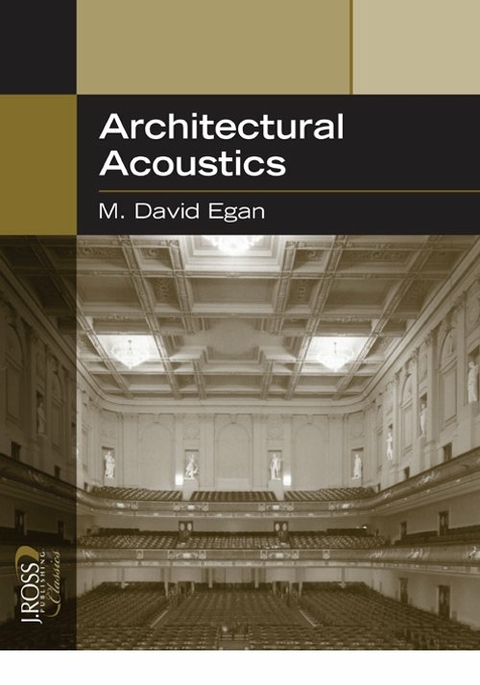
Architectural Acoustics (eBook)
448 Seiten
J. Ross Publishing (Verlag)
978-1-60427-640-4 (ISBN)
- Offers more than 540 illustrations to visually explain basic acoustic engineering principles with complete clarity, and tables of engineering data that further enhance understanding and the usefulness of the text
- Contains many valuable checklists of design aids, data tables of sound absorption, and sound isolation properties for a wide variety of building materials
- Presents case study examples of common problems, and step-by-step practical solutions
- Provides handy access to useful formulas, a metric system conversion table, a summary of common building acoustic terms, and extensive references
The goal of this widely used book is to present in a highly illustrated format the principles of design for good hearing and freedom from noise in and around buildings. The more than 540 illustrations are not merely supplements to the text as with nearly all traditional books. In this book, the illustrations are the core of the coverage of basic principles of sound and hearing, sound absorption and noise reduction, sound isolation and criteria for noise, control of HVAC systems noise and vibrations, auditorium acoustics design, and electronic sound systems. The book is written for architects, interior designers, engineers, and all others concerned with the design and construction of buildings who need to know the basics of architectural acoustics, but who do not have the time to digest wordy presentations. Designers who understand the basic principles of acoustics will possess an important new tool for shaping the built environment. Hopefully, not only better acoustical environments, but also better buildings should result.
J. Ross Publishing Classics are world-renowned texts and monographs written by preeminent scholars. These books have been widely read, discussed, and cited in the literature since their inaugural publications but unavailable for some time to students, researchers, professionals, and libraries. J. Ross Publishing is proudly making these valuable references and texts available once again.
M. David Egan, Hon. AIA, is a consultant in acoustics and Professor Emeritus at the College of Architecture, Clemson University. He has been principal consultant of Egan Acoustics in Anderson, South Carolina for more than 35 years. A graduate of Lafayette College (B.S.) and MIT (M.S.), Professor Egan also has taught at Tulane University, Georgia Institute of Technology, University of North Carolina at Charlotte, and Washington University. He is the author of Concepts in Architectural Acoustics, Concepts in Thermal Comfort, Concepts in Building Firesafety, and Concepts in Architectural Lighting (two editions). In addition to consulting, teaching, and writing, Professor Egan is a fellow of the Acoustical Society of America, member of the National Council of Acoustical Consultants, and an Association of Collegiate Schools of Architecture (ACSA) Distinguished Professor.
Foreword
Preface
Acknowledgements
Introduction
Chapter 1 — Basic Theory
Chapter 2 — Sound Absorption
Chapter 3 — Room Acoustics
Chapter 4 — Sound Isolation
Chapter 5 — Mechanical System Noise and Vibrations
Chapter 6 — Speech Privacy
Chapter 7 — Electronic Sound Systems
Selected References on Architectural Acoustics and Noise Control
Appendixes
| Erscheint lt. Verlag | 1.2.2007 |
|---|---|
| Sprache | englisch |
| Themenwelt | Naturwissenschaften ► Physik / Astronomie ► Mechanik |
| ISBN-10 | 1-60427-640-1 / 1604276401 |
| ISBN-13 | 978-1-60427-640-4 / 9781604276404 |
| Informationen gemäß Produktsicherheitsverordnung (GPSR) | |
| Haben Sie eine Frage zum Produkt? |
 PDF (Adobe DRM)
Kopierschutz: Adobe-DRM
Adobe-DRM ist ein Kopierschutz, der das eBook vor Mißbrauch schützen soll. Dabei wird das eBook bereits beim Download auf Ihre persönliche Adobe-ID autorisiert. Lesen können Sie das eBook dann nur auf den Geräten, welche ebenfalls auf Ihre Adobe-ID registriert sind.
Details zum Adobe-DRM
Dateiformat: PDF (Portable Document Format)
Mit einem festen Seitenlayout eignet sich die PDF besonders für Fachbücher mit Spalten, Tabellen und Abbildungen. Eine PDF kann auf fast allen Geräten angezeigt werden, ist aber für kleine Displays (Smartphone, eReader) nur eingeschränkt geeignet.
Systemvoraussetzungen:
PC/Mac: Mit einem PC oder Mac können Sie dieses eBook lesen. Sie benötigen eine
eReader: Dieses eBook kann mit (fast) allen eBook-Readern gelesen werden. Mit dem amazon-Kindle ist es aber nicht kompatibel.
Smartphone/Tablet: Egal ob Apple oder Android, dieses eBook können Sie lesen. Sie benötigen eine
Geräteliste und zusätzliche Hinweise
Buying eBooks from abroad
For tax law reasons we can sell eBooks just within Germany and Switzerland. Regrettably we cannot fulfill eBook-orders from other countries.
aus dem Bereich