


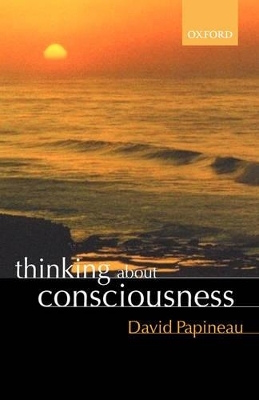
Thinking about Consciousness
Seiten
2004
Oxford University Press (Verlag)
978-0-19-927115-3 (ISBN)
Oxford University Press (Verlag)
978-0-19-927115-3 (ISBN)
Consciousness is regarded as an intractable mystery, because we humans think about it in a special way. This book analyses this special mode of thought, and exposes the ways in which it can lead us into confusions about consciousness. By analysing the structure of phenomenal concepts, it exposes the flaws in the standard arguments for dualism.
Consciousness is widely regarded as an intractable mystery. Many scientists and philosophers view it as an enigma whose solution waits on some unforeseeable theoretical breakthrough. David Papineau argues that this pessimism is quite misplaced. Consciousness seems mysterious, not because of any hidden essence, but only because we humans think about it in a special way. Thinking about Consciousness analyses this special mode of thought in detail, and exposes the ways in which it can lead us into confusions about consciousness.
At the heart of the book lies a distinction between two ways of thinking about conscious states. We humans can think about conscious states materially, as normal items inhabiting the material world. But we can also think about them phenomenally, as items that feel a certain way. Dualists hold that this phenomenal mode of thought describes some special non-material reality. But David Papineau argues that it is invalid to move from a distinctive phenomenal mode of thought to a distinct non-material reality. By carefully analysing the structure of phenomenal concepts, he is able to expose the flaws in the standard arguments for dualism, while at the same time explaining why dualism can seem so intuitively compelling.
Thinking about Consciousness also casts a new light on contemporary scientific research into consciousness. Much of this research is motivated by the apparently 'hard problem' of identifying the referents of phenomenal concepts. David Papineau argues that such research promises less than it can deliver. Once phenomenal concepts are recognised for what they are, many of the questions posed by consciousness research turn out to be irredeemably vague.
This is the first book to provide a detailed analysis of phenomenal concepts from a materialist point of view. By recognising the importance of phenomenal thinking, David Papineau is able to place a materialist account of consciousness on a firm foundation, and to lay many traditional problems of consciousness to rest.
Consciousness is widely regarded as an intractable mystery. Many scientists and philosophers view it as an enigma whose solution waits on some unforeseeable theoretical breakthrough. David Papineau argues that this pessimism is quite misplaced. Consciousness seems mysterious, not because of any hidden essence, but only because we humans think about it in a special way. Thinking about Consciousness analyses this special mode of thought in detail, and exposes the ways in which it can lead us into confusions about consciousness.
At the heart of the book lies a distinction between two ways of thinking about conscious states. We humans can think about conscious states materially, as normal items inhabiting the material world. But we can also think about them phenomenally, as items that feel a certain way. Dualists hold that this phenomenal mode of thought describes some special non-material reality. But David Papineau argues that it is invalid to move from a distinctive phenomenal mode of thought to a distinct non-material reality. By carefully analysing the structure of phenomenal concepts, he is able to expose the flaws in the standard arguments for dualism, while at the same time explaining why dualism can seem so intuitively compelling.
Thinking about Consciousness also casts a new light on contemporary scientific research into consciousness. Much of this research is motivated by the apparently 'hard problem' of identifying the referents of phenomenal concepts. David Papineau argues that such research promises less than it can deliver. Once phenomenal concepts are recognised for what they are, many of the questions posed by consciousness research turn out to be irredeemably vague.
This is the first book to provide a detailed analysis of phenomenal concepts from a materialist point of view. By recognising the importance of phenomenal thinking, David Papineau is able to place a materialist account of consciousness on a firm foundation, and to lay many traditional problems of consciousness to rest.
David Papineau is Professor of Philosophy at King's College London. His books include Theory and Meaning (Clarendon 1979), Reality and Representation (Blackwell 1987), Philosophical Naturalism (Blackwell 1993), The Philosophy of Science (Oxford Readings in Philosophy 1996), and a collection of essays, The Roots of Reason (Clarendon 2003).
Preface ; Introduction ; 1. The Case for Materialism ; 2. Conceptual Dualism ; 3. The Impossibility of Zombies ; 4. Phenomenal Concepts ; 5. The Explanatory Gap ; 6. The Intuition of Distinctness ; 7. Prospects for the Scientific Study of Phenomenal Consciousness ; Appendix: The History of the Completeness of Physics
| Erscheint lt. Verlag | 8.4.2004 |
|---|---|
| Verlagsort | Oxford |
| Sprache | englisch |
| Maße | 139 x 216 mm |
| Gewicht | 407 g |
| Themenwelt | Geisteswissenschaften ► Philosophie |
| Geisteswissenschaften ► Psychologie ► Allgemeine Psychologie | |
| Geisteswissenschaften ► Psychologie ► Verhaltenstherapie | |
| Naturwissenschaften ► Physik / Astronomie | |
| ISBN-10 | 0-19-927115-1 / 0199271151 |
| ISBN-13 | 978-0-19-927115-3 / 9780199271153 |
| Zustand | Neuware |
| Informationen gemäß Produktsicherheitsverordnung (GPSR) | |
| Haben Sie eine Frage zum Produkt? |
Mehr entdecken
aus dem Bereich



aus dem Bereich
Paket bestehend aus »Das Patienten-Manual« und »Das Trainer-Manual«
Buch | Softcover (2025)
Schattauer (Verlag)
CHF 125,95


