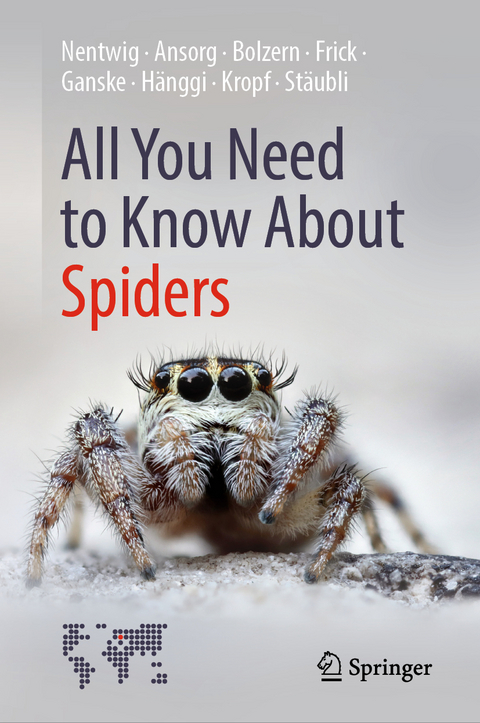
All You Need to Know About Spiders
Springer International Publishing (Verlag)
978-3-030-90880-5 (ISBN)
Spiders are super predators and devour everything they can overpower. To do this, they have developed incredibly good catching techniques and, with spider silk, a tool that makes material technology green with envy. The males are usually smaller than the females and, in order to have sex, they have to come up with a lot to avoid being misunderstood as easy prey: Dancing, drumming, and gifts almost always help. Spiders use their venom in very precise doses, and since humans are not on their menu, they are harmless to us. Many people's (unnecessary) fear of spiders finds cultural roots as early as the Middle Ages. Nevertheless, spider fear is easily treatable. There is no habitat or building without spiders. And that's a good thing, because spiders have fascinating properties and their world is full of surprises. Everything you need to know about them is explained in this book in understandable language by experts for laymen. In addition, some of the most common spider species in the house and garden are briefly presented with tips for observation.
The authorsThis book is authored by eight scientists, all of them members of the Association for the Promotion of Spider Research: Wolfgang Nentwig, Jutta Ansorg, Angelo Bolzern, Holger Frick, Anne-Sarah Ganske, Ambros Hänggi, Christin Kropf und Anna Stäubli
lt;b>Wolfgang Nentwig: he studied biology at the University of Marburg, Germany, 1981 PhD, 1983-1984 guest researcher at the Smithsonian Tropical Research Institute, Panama, 1985-1988 assistant professor at the University of Regensburg, Germany, 1988-2019 full professor for ecology, University of Bern, Switzerland. Co-organizer of the European Spiders identification website and of the World Spider Catalog
Jutta Ansorg: she studied power engineering and process technology with a PhD 2001 at the Technical University of Berlin, Germany, 1993-98 assistant lecturer in mathematics, 1998-2014 engineer in several international companies constructing power plants in Switzerland, since 2014 specialist for clean air at the canton of Aargau, Switzerland.
Angelo Bolzern: he studied biology with a PhD 2010 at the University of Basel, Switzerland, 2012-2013 a research stay at the American Museum of Natural History, New York (USA), spider taxonomy and systematics, 2014-2018 researcher, nature protection, high school teacher, since 2019 educational employee, Natural History Museum Basel, Switzerland.
Holger Frick: he studied biology with a PhD 2010 at the University of Bern, Switzerland, 2010-2011 postdoc at the Natural History Museum of Denmark, Kopenhagen, 2011-2014 Natural History Collection Liechtenstein, 2014-2019 Director Nature Museum Naturama Aargau, Switzerland, 2019-2020 Swiss Academy of Natural Sciences, since 2021 curator at the Natural History Museum Basel, Switzerland
Anne-Sarah Ganske: she studied biology at the University of Greifswald, Germany, PhD as a Marie-Sklodowska-Curie-Fellow at the Natural History Museum Wien, Austria, PhD 2019 at the University of Wien.
Ambros Hänggi: he studied biology at the University of Bern, Switzerland, PhD in 1987, 1988-1989 postdoc, 1990-2020 curator at the Natural History Museum Basel, Switzerland. Co-organizer of the European Spiders identification website
Christian Kropf: he studied biology at the University of Graz, Austria, 1992 PhD, 1992-1995 assistant, since 1995 curator at the Natural History Museum Bern, Switzerland, since 1996 also teaching at the University of Bern, 2011 habilitation. Co-organizer of the European Spiders identification website and of the World Spider Catalog
Anna Stäubli: she studied natural sciences at the ETH Zürich, Switzerland 1998, 1998-2013 employed in an SME for nature protection in agriculture, since 2013 owner of an SME for nature protection in agriculture.
Preface
Part I: Morphology and function of spiders- What do spiders look like?.- How do spiders hear, smell, taste, and sense?.- How do spiders see?- How do spiders move? -How can spiders grow despite their outer skeleton?.- Spider venom.- Spider silk.- Prey catch and spider webs.- How do spiders feed and digest?- Sex of spiders Part II: We live in a world full of spiders- Some like it cold.- how spiders survive adverse seasons.- How do spiders defend themselves against enemies? -The importance of spiders in our environment.- Species richness of spiders.- Worldwide import and spread of spiders.- Spiders in and at our house- Fascinating spiders- Part III: our emotional side towards spiders- Fear of spiders.- Communication about spiders.- spiders and humans: a tense relationship? -Spiders as pets?- Appendix- Common spider families- How to determine spiders?-Authors- Association for the Promotion of Spider Research- References- Index.
"All You Need to Know About Spiders is an excellent introduction to spider biology for general readers. It is an easy and informative read and will provide all of the essential information anyone curious about this aspect of the natural world will need to know in order to appreciate how incredible spiders are and how essential they are in controlling insect populations in all terrestrial habitats of this planet." (Paula E. Cushing, The Quarterly Review of Biology, Vol. 99 (3), September, 2024)
"The book is well-illustrated. ... this popular book has made a very good impression on me. No doubt it will be a very useful and reliable source of general information about spiders for 6th-formers, students and aspiring naturalists. Yet, not belonging to any of these categories, as a professional arachnologist, I found the reading of this book refreshing and very rewarding. Finally, it is a good value for money. I highly recommend it to both amateur and professional arachnologists alike." (Dmitri V. Logunov, Newsletter of the British Arachnological Society, Issue 154, 2022)
“The book is well-illustrated. … this popular book has made a very good impression on me. No doubt it will be a very useful and reliable source of general information about spiders for 6th-formers, students and aspiring naturalists. Yet, not belonging to any of these categories, as a professional arachnologist, I found the reading of this book refreshing and very rewarding. Finally, it is a good value for money. I highly recommend it to both amateur and professional arachnologists alike.” (Dmitri V. Logunov, Newsletter of the British Arachnological Society, Issue 154, 2022)
| Erscheinungsdatum | 05.04.2022 |
|---|---|
| Zusatzinfo | XIV, 245 p. 163 illus., 151 illus. in color. |
| Verlagsort | Cham |
| Sprache | englisch |
| Maße | 155 x 235 mm |
| Gewicht | 546 g |
| Themenwelt | Naturwissenschaften ► Biologie ► Zoologie |
| Schlagworte | Arachnida • Arachnology • arachnophobia • Araneae • Behaviour • spider biology • Spider diversity • Spider morphology • Spider phobia • Spider physiology • Spider venoms • Venom • Venomous spider |
| ISBN-10 | 3-030-90880-1 / 3030908801 |
| ISBN-13 | 978-3-030-90880-5 / 9783030908805 |
| Zustand | Neuware |
| Informationen gemäß Produktsicherheitsverordnung (GPSR) | |
| Haben Sie eine Frage zum Produkt? |
aus dem Bereich