


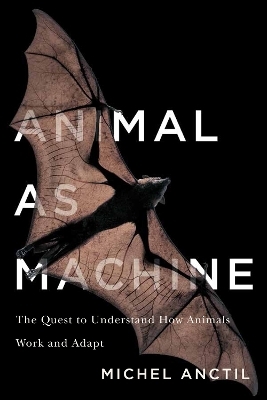
Animal as Machine
The Quest to Understand How Animals Work and Adapt
2022
McGill-Queen's University Press (Verlag)
978-0-2280-1053-1 (ISBN)
McGill-Queen's University Press (Verlag)
978-0-2280-1053-1 (ISBN)
Animal as Machine explores the life, work, and ideas of scientists who subscribed to mechanistic concepts to explain how animals process food, breathe, circulate their blood, and sense their environment. A remarkable story of the larger-than-life personalities and historical episodes that marked the emergence of animal physiology.
Through the ages natural historians have puzzled over how animals work, wavering between a vitalist belief in a soul animating bodily functions and a mechanistic outlook in which animal body parts are seen as pieces of organic machinery.
Animal as Machine explores the life, work, and ideas of scientists who, branding themselves as physiologists, subscribed to mechanistic concepts to explain how animals acquire and process food, breathe, circulate their blood, and sense their environment. As medical physiology thrived in the nineteenth century, zoologists struggled to forge their own distinctive physiology predicated on understanding animal functions in a context of environmental adaptation and evolutionary forces. Physiological schools with distinct emphases that shaped their outlook sprang up around the world. Dividing their time between fieldwork in marine stations and laboratory experimentation, animal physiologists stood in awe of the diversity and ingenuity of the functional strategies by which animals survived.
Animal as Machine tells a remarkable and insightful story of the larger-than-life personalities and gripping historical episodes that marked the emergence and blossoming of animal physiology.
Through the ages natural historians have puzzled over how animals work, wavering between a vitalist belief in a soul animating bodily functions and a mechanistic outlook in which animal body parts are seen as pieces of organic machinery.
Animal as Machine explores the life, work, and ideas of scientists who, branding themselves as physiologists, subscribed to mechanistic concepts to explain how animals acquire and process food, breathe, circulate their blood, and sense their environment. As medical physiology thrived in the nineteenth century, zoologists struggled to forge their own distinctive physiology predicated on understanding animal functions in a context of environmental adaptation and evolutionary forces. Physiological schools with distinct emphases that shaped their outlook sprang up around the world. Dividing their time between fieldwork in marine stations and laboratory experimentation, animal physiologists stood in awe of the diversity and ingenuity of the functional strategies by which animals survived.
Animal as Machine tells a remarkable and insightful story of the larger-than-life personalities and gripping historical episodes that marked the emergence and blossoming of animal physiology.
Michel Anctil is honorary professor of biology at the Université de Montréal and author of Dawn of the Neuron: The Early Struggles to Trace the Origin of Nervous Systems and Luminous Creatures: The History and Science of Light Production in Living Organisms.
| Erscheinungsdatum | 17.03.2022 |
|---|---|
| Zusatzinfo | 30 photos |
| Verlagsort | Montreal |
| Sprache | englisch |
| Maße | 152 x 229 mm |
| Themenwelt | Naturwissenschaften ► Biologie ► Zoologie |
| ISBN-10 | 0-2280-1053-5 / 0228010535 |
| ISBN-13 | 978-0-2280-1053-1 / 9780228010531 |
| Zustand | Neuware |
| Informationen gemäß Produktsicherheitsverordnung (GPSR) | |
| Haben Sie eine Frage zum Produkt? |
Mehr entdecken
aus dem Bereich

aus dem Bereich


