


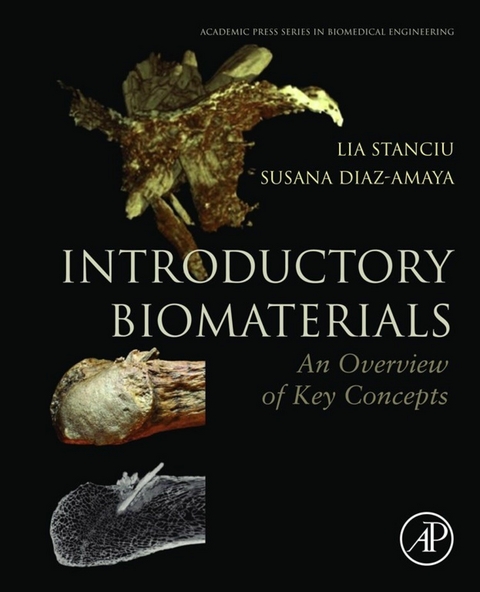
Introductory Biomaterials (eBook)
368 Seiten
Elsevier Science (Verlag)
978-0-12-809524-9 (ISBN)
Lia Stanciu Ph.D., is a Professor of Materials and Biomedical Engineering at Purdue University. She received her Ph.D. in Materials Science in 2003 from University of California Davis. She is the instructor of an introductory Biomaterials class at Purdue, which she has been teaching since 2007. She has authored over 130 peer reviewed journal articles and her current research focuses on Biosensors and Biolelectronic Devices.
Introductory Biomaterials enables undergraduate students in Biomedical, Chemical, Materials and other relevant Engineering disciplines to become familiar with the key concepts of Biomaterials principles: biocompatibility, structure-property-applications relationships, mechanical response of natural tissues, and cellular pathways for tissue-material ingrowth. Written in a clear, concise manner that weds theory with applications, this book helps students to understand the often intricate relationships between materials the implant devices that are made from them, and how the human body reacts to them. The book includes such concepts as requirements for metals, alloys, and ceramic materials to be used in load bearing implants (corrosion concepts, stress shielding, mechanical properties, composition), what properties of polymers impact their use in medicine (leaching and swelling, creep and stress relaxation); the tissue response to biomaterials, concepts related to drug delivery applications (polymer degradation, encapsulation), and tissue engineering (scaffold porosity, diffusion of nutrients, mechanical properties). - Begins with structure-properties, followed immediately by their impact on actual biomaterials classes and devices, thus directly relating theory to applications (e.g. polymers to polymeric stents; metals to fracture fixation devices)- Explains concepts in a clear, progressive manner, with numerous examples and figures to enhance student learning- Covers all key biomaterials classes: metallic, ceramic, polymeric, composite and biological- Includes a timely chapter on medical device regulation
| Erscheint lt. Verlag | 23.9.2021 |
|---|---|
| Sprache | englisch |
| Themenwelt | Medizin / Pharmazie ► Allgemeines / Lexika |
| Medizin / Pharmazie ► Pflege | |
| Medizin / Pharmazie ► Physiotherapie / Ergotherapie ► Orthopädie | |
| Naturwissenschaften ► Biologie | |
| Technik ► Maschinenbau | |
| Technik ► Medizintechnik | |
| ISBN-10 | 0-12-809524-5 / 0128095245 |
| ISBN-13 | 978-0-12-809524-9 / 9780128095249 |
| Informationen gemäß Produktsicherheitsverordnung (GPSR) | |
| Haben Sie eine Frage zum Produkt? |
 EPUB (Adobe DRM)
Kopierschutz: Adobe-DRM
Adobe-DRM ist ein Kopierschutz, der das eBook vor Mißbrauch schützen soll. Dabei wird das eBook bereits beim Download auf Ihre persönliche Adobe-ID autorisiert. Lesen können Sie das eBook dann nur auf den Geräten, welche ebenfalls auf Ihre Adobe-ID registriert sind.
Details zum Adobe-DRM
Dateiformat: EPUB (Electronic Publication)
EPUB ist ein offener Standard für eBooks und eignet sich besonders zur Darstellung von Belletristik und Sachbüchern. Der Fließtext wird dynamisch an die Display- und Schriftgröße angepasst. Auch für mobile Lesegeräte ist EPUB daher gut geeignet.
Systemvoraussetzungen:
PC/Mac: Mit einem PC oder Mac können Sie dieses eBook lesen. Sie benötigen eine
eReader: Dieses eBook kann mit (fast) allen eBook-Readern gelesen werden. Mit dem amazon-Kindle ist es aber nicht kompatibel.
Smartphone/Tablet: Egal ob Apple oder Android, dieses eBook können Sie lesen. Sie benötigen eine
Geräteliste und zusätzliche Hinweise
Buying eBooks from abroad
For tax law reasons we can sell eBooks just within Germany and Switzerland. Regrettably we cannot fulfill eBook-orders from other countries.


