


Electrospun Perovskite Photoabsorber, Electron- and Hole Transport Materials for Flexible Photovoltaics
Seiten
2021
Dr. Hut (Verlag)
9783843948715 (ISBN)
Dr. Hut (Verlag)
9783843948715 (ISBN)
- Keine Verlagsinformationen verfügbar
- Artikel merken
In recent years, scientists have been exploring and exploiting thin film characteristics of perovskite solar cells for flexible devices. While most of the research still focuses on thin film deposition methods, fibrous geometries are largely neglected.
Electrospinning, as a versatile and up scalable method, enables the formation of highly flexible fiber structures, suitable for optoelectronic applications. An intense screening through common perovskite solar cell components, including hole- (CuI, CuSCN, NiO, PEDOT:PSS) and electron transport materials (TiO2, SnO2, ZnO), as well as photo-absorbing perovskites (MAPbI3, FAPbI3, CsPbI3, (MA)3Bi2I9), has led to a variety of novel composite fibers presented in this thesis.
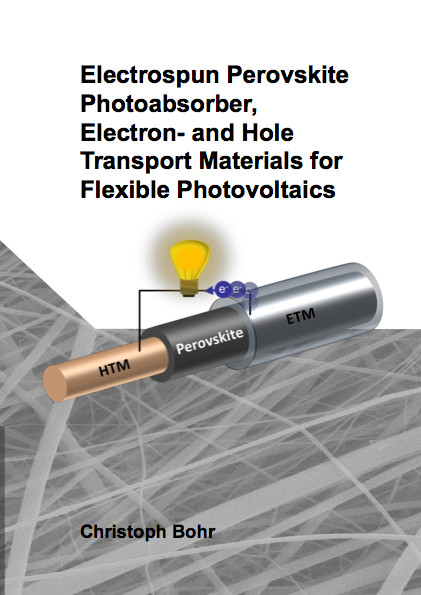
The targeted structure for a here proposed perovskite solar cell fiber consists of a hole conducting core, a photoabsorbent perovskite interlayer, and an electron conducting shell. Achieved through a core-shell electrospinning technique utilizing multi channeled spinnerets, first realizations of material compositions (PEDOT:PSS/MAPbI3 and CuSCN/MAPbI3) in coaxial geometry were possible and studied in detail.
Since electrospun triaxial fibers are still scarcely reported in literature, the here presented triaxial CuSCN/MaPbI3/Zn(OAc)2 composite fibers pave the way for a realization of electrospun perovskite solar cells.
Electrospinning, as a versatile and up scalable method, enables the formation of highly flexible fiber structures, suitable for optoelectronic applications. An intense screening through common perovskite solar cell components, including hole- (CuI, CuSCN, NiO, PEDOT:PSS) and electron transport materials (TiO2, SnO2, ZnO), as well as photo-absorbing perovskites (MAPbI3, FAPbI3, CsPbI3, (MA)3Bi2I9), has led to a variety of novel composite fibers presented in this thesis.
The targeted structure for a here proposed perovskite solar cell fiber consists of a hole conducting core, a photoabsorbent perovskite interlayer, and an electron conducting shell. Achieved through a core-shell electrospinning technique utilizing multi channeled spinnerets, first realizations of material compositions (PEDOT:PSS/MAPbI3 and CuSCN/MAPbI3) in coaxial geometry were possible and studied in detail.
Since electrospun triaxial fibers are still scarcely reported in literature, the here presented triaxial CuSCN/MaPbI3/Zn(OAc)2 composite fibers pave the way for a realization of electrospun perovskite solar cells.
| Erscheinungsdatum | 28.09.2021 |
|---|---|
| Reihe/Serie | Anorganische Chemie |
| Verlagsort | München |
| Sprache | englisch |
| Maße | 148 x 210 mm |
| Gewicht | 280 g |
| Themenwelt | Naturwissenschaften ► Chemie ► Anorganische Chemie |
| Schlagworte | electrospinning • nanofibers • Perovskite solar cells |
| ISBN-13 | 9783843948715 / 9783843948715 |
| Zustand | Neuware |
| Informationen gemäß Produktsicherheitsverordnung (GPSR) | |
| Haben Sie eine Frage zum Produkt? |
Mehr entdecken
aus dem Bereich



aus dem Bereich


