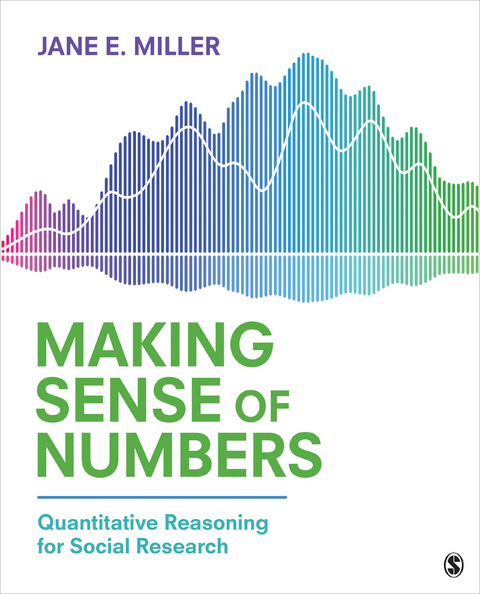
Making Sense of Numbers (eBook)
Sage Publications, Inc (Verlag)
9781544355627 (ISBN)
List of Figures
List of Tables
Preface
Acknowledgments
About the Author
PART I: INTRODUCTION
Chapter 1: Introduction to Making Sense of Numbers
The Many Uses of Numbers
Common Tasks Involving Numbers
Plausibility of Numeric Values
Challenges in Making Sense of Numbers
How We Learn to Make Sense of Numbers
Chapter 2: Foundational Concepts for Quantitative Research
Terminology for Quantitative Research
The Research Circle
Goals Of Quantitative Research
The W’s
Report and Interpret Numbers
Specify Direction and Magnitude
PART II: HOW TOPIC, MEASUREMENT, AND CONTEXT HELP MAKE SENSE OF NUMBERS
Chapter 3: Topic and Conceptualization
Conceptualization
Scope of a Definition
How Topic and Scope Affect Plausibility
How Topic and Perspective Affect Optimal Values
Chapter 4: Measurement
Measurement
Factors Affecting Operationalization
Levels of Measurement
Units
Data Collection and Level of Measurement
How Measurement Affects Plausibility
Reliability and Validity of Numeric Measures
Chapter 5: Context
What Is Context?
How Context Affects Plausibility
How Context Affects Measurement
Population Versus Study Sample
Representativeness
Generalization
Level of Analysis and Fallacy of Level
PART III: EXHIBITS FOR COMMUNICATING NUMERIC INFORMATION
Chapter 6: Working With Tables
Criteria for Effective Tables
Anatomy of a Table
Organizing Data in Tables and Charts
Reading Data From Tables
Considerations for Creating Tables
Chapter 7: Working With Charts and Visualizations
Criteria for Effective Charts and Visualizations
Visual Perception Principles
Anatomy of a Chart or Visualization
Charts and Visualizations for Specific Tasks
Design Issues
Common Errors in Chart Creation
PART IV: MAKING SENSE OF NUMBERS FROM MATHEMATICAL AND STATISTICAL METHODS
Chapter 8: Comparison Values, Contrast Sizes, and Standards
Reference Groups and Comparison Values
Standards, Thresholds, and Target Values
Contrast Sizes for Quantitative Variables
Considerations for Comparability
Chapter 9: Numbers, Comparisons, and Calculations
Numeric Measures of Level
Plausibility Criteria for Measures of Level
Measures of Position in a Ranked List
Plausibility Criteria for Measures of Position
Mathematical Calculations
Plausibility Criteria for Results of Calculations
How Level of Measurement Affects Valid Types of Comparison
Choosing Types of Comparisons
Chapter 10: Distributions and Associations
Distributions of Single Variables
Plausibility Criteria for Univariate Statistics
Tables and Charts for Presenting Distributions
Associations Between Two or More Variables
Three-Way Associations
Plausibility Criteria for Bivariate and Three-Way Statistics
Comparisons by Level of Measurement, Revisited
PART V: ASSESSING THE QUALITY OF NUMERIC ESTIMATES
Chapter 11: Bias
What Is Bias?
Time Structure of Study Designs
Sampling Methods
Study Nonresponse
Item Nonresponse
Measurement Bias
Data Sources
Chapter 12: Causality
Causality Defined
Criteria for Assessing Causality
Experimental Studies
Observational Studies
Research Strategies for Assessing Confounding
Random Sampling vs. Random Assignment
Implications of Causality for Quantitative Research
Chapter 13: Uncertainty of Numeric Estimates
What Is Statistical Uncertainty?
Inferential Statistics
Measures of Uncertainty
Uncertainty vs. Bias
Basics of Hypothesis Testing
Drawbacks of Traditional Hypothesis Testing
Interpreting Inferential Statistics for Bivariate and Three-Way Procedures
PART VI: PULLING IT ALL TOGETHER
Chapter 14: Communicating Quantitative Research
Tools for Presenting Quantitative Research
Expository Writing Techniques
Writing About Numbers in Particular
Conveying the Type of Measure or Calculation
Writing About Distributions
Writing About Associations
Writing About Complex Patterns
Content and Structure of Research Formats
Chapter 15: The Role of Research Methods in Making Sense of Numbers
The W’s Revisited
Practical Importance
Importance of a Numeric Finding: The Big Picture
How Study Design, Measurement, and Sample Size Affect “Importance”
Making Sense of Numbers in Quantitative Research Tasks
APPENDIXES
Appendix A: Why and How to Create New Variables
Why New Variables Might Be Needed
Transformations of Numbers
Indexes and Scales
New Continuous Variables
New Categorical Variables
Appendix B: Sampling Weights
The Purpose of Sampling Weights
Sampling Weights for Disproportionate Sampling
Communicating Use of Sampling Weights
Appendix C: Brief Technical Background on Inferential Statistics
Standard Error and Sample Size
Margin of Error
Confidence Interval
Criteria for Making Sense of Measures of Uncertainty
Hypothesis Testing
Errors in Hypothesis Testing
Plausibility Criteria for Inferential Test Statistics
References
Index
| Erscheint lt. Verlag | 7.9.2021 |
|---|---|
| Verlagsort | Thousand Oaks |
| Sprache | englisch |
| Themenwelt | Naturwissenschaften |
| Sozialwissenschaften ► Politik / Verwaltung ► Politische Theorie | |
| Sozialwissenschaften ► Soziologie ► Empirische Sozialforschung | |
| Schlagworte | Communication of quantitative information • Making sense of numbers • quantitative reasoning • Statistical literacy |
| ISBN-13 | 9781544355627 / 9781544355627 |
| Informationen gemäß Produktsicherheitsverordnung (GPSR) | |
| Haben Sie eine Frage zum Produkt? |
 PDF (Adobe DRM)
Kopierschutz: Adobe-DRM
Adobe-DRM ist ein Kopierschutz, der das eBook vor Mißbrauch schützen soll. Dabei wird das eBook bereits beim Download auf Ihre persönliche Adobe-ID autorisiert. Lesen können Sie das eBook dann nur auf den Geräten, welche ebenfalls auf Ihre Adobe-ID registriert sind.
Details zum Adobe-DRM
Dateiformat: PDF (Portable Document Format)
Mit einem festen Seitenlayout eignet sich die PDF besonders für Fachbücher mit Spalten, Tabellen und Abbildungen. Eine PDF kann auf fast allen Geräten angezeigt werden, ist aber für kleine Displays (Smartphone, eReader) nur eingeschränkt geeignet.
Systemvoraussetzungen:
PC/Mac: Mit einem PC oder Mac können Sie dieses eBook lesen. Sie benötigen eine
eReader: Dieses eBook kann mit (fast) allen eBook-Readern gelesen werden. Mit dem amazon-Kindle ist es aber nicht kompatibel.
Smartphone/Tablet: Egal ob Apple oder Android, dieses eBook können Sie lesen. Sie benötigen eine
Geräteliste und zusätzliche Hinweise
Buying eBooks from abroad
For tax law reasons we can sell eBooks just within Germany and Switzerland. Regrettably we cannot fulfill eBook-orders from other countries.
aus dem Bereich