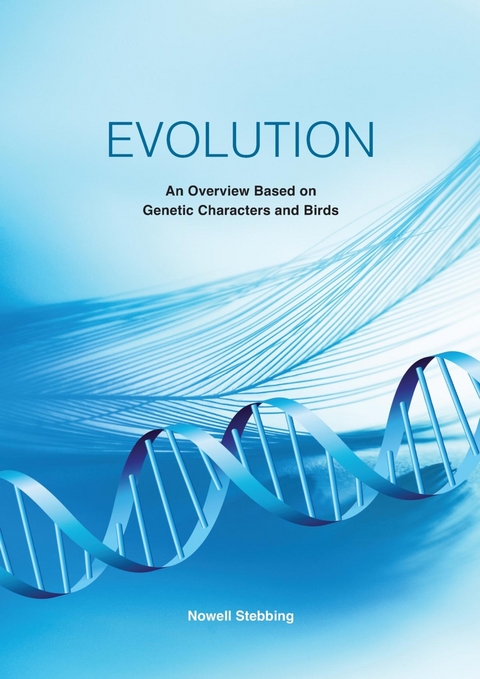
Life is a peculiar feature in the Universe. At present, we know of no place, other than our planet, where it has arisen. However life arose, the Earth has been populated by quite different species at different times. They arise with changes in climate, due ultimately to volcanic activity. Life-forms interact with the environment and with each other. For any species, these are all external factors that affect their adaptation and changes, which are recognised as evolution.
The Earth's covering of living organisms arose over 500 million years ago, with multicellular forms which all have bi-parental breeding (the eukaryotes). The cells of eukaryotes contain a great deal of DNA but surprisingly few genes, considering the vast array of different characters. Their genes specify proteins, several of which are required in the assembly of any character, such as feathers or toes. Characters arise during development of the embryo. Because they have two parents, eukaryotes have two genes for every protein. These are features mediated by internal processes, arising from the genetic constitution of eukaryotes. They determine ways in which species can respond to external changes.
Some problems in the theory of evolution, as set out by Darwin, were apparent from the beginning. Advances in molecular biology have provided ideas about the origin of totally new characters and processes for their rapid introduction, additional to the slow mechanism of natural selection.
The theoretical basis of evolution has been controversial in terms of other world-views and religions and even much of the science has been hotly debated. From a general perspective the difficulties are compounded by several misconceptions regarding genetics but also the role of 'theories' in advancing knowledge.
This book outlines recent work in molecular biology that clarifies some of the problems in the theory of evolution. Birds have been chosen to illustrate the interplay of 'internal' and 'external' factors in evolution because they have adapted to the whole range of environments to be found on Earth. There are numerous species so their taxonomy needs to be considered. Species can be arranged in sequences, based on their features, determined from fossils and genetic characters, in living species. The results are 'phylogenies' or 'cladograms', which are proposals for evolutionary sequences of species.
| Erscheint lt. Verlag | 17.9.2021 |
|---|---|
| Sprache | englisch |
| Themenwelt | Naturwissenschaften ► Biologie ► Evolution |
| Schlagworte | Birds • Cladistics • DNA • Evolution • Ornithology |
| ISBN-13 | 9781904525110 / 9781904525110 |
| Informationen gemäß Produktsicherheitsverordnung (GPSR) | |
| Haben Sie eine Frage zum Produkt? |
 EPUB (Adobe DRM)
Kopierschutz: Adobe-DRM
Adobe-DRM ist ein Kopierschutz, der das eBook vor Mißbrauch schützen soll. Dabei wird das eBook bereits beim Download auf Ihre persönliche Adobe-ID autorisiert. Lesen können Sie das eBook dann nur auf den Geräten, welche ebenfalls auf Ihre Adobe-ID registriert sind.
Details zum Adobe-DRM
Dateiformat: EPUB (Electronic Publication)
EPUB ist ein offener Standard für eBooks und eignet sich besonders zur Darstellung von Belletristik und Sachbüchern. Der Fließtext wird dynamisch an die Display- und Schriftgröße angepasst. Auch für mobile Lesegeräte ist EPUB daher gut geeignet.
Systemvoraussetzungen:
PC/Mac: Mit einem PC oder Mac können Sie dieses eBook lesen. Sie benötigen eine
eReader: Dieses eBook kann mit (fast) allen eBook-Readern gelesen werden. Mit dem amazon-Kindle ist es aber nicht kompatibel.
Smartphone/Tablet: Egal ob Apple oder Android, dieses eBook können Sie lesen. Sie benötigen eine
Geräteliste und zusätzliche Hinweise
Buying eBooks from abroad
For tax law reasons we can sell eBooks just within Germany and Switzerland. Regrettably we cannot fulfill eBook-orders from other countries.
aus dem Bereich