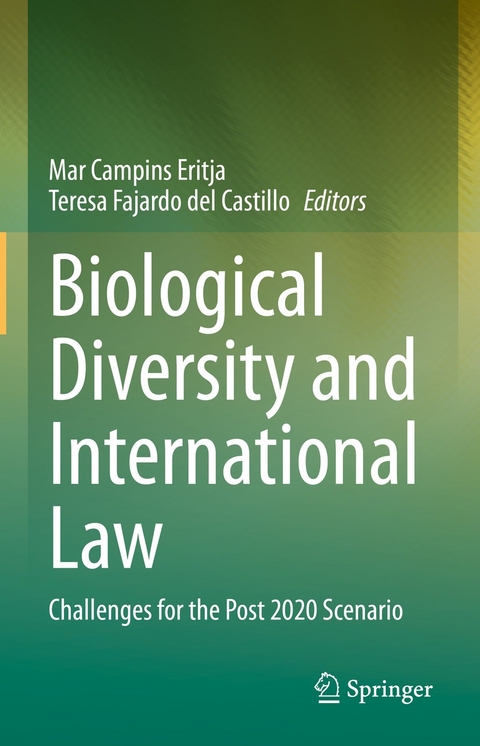
Biological Diversity and International Law (eBook)
XV, 224 Seiten
Springer International Publishing (Verlag)
978-3-030-72961-5 (ISBN)
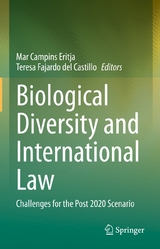
The book focuses on the interactions between international legal regimes related to biodiversity governance. It addresses the systemic challenges by analyzing the legal interactions between international biodiversity law and related international law applicable to economic activities, as well as issues related to the governance of biodiversity based on functional, normative, and geographic dimensions, in order to present a crosscutting, holistic approach. The global COVID-19 pandemic, the imminent revision of the Strategic Plan for Biodiversity 2011-2020, and the Aichi Targets have created the momentum to focus on the interactions between the Convention on Biological Diversity and other international environmental regimes.
Firstly, it discusses the principles that inspire biodiversity-related conventional law, the soft law that conveys targets for enforcement of the Biodiversity Convention, their structural, regulatory and implementation gaps, the systemic relations arising from national interests, and the role of scientific advisory bodies in biodiversity-related agreements. The second part then addresses interactions in specific conventional frameworks, such as the law of multilateral trade and global public health, and the participation of communities in the management of genetic resources. Lastly, the third part illustrates these issues using four case studies focusing on the challenges for sustainability and marine biodiversity in small islands, the Arctic Ocean, the Caribbean Sea, and the Mediterranean Sea, as a way to strengthen a horizontal and joint approach.The book is primarily intended for academics, researchers, and students interested in international environmental law and policy and in interactions for creating conditions for fair, sustainable, and resilient environmental development. By offering an analysis of instruments and criteria for systemic relations in those areas, it will also appeal to public and private actors at the domestic and international level.
Mar Campins Eritja is Professor of Public International Law and European Union Law at the University of Barcelona's Faculty of Law. She is the Holder and Director of the Jean Monnet Chair on Environmental EU Law at the University of Barcelona. Her main fields of teaching and research are: International Environmental Law and European Union Environmental Law, as well as institutional European Union Law.
Teresa Fajardo del Castillo is Associate Professor of Public International Law and European Law, at the University of Granada's Faculty of Law. She is an associated member of the Jean Monnet Chair on EU Environmental Law at the University of Barcelona. Her main research areas are international and European environmental law, EU migration policies and soft law.
| Erscheint lt. Verlag | 16.7.2021 |
|---|---|
| Zusatzinfo | XV, 224 p. 1 illus. |
| Sprache | englisch |
| Themenwelt | Naturwissenschaften ► Biologie |
| Recht / Steuern ► EU / Internationales Recht | |
| Recht / Steuern ► Privatrecht / Bürgerliches Recht | |
| Schlagworte | Arctic Ocean-related Environmental Agreements • Biodiversity Convention • Biodiversity Governance • Biodiversity-related Conventional Law • Caribbean Sea-related Environmental Agreements • Climate Change law • Environmental Law • food security • Global Pact for the Environment • global warming • International Legal Regimes • Law of the Sea • Marine Biodiversity-related Agreements • Maritime Law • Mediterranean Sea-related Environmental Agreements • Scientific Advisory Bodies • SDG • Sustainable Development Goals • UN Biodiversity Convention • WTO Law |
| ISBN-10 | 3-030-72961-3 / 3030729613 |
| ISBN-13 | 978-3-030-72961-5 / 9783030729615 |
| Informationen gemäß Produktsicherheitsverordnung (GPSR) | |
| Haben Sie eine Frage zum Produkt? |
 PDF (Wasserzeichen)
DRM: Digitales Wasserzeichen
Dieses eBook enthält ein digitales Wasserzeichen und ist damit für Sie personalisiert. Bei einer missbräuchlichen Weitergabe des eBooks an Dritte ist eine Rückverfolgung an die Quelle möglich.
Dateiformat: PDF (Portable Document Format)
Mit einem festen Seitenlayout eignet sich die PDF besonders für Fachbücher mit Spalten, Tabellen und Abbildungen. Eine PDF kann auf fast allen Geräten angezeigt werden, ist aber für kleine Displays (Smartphone, eReader) nur eingeschränkt geeignet.
Systemvoraussetzungen:
PC/Mac: Mit einem PC oder Mac können Sie dieses eBook lesen. Sie benötigen dafür einen PDF-Viewer - z.B. den Adobe Reader oder Adobe Digital Editions.
eReader: Dieses eBook kann mit (fast) allen eBook-Readern gelesen werden. Mit dem amazon-Kindle ist es aber nicht kompatibel.
Smartphone/Tablet: Egal ob Apple oder Android, dieses eBook können Sie lesen. Sie benötigen dafür einen PDF-Viewer - z.B. die kostenlose Adobe Digital Editions-App.
Buying eBooks from abroad
For tax law reasons we can sell eBooks just within Germany and Switzerland. Regrettably we cannot fulfill eBook-orders from other countries.
aus dem Bereich