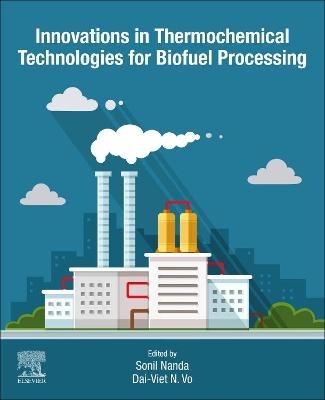
Innovations in Thermochemical Technologies for Biofuel Processing
Elsevier - Health Sciences Division (Verlag)
978-0-323-85586-0 (ISBN)
The book comprehensively discusses the strengths, weaknesses, opportunities and threats of notable biofuels (e.g., bio-oil, biocrude oil, biodiesel, bioethanol, biobutanol, bio-jet fuels, biohydrogen, biomethane, synthesis gas, hydrocarbon fuels, etc.).
Dr. Sonil Nanda is an Assistant Professor and Canada Research Chair in “Clean Agricultural Technology and Energy in the Department of Engineering, Faculty of Agriculture at Dalhousie University, Canada. He received his Ph.D. in Biology from York University, Canada; his M.Sc. in Applied Microbiology from Vellore Institute of Technology (VIT University), India; and his B.Sc. in Microbiology from the Odisha University of Agriculture and Technology, India. He was a Postdoctoral Fellow at York University and the University of Western Ontario and a Research Associate in the Department of Chemical and Biological Engineering at the University of Saskatchewan in Saskatoon, Canada. He was the Director of Research and Development at Titan Clean Energy Projects Corporation in Craik, Saskatchewan. Dr. Nanda’s research areas focus on producing advanced biofuels and biochemicals through thermochemical and biochemical conversion technologies, including gasification, pyrolysis, carbonization, torrefaction, and fermentation. He has gained expertise in the hydrothermal gasification of various organic wastes and biomass, including agricultural and forestry residues, industrial effluents, municipal solid waste, cattle manure, sewage sludge, food wastes, waste tires, and petroleum residues to produce hydrogen fuel. His parallel interests are generating hydrothermal flames for treating hazardous wastes, agronomic biochar applications, phytoremediation of heavy metal-contaminated soils, and carbon capture and sequestration. Dr. Nanda has published 19 edited books, 85 book chapters, and more than 165 peer-reviewed journal articles. He is the editor of some popular books entitled “Emerging Biofuels (Elsevier), “Biomass to Bioenergy: Modern Technological Strategies for Biorefineries (Elsevier), “Innovations in Thermochemical Technologies for Biofuel Processing (Elsevier), “New Dimensions in Production and Utilization of Hydrogen (Elsevier), “Biorefinery of Alternative Resources: Targeting Green Fuels and Platform Chemicals (Springer Nature), “Recent Advancements in Biofuels and Bioenergy Utilization (Springer Nature), “Catalytic and Noncatalytic Upgrading of Oils (American Chemical Society), “Fuel Processing and Energy Utilization (CRC Press), “Bioprocessing of Biofuels (CRC Press), “Progressive Thermochemical Biorefining Technologies (CRC Press), “Algal Biorefinery: Developments, Challenges and Opportunities (Routledge), “Biohydrogen: Developments and Prospects (Apple Academic Press), and “Biomethane: Developments and Prospects (Apple Academic Press). Dr. Nanda is a fellow member of the Society for Applied Biotechnology in India and a life member of the Indian Institute of Chemical Engineers, the Association of Microbiologists of India, the Indian Science Congress Association, and the Biotech Research Society of India. He is also a member of several chemical engineering societies across North America, such as the American Chemical Society, the American Institute of Chemical Engineers, the Chemical Institute of Canada, the Combustion Institute-Canadian Section, and Engineers Without Borders Canada. Dr. Nanda is an Assistant Subject Editor of the International Journal of Hydrogen Energy (Elsevier) as well as an Associate Editor of Environmental Chemistry Letters (Springer Nature) and Applied Nanoscience (Springer Nature). He has also edited several Special Issues in renowned journals such as the International Journal of Hydrogen Energy (Elsevier), Chemical Engineering Science (Elsevier), Catalysis Today (Elsevier), Biomass Conversion and Biorefinery (Springer Nature), Waste and Biomass Valorization (Springer Nature), Topics in Catalysis (Springer Nature), SN Applied Sciences (Springer Nature), Chemical Engineering & Technology (Wiley), and The Canadian Journal of Chemical Engineering (Wiley). Dai-Viet N. Vo is deputy director of the Institute of Applied Technology and Sustainable Development, Nguyen Tat Thanh University, in Vietnam. He worked as the principal investigator and co-investigator for 23 different funded research projects related to sustainable and alternative energy, and published two books, 15 book chapters, more than 300 peer-reviewed journals including 101 prestigious review articles, and more than 80 conference proceedings. Dr. Vo is an assistant subject editor for the International Journal of Hydrogen Energy (Elsevier) and guest editor for several special issues in high-impact factor journals such as the International Journal of Hydrogen Energy (Elsevier), Comptes Rendus Chimie (Elsevier), Chemical Engineering Science (Elsevier), and Topics in Catalysis (Springer), amongst others.
Section 1: Biomass Feedstocks: Classification, Characterization and Candidacy
1. Recent progress in the characterization of feedstocks and products for design and optimization of biomass thermochemical conversions
2. State-of-the-art approaches in biomass conversion to fuels and chemicals
3. Upcycling biomass resources into fuels and chemicals to support sustainability
Section 2: Biomass-to-Liquid, Biomass-to-Gas and Gas-to-Liquid Technologies
4. Production of solid fuel and bio-oil for energy application via slow, fast and intermediate pyrolysis processes
5. Progress in biomass fast pyrolysis technique: Outlook of modern experimental and theoretical approaches
6. Biofuel production with integrated pyrolysis and catalytic upgrading system
7. Thermochemical valorization of oil palm biomass to value-added products: A biorefinery concept
8. Progress of biomass air gasification to produce energy-dense synthesis gas
9. Hydrothermal gasification of biomass and organic wastes for hydrogen production: Advances, Challenges and Prospects
Section 3: Reforming and Fuel Upgrading Technologies
10. Clean and sustainable biofuels through syngas fermentation: Challenges and opportunities
11. Hydrogen and carbon co-generation from catalytic methane decomposition: Current progress and future trends
12. Artificial neural network modeling method for forecasting syngas generation from reforming processes
13. Carbon-based catalyst in the production of biodiesel: A review
14. Upgrading bio-hydrogenated diesel from palm-fatty acid with self-reliable hydrogen synthesis
| Erscheinungsdatum | 13.01.2022 |
|---|---|
| Verlagsort | Philadelphia |
| Sprache | englisch |
| Maße | 191 x 235 mm |
| Gewicht | 1000 g |
| Themenwelt | Naturwissenschaften ► Chemie ► Technische Chemie |
| Technik | |
| ISBN-10 | 0-323-85586-5 / 0323855865 |
| ISBN-13 | 978-0-323-85586-0 / 9780323855860 |
| Zustand | Neuware |
| Informationen gemäß Produktsicherheitsverordnung (GPSR) | |
| Haben Sie eine Frage zum Produkt? |
aus dem Bereich