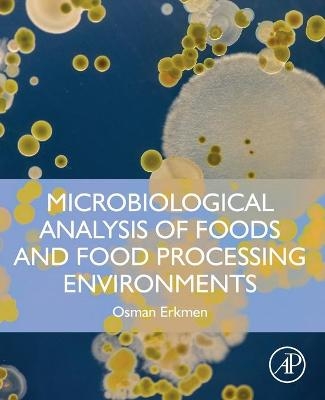
Microbiological Analysis of Foods and Food Processing Environments
Academic Press Inc (Verlag)
978-0-323-91651-6 (ISBN)
Food safety, applications of food standards, and identification of microorganisms in a variety of environments depend on the awareness of microorganisms in their sources, making this book useful for many industry professionals.
Osman Erkmen is professor of food microbiology in the Department of Food Engineering, Gaziantep University. Gaziantep, Turkey. He started his career as a research assistant at the Department of Food Engineering in 1985 and later became an assistant professor in 1994 and associate professor of food microbiology in 1999. He has been working as a professor in this department since 2004, where he teaches courses in general microbiology, food microbiology, food sanitation, and food toxicology. His research focuses on the uses of nonthermal processes and natural antimicrobials in food preservation; the production of fermented foods; the microbial production of lycopene, thiamin, alcohol, and citric acid from industrial wastes; and microbial inactivation and modeling. He studies the combined effect of nonthermal processes, natural antimicrobials in the destruction of microbial cells and spores, and its application in food preservation, as well as characteristics of white and red wines production from Gaziantep grapes. Professor Erkmen has published over 150 research articles, reviews, book chapters, proceeding articles, and popular articles, edited two books, and authored three books in the fields of food microbiology, general microbiology, food toxicology and food sanitation, with more than 3,500 citations. He has more than 10 patents, organized more than 20 international scientific symposiums, and participated in more than 65 international symposiums.
SECTION I General Food Microbiology Analyzing Practices
1. Sampling and Sample Preparation Techniques
2. Plate Count Techniques
3. Direct Microscopic Count Techniques
4. Most Probable Number Technique
5. Membrane Filter Techniques
6. Yeasts and Molds Counting Techniques
7. Sanitation Detection Techniques in Food Processing Plants
SECTION II Counting of Important Microbial Groups from Food Products
8. Injured Microorganisms and Viable but non-Culturable Cells
9. Counting of Cold-Tolerant Microorganisms
10. Counting of Mesophilic and Thermophilic Sporeformers
11. Counting of Halophilic, Osmophilic and Xerophilic Microorganisms
12. Counting of Thermoduric Microorganisms
Section III Isolation and Counting of Indicator and Pathogenic Microorganisms
13. Isolation and Counting of Coliforms and Escherichia coli
14. Isolation and Counting of Enterococcus
15. Isolation and Counting of Salmonella
16. Isolation and Counting of Listeria monocytogenes
17. Isolation and Counting of Campylobacter jejuni
18. Isolation and Counting of Yersinia enterocolitica
19. Isolation and Counting of Bacillus cereus
20. Isolation and Counting of Clostridium perfringens
21. Isolation and Counting of Staphylococcus aureus
22. Isolation of Clostridium botulinum
23. Isolation and Counting of Vibrio
24. Isolation and Counting of Shigella dysenteriae
25. Isolation and Counting of Brucella
26. Isolation and Counting of Aeromonas hydrophila
27. Isolation and Counting of Plesiomonas shigelloides
SECTION IV Detection of Toxigenic Fungi, Viruses and Parasites
28. Isolation and Counting of Toxigenic Fungi
29. Isolation of Foodborne and Waterborne Viruses, and Typing Techniques
30. Detection of Foodborne and Waterborne Parasites
SECTION V Identification of Foods Safety and Quality
31. Analysis of Milk and Milk Products
32. Analysis of Meat, Poultry and their Products
33. Analysis of Fermented Foods
34. Analysis of Fruits, Vegetables and Precooked Frozen Foods
35. Analysis of Fruit Juice and Concentrate Fruits
36. Analysis of Eggs and Egg Products
37. Analysis of Cereals and Cereal Products
38. Analysis of Seafoods
39. Analysis of Canned Foods
40. Analysis of Salad Dressings and Spices
41. Analysis of Bottled Soft Drinks
42. Analysis of Bottled and Process Water
| Erscheinungsdatum | 14.12.2021 |
|---|---|
| Verlagsort | Oxford |
| Sprache | englisch |
| Maße | 191 x 235 mm |
| Gewicht | 1090 g |
| Themenwelt | Studium ► 2. Studienabschnitt (Klinik) ► Pharmakologie / Toxikologie |
| Naturwissenschaften ► Biologie ► Mikrobiologie / Immunologie | |
| Technik ► Lebensmitteltechnologie | |
| ISBN-10 | 0-323-91651-1 / 0323916511 |
| ISBN-13 | 978-0-323-91651-6 / 9780323916516 |
| Zustand | Neuware |
| Informationen gemäß Produktsicherheitsverordnung (GPSR) | |
| Haben Sie eine Frage zum Produkt? |
aus dem Bereich