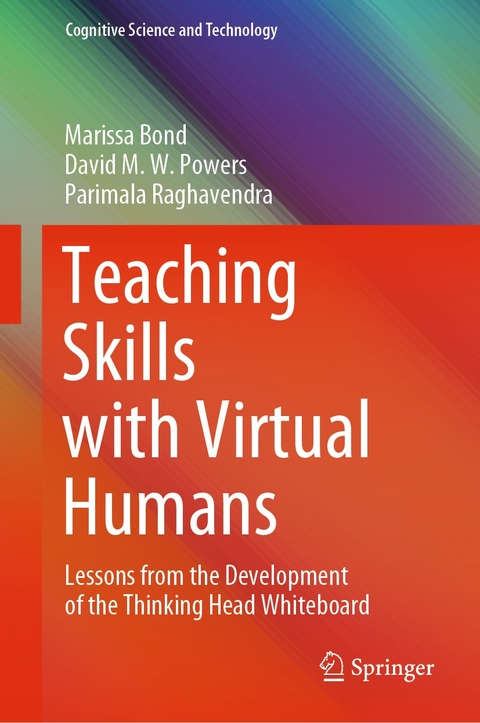
Teaching Skills with Virtual Humans (eBook)
XI, 116 Seiten
Springer Singapore (Verlag)
978-981-16-2312-7 (ISBN)
This book highlights current research into virtual tutoring software and presents a case study of the design and application of a social tutor for children with autism. Best practice guidelines for developing software-based educational interventions are discussed, with a major emphasis on facilitating the generalisation of skills to contexts outside of the software itself, and on maintaining these skills over time.
Further, the book presents the software solution Thinking Head Whiteboard, which provides a framework for families and educators to create unique educational activities utilising virtual character technology and customised to match learners' needs and interests. In turn, the book describes the development and evaluation of a social tutor incorporating multiple life-like virtual humans, leading to an exploration of the lessons learned and recommendations for the future development of related technologies.Marissa Bond completed her PhD at Flinders University, where she focused on using virtual humans to help children with autism develop their social skills, an undertaking that combined her fascination with virtual humans and artificial intelligence with her love of teaching and education. She now looks after both the education and software development teams at Lumination, an Adelaide-based EduTech company. Marissa holds qualifications in primary school teaching and computer science, and has industry experience as a software developer, educator and science communicator.
David Powers is a Professor of Computer and Cognitive Science at Flinders University. He holds a PhD in Computational Psycholinguistics and cofounded SIGNLL and CoNLL, the Special Interest Group and Conference in Computational Natural Language Learning, and aspects of his research have since been commercialized through several startups. His current research in Computational Cognitive Science focuses on Assistive Technology for people with disabilities, focusing particularly on issues relating to language and learning, as well as Artificial Intelligence and Human Computer Interface technologies involving Natural Language, Machine Learning, Neural Networks and/or Brain Computer Interface.
Parimala Raghavendra is an Associate Professor of Disability and Community Inclusion at Flinders University. She has extensive clinical, research and teaching experience in the area of augmentative and alternative communication for children and adults with developmental disability, gained through her studies and work in India, Singapore, the USA, Sweden and Australia. Her current research focuses on investigating the impact of learning to use social media on the social networks and wellbeing of young people and adults with disabilities, and on using mobile technologies to enhance the participation of people with disabilities.
This book highlights current research into virtual tutoring software and presents a case study of the design and application of a social tutor for children with autism. Best practice guidelines for developing software-based educational interventions are discussed, with a major emphasis on facilitating the generalisation of skills to contexts outside of the software itself, and on maintaining these skills over time. Further, the book presents the software solution Thinking Head Whiteboard, which provides a framework for families and educators to create unique educational activities utilising virtual character technology and customised to match learners' needs and interests. In turn, the book describes the development and evaluation of a social tutor incorporating multiple life-like virtual humans, leading to an exploration of the lessons learned and recommendations for the future development of related technologies.
| Erscheint lt. Verlag | 10.6.2021 |
|---|---|
| Reihe/Serie | Cognitive Science and Technology | Cognitive Science and Technology |
| Zusatzinfo | XI, 116 p. 7 illus., 6 illus. in color. |
| Sprache | englisch |
| Themenwelt | Informatik ► Theorie / Studium ► Künstliche Intelligenz / Robotik |
| Naturwissenschaften | |
| Sozialwissenschaften ► Pädagogik | |
| Technik ► Bauwesen | |
| Schlagworte | assistive technologies • Autism • Complexity • Education for children • Embodied Conversational Agents (ECA) • Life-like virtual humans • Social skills interventions • Social tutor • Software-based interventions • Virtual tutoring software • Virtual tutors |
| ISBN-10 | 981-16-2312-0 / 9811623120 |
| ISBN-13 | 978-981-16-2312-7 / 9789811623127 |
| Informationen gemäß Produktsicherheitsverordnung (GPSR) | |
| Haben Sie eine Frage zum Produkt? |
 PDF (Wasserzeichen)
Größe: 2,6 MB
DRM: Digitales Wasserzeichen
Dieses eBook enthält ein digitales Wasserzeichen und ist damit für Sie personalisiert. Bei einer missbräuchlichen Weitergabe des eBooks an Dritte ist eine Rückverfolgung an die Quelle möglich.
Dateiformat: PDF (Portable Document Format)
Mit einem festen Seitenlayout eignet sich die PDF besonders für Fachbücher mit Spalten, Tabellen und Abbildungen. Eine PDF kann auf fast allen Geräten angezeigt werden, ist aber für kleine Displays (Smartphone, eReader) nur eingeschränkt geeignet.
Systemvoraussetzungen:
PC/Mac: Mit einem PC oder Mac können Sie dieses eBook lesen. Sie benötigen dafür einen PDF-Viewer - z.B. den Adobe Reader oder Adobe Digital Editions.
eReader: Dieses eBook kann mit (fast) allen eBook-Readern gelesen werden. Mit dem amazon-Kindle ist es aber nicht kompatibel.
Smartphone/Tablet: Egal ob Apple oder Android, dieses eBook können Sie lesen. Sie benötigen dafür einen PDF-Viewer - z.B. die kostenlose Adobe Digital Editions-App.
Buying eBooks from abroad
For tax law reasons we can sell eBooks just within Germany and Switzerland. Regrettably we cannot fulfill eBook-orders from other countries.
aus dem Bereich