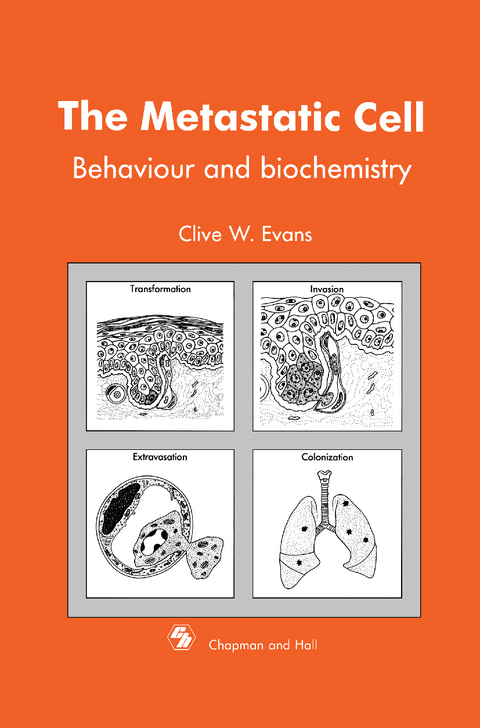
Metastatic Cell
Chapman and Hall (Verlag)
978-0-412-30300-5 (ISBN)
The normally functioning cell has controls which prevent it proliferating and invading regions of the body from which it is normally excluded. Under certain conditions, the normal rules breakdown and cell proliferation and migration, or metastasis, leads to the formation of tumours. The metastatic behaviour of malignant tumour cells is responsible for the majority of cancer deaths. This book deals with the behaviour and biochemistry of errant cells, a subject that is at the forefront of current reserch in cellular and molecular biology, providing general and specialized information on cell adhesion and mobility in the metastatic process, the behaviour of the cells involved and how they differ from normal cells. Whilst not intended to be all-encompassing, this book provides a general background to the metastatic cell, describing the current status of knowledge about its genotype and phenotype and discussing aspects of its behaviour which are thought to be crucial in the metastatic response. Possible future directions for research and ways in which metastasis might be controlled are also covered.
The book aims to give senior biological, medical and veterinary students an understanding of the metastatic cell and is a synthesis of current research for more advanced workers.
Part 1 The tumour cell phenotype: what is a tumour?; general aspects of cell growth; how are tumours classified?; grading and staging; what causes tumours?; how do tumour cells differ from normal cells?; characteristic features of tumour cells; the significance of the immune system in tumour development - immunosurveillance; the induction of tumour dormancy. Part 2 The invasive and metastatic behaviour of malignant cells: invasion and metastisis "In Vivo"; resistance to invasion; the problem of metastasis; the metastatic process - general principles; the spread of carcinomas and sarcomas; the blood system; the structure of blood vessels; functional properties of the vascular endothelium; haemodynamics; the extracellular matrix; the lymphatic system; the extravasation of leukocytes - general principles; essential steps in the metastatic process; the nature and pattern of tumour spread; the role of enzymes in invasion and metastasis; metastasis and immune status. Part 3 "In Vivo" models for the study of invasion and metastasis: general features of model systems; transplantable tumour cell lines; "Artificial" and "Spontaneous" metastasis; the B16 malignant melanoma - a murine model system for the study of invasion and metastasis; "In Vivo" models for lymphatic metastasis; the nude mouse as a model system for invasion and metastasis; transparent model systems for studying cell behaviour during invasion and metastasis; the embryonic chick as a model system for invasion and metastasis. Part 4 "In Vitro" model systems for the study of invasion and metastasis: invasion and metastasis "In Vitro"; general features of "In Vitro" model systems; two dimensional confrontation models; invasion of cell monolayers; invasion of filters; electrophysiological assessment of invasion; invasion of collagen gels; invasion of organs, tissue fragments and aggregates; a comparison of "In Vitro" and "In Vivo" models; Part 5 The adhesive and locomotory behaviour of tumour cells: general aspects of cell adhesion; measuring adhesion; mechanisms of cell - cell adhesion; mechanisms of cell-substrate adhesion; the modulation of adhesion; oncogenes and cell adhesion; cell adhesion and metastasis; homologies within the different adhesive systems; general aspects of cell locomotion; measuring locomotion; chemotaxis and chemokinesis; adhesion and locomotion - haptotaxis; the effects of tumour cells on host locomotion-related functions; locomotion, invasion and metastasis. Part 6 Reflections and new horizons: genes, their regulation and malignancy; cancer in transgenic mice; the reversibility of cancer; the effective treatment of cancer - observations and speculations; an ultimate understanding?.
| Erscheint lt. Verlag | 31.12.1990 |
|---|---|
| Zusatzinfo | XIV, 556 p. |
| Verlagsort | London |
| Sprache | englisch |
| Maße | 155 x 235 mm |
| Themenwelt | Naturwissenschaften ► Biologie ► Genetik / Molekularbiologie |
| Naturwissenschaften ► Biologie ► Zoologie | |
| ISBN-10 | 0-412-30300-0 / 0412303000 |
| ISBN-13 | 978-0-412-30300-5 / 9780412303005 |
| Zustand | Neuware |
| Informationen gemäß Produktsicherheitsverordnung (GPSR) | |
| Haben Sie eine Frage zum Produkt? |
aus dem Bereich