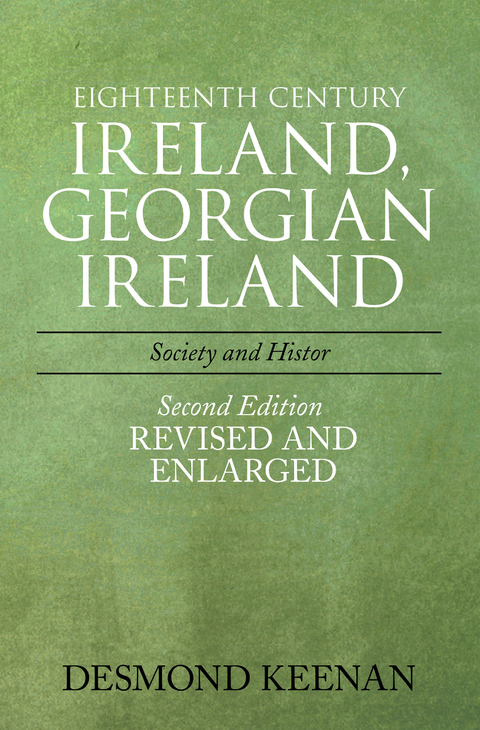
Eighteenth Century Ireland, Georgian Ireland (eBook)
1032 Seiten
Xlibris Us (Verlag)
978-1-6641-2859-0 (ISBN)
It is a peculiarity, as yet unexplained, that most of the Catholic working classes, by the end of the century, had names that reflected their ancestry as minor local chiefs. The question remains where did the descendants of the former workers, the villeins and betaghs go? The answer seems to be that in times of war and famine the members of even the smallest chiefly family stood a better chance of surviving. This would explain the long-standing grievance of the Catholic peasants that they were unjustly deprived of their land. We will perhaps never know the answer to this question.
Penal Laws against religious minorities were the norm in Europe. The religion of the state was decided by the king according to the adage cuius regio eius religio (each king decides the state religion for his own kingdom). At the end of the 17th century, the Catholic landowners fought hard for the Catholic James II. But in the 18th century they lost interest and preferred to come to terms with the actually reigning monarch, and became Protestants to retain their lands and influence. Unlike in Scotland, support for the Catholic Stuarts remained minimal. Nor was there any attempt to establish in independent kingdom or republic. When such an attempt was made at the very end of the century it was led by Protestant gentlemen in imitation of their American cousins.
Ireland in the 18th century was not ruled by a foreign elite like the British raj in India. It was an aristocratic society, like all the other European societies at the time. Some of these were descendants of Gaelic chiefs; some were descendants of those who had received grants of confiscated land; some were descendants of the moneylenders who had lent money to improvident Gaelic chiefs. Together these formed the ruling aristocracy who controlled Parliament and made the Irish laws, controlled the army, the judiciary and the executive. Access to this elite was open to any gentleman who was willing to take the oath of allegiance and conform to the state church, the Established Church but not the nonconformists.
British kings did not occupy Ireland and impose foreign rule. Ireland had her own Government and elected Parliament. By a decree of King John in the 12th century, the Lordship of Ireland was annexed to the person of the king of England. When not present in Ireland in person, and he rarely was, his powers were exercised by a Lord Lieutenant to whom considerable executive power was given. He presided over the Irish Privy Council which drew up the legislation to be presented to the Irish Parliament. One restraint was imposed on the Irish Parliament. By Poynings’ Law it was not allowed to pass legislation that infringed on the rights of the king or his English Privy Council. The British Parliament had no interest in the internal affairs of Ireland. The Irish Council were free to devise their own legislation and they did so.
The events in Irish republican fantasy are examined in detail. The was no major rebellion against alleged British rule. The vast majority of Catholics and Protestants rallied to the support of their lawful Government. The were local uprisings easily suppressed by the local militias and yeomanry. Atrocities were not all on one side.
Ireland at last enjoyed a century of peace with no wasteful and destructive wars within its bounds. No longer were its crops burned, its buildings destroyed, its cattle driven off, its population reduced by fever and famine. Its trade was resumed and gradually wealth accumulated and was no longer dispersed on local wars. Gentlemen, as in England, could afford to build great country and town houses. The arts flourished as never before. Skilled masons could build great houses. Stone cutters could carve sculptures. The most delicate mouldings could be applied to ceilings. The theatre flourished.
While some gentlemen led the life of wastrels, others devoted themselves to the promotion of agriculture and industry. Everywhere mines were dug to exploit minerals. Ireland had not the same richness of minerals as England, but every effort was made to find and exploit them. Roads were improved, canals dug, rivers deepened, and ports developed. Market towns spread all over Ireland which provided local farmers with outlets for their produce and increased the wealth of the landlords.
This wealth was however very unevenly spread. The population was ever increasing and the poor remained miserably poor. In a bad year, hundreds of thousands of the very poor could perish through cold and famine. But the numbers of the very poor kept on growing. Only among the Presbyterians in Ulster was there emigration on any scale. Even before the American Revolution they found a great freedom and greater opportunities in the American colonies. Catholics, were born, lived and died in the same parish.
Altogether it was a century of great achievement.
| Erscheint lt. Verlag | 11.10.2020 |
|---|---|
| Sprache | englisch |
| Themenwelt | Naturwissenschaften |
| Sozialwissenschaften ► Soziologie ► Spezielle Soziologien | |
| Wirtschaft ► Volkswirtschaftslehre ► Wirtschaftspolitik | |
| Schlagworte | Eighteenth Century Ireland • Georgian Ireland • History |
| ISBN-10 | 1-6641-2859-X / 166412859X |
| ISBN-13 | 978-1-6641-2859-0 / 9781664128590 |
| Informationen gemäß Produktsicherheitsverordnung (GPSR) | |
| Haben Sie eine Frage zum Produkt? |
 EPUB (Adobe DRM)
Kopierschutz: Adobe-DRM
Adobe-DRM ist ein Kopierschutz, der das eBook vor Mißbrauch schützen soll. Dabei wird das eBook bereits beim Download auf Ihre persönliche Adobe-ID autorisiert. Lesen können Sie das eBook dann nur auf den Geräten, welche ebenfalls auf Ihre Adobe-ID registriert sind.
Details zum Adobe-DRM
Dateiformat: EPUB (Electronic Publication)
EPUB ist ein offener Standard für eBooks und eignet sich besonders zur Darstellung von Belletristik und Sachbüchern. Der Fließtext wird dynamisch an die Display- und Schriftgröße angepasst. Auch für mobile Lesegeräte ist EPUB daher gut geeignet.
Systemvoraussetzungen:
PC/Mac: Mit einem PC oder Mac können Sie dieses eBook lesen. Sie benötigen eine
eReader: Dieses eBook kann mit (fast) allen eBook-Readern gelesen werden. Mit dem amazon-Kindle ist es aber nicht kompatibel.
Smartphone/Tablet: Egal ob Apple oder Android, dieses eBook können Sie lesen. Sie benötigen eine
Geräteliste und zusätzliche Hinweise
Buying eBooks from abroad
For tax law reasons we can sell eBooks just within Germany and Switzerland. Regrettably we cannot fulfill eBook-orders from other countries.
aus dem Bereich