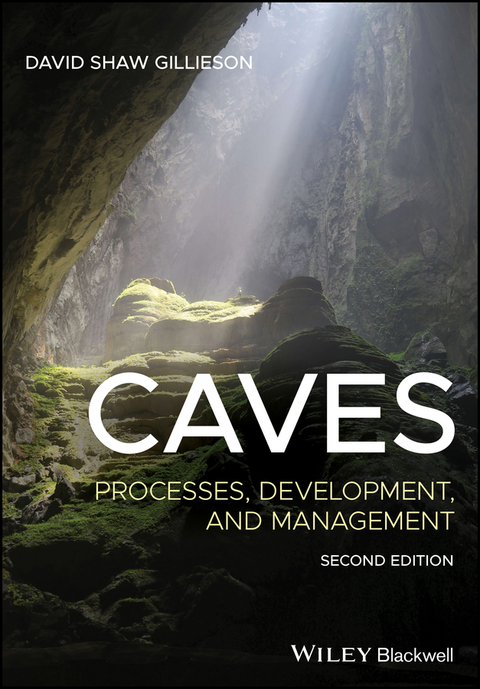
Caves (eBook)
John Wiley & Sons (Verlag)
978-1-119-45559-2 (ISBN)
About the Author
David Shaw Gillieson is an Honorary Professorial Fellow at the School of Geography, Earth and Atmospheric Sciences, University of Melbourne, Carlton, Victoria, Australia. He has held academic appointments at the Australian National University, University of New South Wales and James Cook University. Over the last fifty years he has explored and studied caves in Australasia, Europe, North America, Oceania and Southeast Asia. He is currently Treasurer of the Australasian Cave and Karst Management Association, and is a former Chair of the International Geographical Union Commission on Karst. He has been involved in the evaluation and writing of World Heritage nominations, and cave and karst management plans across the globe.
People have been interested in caves for a very long time. Our distant ancestors used them for shelter, as sources of water, and as places in which to conduct essential rituals. They adorned their walls with quite sophisticated artwork depicting both their existential and spiritual concerns. Caves feature in our mythology, they are used as places of worship in many cultures, and they are used throughout the world as places in which to store prized foodstuffs and wine. For at least two hundred years they have attracted scientists, artists, photographers, and recreational cavers. This book aims examines how caves form, the light they shed on past environments and climates, and the values, both environmental and cultural, that they provide to humanity. This second edition of Caves: Processes, Development, and Management is a welcome revision of the author's earlier treatment released over twenty years ago. It has been updated, significantly expanded, and largely rewritten. The intervening years have seen a dramatic increase in karst and cave research globally, with significant advances in our understanding of fundamental processes, in our ability to extract proxy climatic and environmental data from cave deposits, and in our understanding of the breadth of cave values and as a result the complexity of their management needs. This new edition adopts a broad international perspective in the research examples used and the cited literature, and has actively sought out material from the tropical world and the southern continents, thus avoiding the European and North American bias frequently found in speleological publications. Caves: Processes, Development, and Management, Second Edition, is organised into four sections. In the first section, contemporary processes of cave formation are examined. The second section of the book deals with past processes and their physical manifestation. In the third section, the use of caves by various organisms from bacteria to humans is explored. The final section of the book reviews our changing approaches to cave management and to catchment management on karst terrains. The book will be of use to anyone who is interested in caves and karst, or who wants to understand about cave formation, development, values and management.
About the Author David Shaw Gillieson is an Honorary Professorial Fellow at the School of Geography, Earth and Atmospheric Sciences, University of Melbourne, Carlton, Victoria, Australia. He has held academic appointments at the Australian National University, University of New South Wales and James Cook University. Over the last fifty years he has explored and studied caves in Australasia, Europe, North America, Oceania and Southeast Asia. He is currently Treasurer of the Australasian Cave and Karst Management Association, and is a former Chair of the International Geographical Union Commission on Karst. He has been involved in the evaluation and writing of World Heritage nominations, and cave and karst management plans across the globe.
Cover 1
Title Page 5
Copyright 6
Contents 9
Preface and Acknowledgements 15
Chapter 1 Introduction 17
1.1 Some Basic Propositions 17
1.2 Now the Details… 19
Chapter 2 Caves and Karst 22
2.1 What Is a Cave? 22
2.2 What Is Karst? 23
2.3 Caves as Systems 25
2.3.1 Caves as Geomorphic Systems 26
2.3.2 Caves as Biological Systems 29
2.4 Where Are the Deepest and Longest Caves? 30
References 32
Chapter 3 Cave Hydrology 34
3.1 Basic Concepts in Karst Drainage Systems 34
3.2 Porosity and Permeability 36
3.2.1 Diffuse Flow 36
3.2.2 Fissure Flow 38
3.2.3 Conduit Flow 38
3.2.4 Understanding the Karst Drainage System 41
3.3 Zonation of the Karst Drainage System 43
3.4 Defining the Catchment of a Cave 46
3.5 Analysis of Karst Drainage Systems 48
3.5.1 Water?Tracing Techniques 48
3.5.2 Spring Hydrograph Analysis 51
3.5.3 Spring Chemograph Analysis 56
3.6 Structure and Function of Karst Drainage Systems 57
3.6.1 Storage and Transfers in the Karst System 57
3.6.2 The Role of Extreme Events 59
3.7 Karst Hydrology of the Mammoth Cave Plateau, Kentucky 63
References 67
Chapter 4 Processes of Rock Dissolution 71
4.1 Introduction 71
4.2 Karst Rocks 71
4.2.1 Limestone 71
4.2.2 Dolomite 78
4.2.3 Evaporite Rocks–Gypsum and Halite 79
4.2.4 Sandstone 80
4.2.5 Granite 81
4.3 Processes of Dissolution of Karst Rocks 82
4.3.1 The Solution of Limestone in Meteoric Waters 82
4.3.2 Soil and Vegetation in the Limestone Solution Process 84
4.3.3 The Zoning of Solution in the Unsaturated Zone 86
4.3.4 Limestone Solution in Seawater 87
4.4 Hydrothermal Solution of Limestone 89
4.5 Solution of Evaporites 90
4.6 Solution of Silicates in Meteoric Waters 91
4.7 Caves in Quaternary Limestone in Southern Australia 93
References 99
Chapter 5 Speleogenesis 102
5.1 Classifying Cave Systems 102
5.2 Controls of Rock Structure on Cave Development 105
5.2.1 Role of Lithology 105
5.2.2 Role of Joints, Fractures, and Faults 106
5.2.3 Cave Breakdown and Evaporite Weathering 110
5.3 Meteoric Speleogenesis, Unconfined and Confined 112
5.3.1 Formation of Caves in Plan 112
5.3.2 Formation of Caves in Length and Depth 113
5.3.3 The Formation of Maze Caves 119
5.3.4 Tectonic and Eustatic Controls on Cave Development 121
5.3.5 Deep Shafts of the World 130
5.4 Hypogene Speleogenesis 131
5.4.1 Solutional Mesoforms as Indicators of Hypogene Origin 133
5.4.2 Condensation and Corrosion in Passage Enlargement 133
5.5 Flank Margin Speleogenesis 136
5.6 Caves Formed in Gypsum 138
5.7 Lava Tubes, Weathering Caves, and Pseudokarst 139
5.7.1 The Formation of Lava Tubes 139
5.7.2 Weathering Caves and Pseudokarst 142
5.8 Life History and Antiquity of Caves 142
5.9 Geological Control and the World's Longest Cave 143
References 149
Chapter 6 Cave Interior Deposits 154
6.1 Introduction 154
6.2 Carbonates 160
6.3 Controls over Carbonate Mineralogy 164
6.4 Other Cave Deposits Formed by Carbonate Minerals 165
6.5 Growth Rates of Speleothems 167
6.6 Important Non?carbonate Minerals 169
6.6.1 Evaporites (Sulphates and Halides) 169
6.6.2 Phosphates and Nitrates 171
6.6.3 Oxides, Silicates, and Hydroxides 172
6.7 Ice in Caves 173
6.8 Other Minerals 174
6.9 Cave Deposits of the Nullarbor Plain, Australia 174
References 182
Chapter 7 Cave Sediments 187
7.1 Introduction 187
7.2 Clastic Sediment Types 187
7.3 Processes of Sedimentation 188
7.3.1 Gravity?Fall Processes 188
7.3.2 Waterlain Clastic Sediments 191
7.3.3 Cave and Rockshelter Entrance Deposits 200
7.4 Sediment Transport and Particle Size 201
7.5 Diagenesis of Cave Sediments 204
7.6 Stratigraphy and its Interpretation 205
7.7 Provenance Studies 206
7.8 Cave Sediments and Environmental History at Zhoukoudian, China 207
References 211
Chapter 8 Dating Cave Deposits 214
8.1 The Importance of Dating Cave Deposits 214
8.2 Dating Techniques and the Quaternary Timescale 215
8.3 Palaeomagnetism 216
8.4 Uranium Series Uranium?Thorium, Uranium?Lead
8.5 Radiocarbon 227
8.6 Other Dating Methods: Cosmogenic Radionuclides, and Tephrochronology 229
8.7 Timing Glacial and Interglacial Events in New Zealand 231
References 237
Chapter 9 Cave Deposits and Past Climates 241
9.1 Introduction 241
9.2 Oxygen Isotope Analysis 242
9.3 The Last Glacial?Interglacial Temperature Record 244
9.4 Carbon Isotopes and Environmental Changes 250
9.5 Cyclone History in the Indo?Pacific Region 251
9.6 Other Proxy Records (Trace Elements, Annual Laminae, Pollen, Lipid Biomarkers) 255
9.7 The Long Environmental History of the Nullarbor Plain, Australia 256
9.8 Some Speculations on the Future 261
References 261
Chapter 10 Cave Ecology 264
10.1 Introduction 264
10.2 Classification of Cave Life and its Function 264
10.3 Adaptations and Modifications to Life in Darkness 265
10.4 Life Zones within Caves 268
10.5 The Cave as a Habitat 271
10.6 Energy Flows in Cave Ecosystems 277
10.7 Cave Microbiology 280
10.8 Origin and Dispersal of Cave?Dwelling Animals 283
10.9 Threats to Cave Fauna 286
10.10 Conservation of Biological Diversity in Caves 291
10.11 Caves and Ecosystem Services 293
10.12 White Nose Syndrome 296
10.13 Unravelling the Secrets of the Carrai Bat Cave 299
References 302
Chapter 11 Cave Archaeology 308
11.1 Introduction 308
11.2 Prehistoric Uses of Caves 309
11.3 Cave Faunas and Hominids 310
11.4 Cave Art in Context 316
11.5 Depositional Environments in Caves 320
11.6 Cave Deposits and Biological Conservation 321
11.7 Taphonomy of Cave Deposits 322
11.8 Archaeology of Liang Bua Cave, Flores (the Hobbit Cave) 325
References 331
Chapter 12 Historic Uses of Caves 334
12.1 Introduction 334
12.2 Caves as Shelter 334
12.3 Caves as Sacred Spaces 337
12.4 Caves as Sources of Raw Materials 340
12.5 Cave Tourism 349
12.6 Cave Dwellings in Turkey 351
References 356
Chapter 13 Cave Management 358
13.1 Introduction – Caves as Contested Spaces 360
13.2 Interpretation and Guide Training 361
13.3 Cave Lighting 364
13.4 Some Engineering Issues in Caves 365
13.5 Impacts of Visitors and Infrastructure on Show Caves 368
13.6 Radon Risk in Caves 374
13.7 Cave Cleaning and its Impacts 378
13.8 Impacts of Recreational Caving on Caves 378
13.9 Cave Rescue 383
13.10 Cave Inventories and Alternative Management Concepts 387
13.11 Rehabilitation and Restoration of Caves 390
13.12 Cave Classification and Management 392
13.13 Policy Approaches to Cave and Karst Protection 394
13.14 Management of the Gunung Mulu World Heritage Area, Sarawak, Malaysia 395
References 404
Chapter 14 Catchment Management in Karst 409
14.1 Introduction 409
14.2 Basic Concepts in Karst Management 409
14.3 Defining Karst Catchments 411
14.4 Vegetation and Caves 414
14.5 Accelerated Soil Loss in Karst 416
14.6 Agricultural Impacts 418
14.6.1 Rocky Desertification 418
14.6.2 Infilling of Dolines 419
14.6.3 Altered Drainage 420
14.6.4 Groundwater Lowering 421
14.6.5 Fertiliser and Herbicides 423
14.6.6 Pesticides 424
14.6.7 Microbial Contamination of Groundwater 425
14.6.8 Golf Courses on Karst 427
14.7 Fire Management in Karst 428
14.8 Conservation Issues in Karst 430
14.9 Assessing Vulnerability in Karst Management 431
14.9.1 Karst Disturbance Index 431
14.9.2 Karst Groundwater Vulnerability 433
14.9.3 Data Availability 434
14.10 Understanding Disputes Over Cave and Karst Resources 437
14.11 The IUCN Guidelines for Cave and Karst Protection 439
References 442
Chapter 15 Documentation of Caves 448
15.1 Geoheritage Assessment 448
15.2 Cave Mapping 452
15.3 Cave Photography 458
15.4 3D Scanning of Caves 465
15.5 Drones 469
15.6 Mapping World Heritage Caves in Gunung Mulu National Park, Malaysia 470
References 473
Glossary of Cave and Karst Terminology 477
Further Reading 490
Geographical Index 491
Subject Index 500
EULA 531
| Erscheint lt. Verlag | 26.5.2021 |
|---|---|
| Sprache | englisch |
| Themenwelt | Naturwissenschaften ► Geowissenschaften ► Geologie |
| Schlagworte | cave bacteria • cave deposits • Cave Exploration • cave formation • cave inhabitants • Cave Management • Cave Research • Development • earth sciences • Environmental Data • Geologie • Geologie u. Geophysik • Geology & Geophysics • Geowissenschaften • Höhle • international perspective • Karst • karst terrains • proxy climatic extraction data • Structural Geology & Tectonics • Strukturgeologie • Strukturgeologie, Tektonik • Values |
| ISBN-10 | 1-119-45559-6 / 1119455596 |
| ISBN-13 | 978-1-119-45559-2 / 9781119455592 |
| Informationen gemäß Produktsicherheitsverordnung (GPSR) | |
| Haben Sie eine Frage zum Produkt? |
 PDF (Adobe DRM)
Kopierschutz: Adobe-DRM
Adobe-DRM ist ein Kopierschutz, der das eBook vor Mißbrauch schützen soll. Dabei wird das eBook bereits beim Download auf Ihre persönliche Adobe-ID autorisiert. Lesen können Sie das eBook dann nur auf den Geräten, welche ebenfalls auf Ihre Adobe-ID registriert sind.
Details zum Adobe-DRM
Dateiformat: PDF (Portable Document Format)
Mit einem festen Seitenlayout eignet sich die PDF besonders für Fachbücher mit Spalten, Tabellen und Abbildungen. Eine PDF kann auf fast allen Geräten angezeigt werden, ist aber für kleine Displays (Smartphone, eReader) nur eingeschränkt geeignet.
Systemvoraussetzungen:
PC/Mac: Mit einem PC oder Mac können Sie dieses eBook lesen. Sie benötigen eine
eReader: Dieses eBook kann mit (fast) allen eBook-Readern gelesen werden. Mit dem amazon-Kindle ist es aber nicht kompatibel.
Smartphone/Tablet: Egal ob Apple oder Android, dieses eBook können Sie lesen. Sie benötigen eine
Geräteliste und zusätzliche Hinweise
Buying eBooks from abroad
For tax law reasons we can sell eBooks just within Germany and Switzerland. Regrettably we cannot fulfill eBook-orders from other countries.
aus dem Bereich