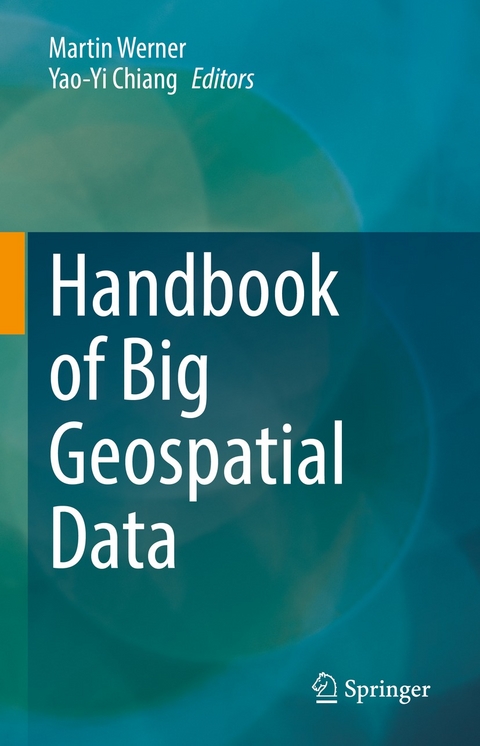
Handbook of Big Geospatial Data (eBook)
XI, 641 Seiten
Springer International Publishing (Verlag)
978-3-030-55462-0 (ISBN)
This handbook covers a wide range of topics related to the collection, processing, analysis, and use of geospatial data in their various forms. This handbook provides an overview of how spatial computing technologies for big data can be organized and implemented to solve real-world problems. Diverse subdomains ranging from indoor mapping and navigation over trajectory computing to earth observation from space, are also present in this handbook. It combines fundamental contributions focusing on spatio-textual analysis, uncertain databases, and spatial statistics with application examples such as road network detection or colocation detection using GPUs. In summary, this handbook gives an essential introduction and overview of the rich field of spatial information science and big geospatial data.
It introduces three different perspectives, which together define the field of big geospatial data: a societal, governmental, and governance perspective. It discusses questions of how the acquisition, distribution and exploitation of big geospatial data must be organized both on the scale of companies and countries. A second perspective is a theory-oriented set of contributions on arbitrary spatial data with contributions introducing into the exciting field of spatial statistics or into uncertain databases. A third perspective is taking a very practical perspective to big geospatial data, ranging from chapters that describe how big geospatial data infrastructures can be implemented and how specific applications can be implemented on top of big geospatial data. This would include for example, research in historic map data, road network extraction, damage estimation from remote sensing imagery, or the analysis of spatio-textual collections and social media. This multi-disciplinary approach makes the book unique.
This handbook can be used as a reference for undergraduate students, graduate students and researchers focused on big geospatial data. Professionals can use this book, as well as practitioners facing big collections of geospatial data.
Martin Werner: The research area of Prof. Werner (*1984) includes methodological research around topics of acquisition, organization, compression, analysis, and visualization of georeferenced or geometric data in large scales. He puts emphasis on methods of distributed computing, machine learning, image and text analysis, randomized data structures, high performance computing and quantum algorithms.
Martin Werner studied mathematics at University Bonn, did a doctorate at the intersection of geometry and applications related to indoor navigation at LMU Munich. In his time as a postdoctoral researcher, junior professor, and senior researcher he completed his view on the processing of spatial data to a comprehensive perspective with stations at LMU Munich, Leibniz-University Hannover, German Aerospace Center (DLR), and UniBW Munich. In April 2020 he joined the faculty of aerospace and geodesy with a professorship for Big Geospatial Data Management.
Yao-Yi Chiang: Yao-Yi Chiang, Ph.D., is an Associate Professor (Research) in Spatial Sciences, the Director of the Spatial Computing Laboratory, and the Associate Director of the NSF's Integrated Media Systems Center (IMSC) at the University of Southern California (USC). He is also a faculty member in Data Science in the USC Viterbi Data Science M.S. program. He is an Action Editor of GeoInformatica (Springer). Dr. Chiang received his Ph.D. degree in Computer Science from the University of Southern California, his bachelor's degree in Information Management from the National Taiwan University. His current research combines spatial science theories with computer algorithms to enable the discovery of useful insights from heterogeneous data for solving real-world problems. His research interests include information integration, machine learning, data mining, computer vision, and knowledge graphs. He has received funding from agencies such as NSF, NIH, DARPA, NGA, and NEH, as well as from industry partners such as NTT Global Networks, BAE Systems, Conveyancing Liability Solutions, and TerraGo. He was recently a visiting researcher at Google AI (2019). Before USC, Dr. Chiang worked as a research scientist for Geosemble Technologies and Fetch Technologies in California. Geosemble Technologies was founded based on a patent on geospatial data fusion techniques, and he was a co-inventor.
| Erscheint lt. Verlag | 7.5.2021 |
|---|---|
| Zusatzinfo | XI, 641 p. 222 illus., 148 illus. in color. |
| Sprache | englisch |
| Themenwelt | Mathematik / Informatik ► Informatik ► Netzwerke |
| Informatik ► Theorie / Studium ► Künstliche Intelligenz / Robotik | |
| Naturwissenschaften ► Geowissenschaften ► Geografie / Kartografie | |
| Wirtschaft | |
| Schlagworte | Algorithms for Big Data • Apache Hadoop • Big data applications • Big Data Infrastructures • Big Data Software Stacks • Cloud Computing • Geographic information science • Geographic Information Systems • Geospatial Big Data • GIS • Historical Maps • Parallel Computing • Remote Sensing • Satellite Remote Sensing • Social Media Analysis • spatial databases • Spatial Machine Learning • Spatio-textual Analysis • Trajectory Computing • uncertain databases |
| ISBN-10 | 3-030-55462-7 / 3030554627 |
| ISBN-13 | 978-3-030-55462-0 / 9783030554620 |
| Informationen gemäß Produktsicherheitsverordnung (GPSR) | |
| Haben Sie eine Frage zum Produkt? |
 PDF (Wasserzeichen)
DRM: Digitales Wasserzeichen
Dieses eBook enthält ein digitales Wasserzeichen und ist damit für Sie personalisiert. Bei einer missbräuchlichen Weitergabe des eBooks an Dritte ist eine Rückverfolgung an die Quelle möglich.
Dateiformat: PDF (Portable Document Format)
Mit einem festen Seitenlayout eignet sich die PDF besonders für Fachbücher mit Spalten, Tabellen und Abbildungen. Eine PDF kann auf fast allen Geräten angezeigt werden, ist aber für kleine Displays (Smartphone, eReader) nur eingeschränkt geeignet.
Systemvoraussetzungen:
PC/Mac: Mit einem PC oder Mac können Sie dieses eBook lesen. Sie benötigen dafür einen PDF-Viewer - z.B. den Adobe Reader oder Adobe Digital Editions.
eReader: Dieses eBook kann mit (fast) allen eBook-Readern gelesen werden. Mit dem amazon-Kindle ist es aber nicht kompatibel.
Smartphone/Tablet: Egal ob Apple oder Android, dieses eBook können Sie lesen. Sie benötigen dafür einen PDF-Viewer - z.B. die kostenlose Adobe Digital Editions-App.
Buying eBooks from abroad
For tax law reasons we can sell eBooks just within Germany and Switzerland. Regrettably we cannot fulfill eBook-orders from other countries.
aus dem Bereich