Concise Reader in Sociological Theory (eBook)
John Wiley & Sons (Verlag)
978-1-119-53617-8 (ISBN)
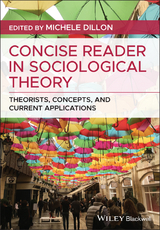
Essential writings from classical and contemporary sociological theorists engagingly introduced and brought to life for students
This Concise Reader in Sociological Theory contains excerpts from the writings of a wide range of key theorists who represent the dynamic breadth of classical and contemporary, macro- and micro-sociological theory. The selected writings elaborate on the core concepts and arguments of sociological theory, and, along with the commentary, explore topics that resonate today such as: crisis and change, institutions and networks, power and inequality, race, gender, difference, and much more.
The text contains editorial introductions to each section that clearly explain the intellectual context of the theorists and their arguments and reinforce their relevance to sociological analysis and society today. The excerpts include writings from the classicists Karl Marx, Max Weber, Emile Durkheim, W.E.B. Du Bois to the contemporary Patricia Hill Collins, Dorothy Smith, Raewyn Connell. This indispensable book:
- Offers a concise review of the diverse field of sociological theory
- Includes contributions from a wide range of noted classical and contemporary theorists
- Incorporates engaging empirical examples from contemporary society
- Demonstrates the relevance and significance of the ideas presented in the theorists' writings
Designed for undergraduate and graduate students in sociology and in social and political theory, Concise Reader in Sociological Theory is an engaging and accessible guide to the most relevant sociological theorists.
Michele Dillon, Ph.D., is Dean of the College of Liberal Arts and Professor of Sociology at the University of New Hampshire, USA, and was educated at University College Dublin, Ireland and the University of California, Berkeley. She has many years of experience teaching sociological theory to undergraduate and graduate students and among a wide range of publications she is the author of Introduction to Sociological Theory 3rd edition (Wiley, 2020).
Essential writings from classical and contemporary sociological theorists engagingly introduced and brought to life for students This Concise Reader in Sociological Theory contains excerpts from the writings of a wide range of key theorists who represent the dynamic breadth of classical and contemporary, macro- and micro-sociological theory. The selected writings elaborate on the core concepts and arguments of sociological theory, and, along with the commentary, explore topics that resonate today such as: crisis and change, institutions and networks, power and inequality, race, gender, difference, and much more. The text contains editorial introductions to each section that clearly explain the intellectual context of the theorists and their arguments and reinforce their relevance to sociological analysis and society today. The excerpts include writings from the classicists Karl Marx, Max Weber, Emile Durkheim, W.E.B. Du Bois to the contemporary Patricia Hill Collins, Dorothy Smith, Raewyn Connell. This indispensable book: Offers a concise review of the diverse field of sociological theory Includes contributions from a wide range of noted classical and contemporary theorists Incorporates engaging empirical examples from contemporary society Demonstrates the relevance and significance of the ideas presented in the theorists' writings Designed for undergraduate and graduate students in sociology and in social and political theory, Concise Reader in Sociological Theory is an engaging and accessible guide to the most relevant sociological theorists.
MICHELE DILLON is Dean of the College of Liberal Arts and Professor of Sociology at the University of New Hampshire, USA, and was educated at University College Dublin, Ireland, and the University of California, Berkeley, USA. She has many years of experience teaching sociological theory to undergraduate and graduate students, and, among a wide range of publications, she is the author of Introduction to Sociological Theory, Third Edition (Wiley, 2020).
INTRODUCTION
Sociological theory offers a rich conceptual tool‐kit with which to think about and analyze our contemporary society. As we reflect upon what it means to live and to understand others in today’s complex world, the insights of sociological theorists provide us with concepts that greatly illuminate the array of social and institutional processes, group dynamics, and cultural motivations that drive the patterns of persistence and change variously evident across local, national, and global contexts. Sociology is a comparatively young discipline. It owes its origins to the principles and values established by eighteenth‐century Enlightenment philosophers, namely the core assumptions that human reason is the source of knowledge, and though of different orders, the source of moral truth and of scientific truth; and that, by virtue of being endowed with human reason, all people are created equal and thus should be free to govern themselves in all matters, including political governance – thus motivating the democratic revolutions of the eighteenth century in America (1776) and in France (1789) and leading to the decline of monarchies and the establishment instead of democratic societies.
It was the French philosopher Auguste Comte (1798–1857) who coined the term sociology in 1839. He was influenced by the Enlightenment emphasis on scientific principles and believed that a science of the social world was necessary to discover and illuminate based on rigorous empirical observation how society works, that is to identify, as he saw it, a “social physics” parallel to the laws of physics and other natural sciences, and to advance social progress as a result of the data yielded from the scientific study of society. In his view, because sociology could and should study all aspects of social life, he argued that sociology would be the science of humanity, the science of society, and would outline “the most systematic theory of the human order” (Comte 1891/1973: 1). Harriet Martineau (1802–76), the English feminist and writer, commonly regarded as the first woman sociologist, translated Comte’s writings into English in 1855 (Hoecker‐Drysdale 1992). Additionally, in her own influential writing she emphasized both the breadth of topics that sociologists can/should study as well as the importance of studying them with rigor and objectivity. In her well‐known book How to Observe Morals and Manners (1838), morals and manners referencing the substantive, wide‐ranging content of sociology (and its encompassing of social class, religion, health, suicide, pop culture, crime, and the arts, among other topics), Martineau also argued that because social life is human‐centered it is different to the natural world. Unlike atoms, for example, humans have emotions. Hence, Martineau pointed to the need for sociologists as scientists to develop the empathy necessary to the observation and understanding of the human condition and to how it manifests in the course of their inquiry. She wrote:
The observer must have sympathy; and his sympathy must be untrammeled and unreserved. If a traveler be a geological inquirer he may have a heart as hard as the rocks he shivers, and yet succeed in his immediate objects … if he be a statistical investigator he may be as abstract as a column of figures, and yet learn what he wants to know: but an observer of morals and manners will be liable to deception at every turn, if he does not find his way to hearts and minds.
(Martineau 1838: 52)
As sociology became further established in the mid‐to‐late nineteenth century it did so amid major societal changes, propelled by industrial capitalism, factory production, the expansion of manufacturing and of railroads, increased urbanization, mass immigration of Irish, Italian, Swedish, German, Polish, and other European individuals and families to the US, the bolstering of democratic institutions and procedures (e.g. voting rights), nation‐building, and mass‐circulating newspapers. Living in a time swirling with change, sociology’s founders were thus well situated to observe and to recognize how large‐scale, macro societal forces take hold, interpenetrate, and structure institutional processes, community, and the organization of everyday life, as well as to ponder the relationship of the individual to society.
This Reader presents a selection of key excerpts from major writings in sociological theory, the classics from the foundations of the discipline to contemporary approaches. As with all disciplines, the classics are so defined not merely because they originated in a different time, but precisely because they contain the essential points or concepts that have endured through a long swath of time and have proven resilient in their explanatory relevance of the dynamic complexity of society even, or especially, amid its many ongoing patterns of change. Sociology, as a social science, is an empirical discipline; this means that sociologists are interested in and committed to knowing the truth about reality – how things actually are and why they are as they are, rather than how ideally they ought to be. Consequently, sociologists embrace scientific method as a way of studying the social world and accept the objective facticity of (properly gathered) data. Sociologists use both qualitative (e.g. ethnographic description, interview and blog transcripts, historical documents) and quantitative (e.g. surveys, census data) data‐gathering methods, and in using data they tend to lean either toward investigating the relationship between a number of macro‐level variables (e.g. education, crime, income inequality, gender) or focusing on how individuals in a particular micro‐context and small groups or communities carve meaning into and make sense of their lives. Regardless of the research method(s) chosen (a decision made based on the specific research question motivating the sociologist’s empirical study), sociologists do not and cannot let the resulting data stand on their own. Data always need to be interpreted. And this is why sociological theory is so important. Theory provides the ideas or concepts that sensitize sociologists about what to think about – what questions to ask about the social world and how it is structured and with what consequences – and theory is equally fundamental in helping sociologists make sense of what they find in their actual research, both of what they might have (empirically or theoretically) expected to find but also of the unexpected. As such, sociological theory is the vocabulary sociologists use to anchor and interpret empirical data about any aspect of society, and to drive the ongoing, back‐and‐forth conversation between theory and data. This, necessarily, given the dynamic nature of social life, is always an energetic and dynamic dialogue. Sociological theory does not exist for the sake of theory, but for the sake of sociological understanding and explanation of the multilayered empirical reality in any given sociohistorical context.
This Reader is organized into five sections. Each section includes excerpts from a core set of theorists, and I provide a short commentary or introduction prior to each specific theorist or to a cluster of theorists in the given section. The Reader begins with a lengthy first section with excerpts from sociology’s classical theorists: Karl Marx (chapter 1), Emile Durkheim (chapter 2), and Max Weber (chapter 3). These three dominant theorists largely comprise the foundational canon of sociology; their respective conceptual contributions have well withstood the test of time despite, from the hindsight of our contemporary experience, some notable silences in their writings with respect to, for example, sexuality and a limited discussion of the significance of gender and race.
The classical tradition was largely introduced to English‐speaking audiences by the towering American social theorist, Talcott Parsons. The excerpts in section II comprise an amalgam representing Parsons’s theorizing, generally referred to as structural functionalism, and different theoretical perspectives that it, in turn, gave rise to based on specific critiques of some of Parsons’s emphases. I briefly introduce Parsons’s ideas (in chapter 4) but because much of his writing is quite dense I do not include an excerpt from him but instead an excerpt from his student and renowned fellow‐theorist Robert K. Merton, exemplifying the structural functionalist perspective. Parsons was famously concerned with how values consensus translated into the social roles and social institutions functional to maintain social order. Countering this focus, conflict theory, exemplified by Ralf Dahrendorf, highlighted the normalcy and functionality of conflict (as opposed to consensus) in society. From a different context, critiquing Parsons’s focus on American society as the paradigm of modernization, neo‐Marxist dependency theorists including Fernando Henrique Cardoso and Enzo Faletto highlighted the conflicting power interests between the West and Latin America, and within Latin American countries dependent on the US (chapter 5). Still other theorists pushed back against Parsons’s main focus on macro structures and what they saw as his diminishment of the individual (even though Parsons affirmed the relevance of the individual as a motivated social actor). With a micro focus on individuals and small groups...
| Erscheint lt. Verlag | 23.4.2021 |
|---|---|
| Sprache | englisch |
| Themenwelt | Naturwissenschaften ► Geowissenschaften ► Geografie / Kartografie |
| Sozialwissenschaften ► Soziologie ► Allgemeine Soziologie | |
| Sozialwissenschaften ► Soziologie ► Mikrosoziologie | |
| Schlagworte | Anthropogeographie • Anthropologie • Anthropology • classical sociological theory • contemporary examples of sociological theory • examples of sociological theory • Geographie • Geography • Gesellschaftstheorie • guide to sociological theory • Human geography • Social & Cultural Anthropology • Social Theory • socio-historical sociological theory • Sociology • Soziale u. kulturelle Anthropologie • Soziologie • text on sociological theory • understanding sociological theory |
| ISBN-10 | 1-119-53617-0 / 1119536170 |
| ISBN-13 | 978-1-119-53617-8 / 9781119536178 |
| Informationen gemäß Produktsicherheitsverordnung (GPSR) | |
| Haben Sie eine Frage zum Produkt? |
 EPUB (Adobe DRM)
Kopierschutz: Adobe-DRM
Adobe-DRM ist ein Kopierschutz, der das eBook vor Mißbrauch schützen soll. Dabei wird das eBook bereits beim Download auf Ihre persönliche Adobe-ID autorisiert. Lesen können Sie das eBook dann nur auf den Geräten, welche ebenfalls auf Ihre Adobe-ID registriert sind.
Details zum Adobe-DRM
Dateiformat: EPUB (Electronic Publication)
EPUB ist ein offener Standard für eBooks und eignet sich besonders zur Darstellung von Belletristik und Sachbüchern. Der Fließtext wird dynamisch an die Display- und Schriftgröße angepasst. Auch für mobile Lesegeräte ist EPUB daher gut geeignet.
Systemvoraussetzungen:
PC/Mac: Mit einem PC oder Mac können Sie dieses eBook lesen. Sie benötigen eine
eReader: Dieses eBook kann mit (fast) allen eBook-Readern gelesen werden. Mit dem amazon-Kindle ist es aber nicht kompatibel.
Smartphone/Tablet: Egal ob Apple oder Android, dieses eBook können Sie lesen. Sie benötigen eine
Geräteliste und zusätzliche Hinweise
Buying eBooks from abroad
For tax law reasons we can sell eBooks just within Germany and Switzerland. Regrettably we cannot fulfill eBook-orders from other countries.
aus dem Bereich