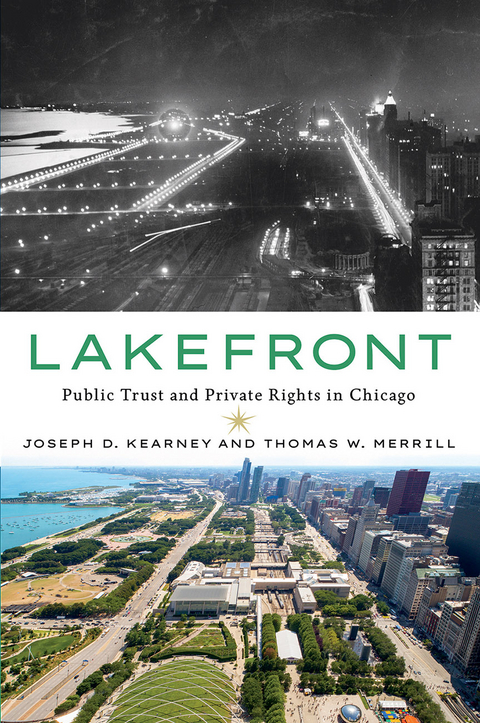
Lakefront (eBook)
392 Seiten
Cornell University Press (Verlag)
978-1-5017-5467-8 (ISBN)
How did Chicago, a city known for commerce, come to have such a splendid public waterfront—its most treasured asset? Lakefront reveals a story of social, political, and legal conflict in which private and public rights have clashed repeatedly over time, only to produce, as a kind of miracle, a generally happy ending.
Joseph D. Kearney and Thomas W. Merrill study the lakefront's evolution from the middle of the nineteenth century to the twenty-first. Their findings have significance for understanding not only Chicago's history but also the law's part in determining the future of significant urban resources such as waterfronts.
The Chicago lakefront is where the American public trust doctrine, holding certain public resources off limits to private development, was born. This book describes the circumstances that gave rise to the doctrine and its fluctuating importance over time, and reveals how it was resurrected in the later twentieth century to become the primary principle for mediating clashes between public and private lakefront rights. Lakefront compares the effectiveness of the public trust idea to other property doctrines, and assesses the role of the law as compared with more institutional developments, such as the emergence of sanitary commissions and park districts, in securing the protection of the lakefront for public uses.
By charting its history, Kearney and Merrill demonstrate that the lakefront's current status is in part a product of individuals and events unique to Chicago. But technological changes, and a transformation in social values in favor of recreational and preservationist uses, also have been critical. Throughout, the law, while also in a state of continual change, has played at least a supporting role.
Joseph D. Kearney is Dean and Professor of Law at Marquette University. Thomas W. Merrill is the Charles Evans Hughes Professor of Law at Columbia University. Before entering academe, both authors clerked at the US Supreme Court and lived for many years in Chicago, where they practiced law and became captivated by the history of the city's lakefront.
Introduction
1. The Lake Front Steal
2. The Lake Front Case
3. The Watchdog of the Lakefront
4. The Struggle for Streeterville
5. Reversing the Chicago River
6. North Lake Shore Drive
7. South Lake Shore Drive and Bridging the River
8. The Transformation of the Public Trust Doctrine
9. The Lakefront Today
Conclusion
| Erscheint lt. Verlag | 15.5.2021 |
|---|---|
| Zusatzinfo | 74 b&w halftones, 16 maps |
| Verlagsort | Ithaca |
| Sprache | englisch |
| Maße | 150 x 150 mm |
| Themenwelt | Geisteswissenschaften ► Geschichte ► Regional- / Ländergeschichte |
| Geschichte ► Teilgebiete der Geschichte ► Militärgeschichte | |
| Naturwissenschaften ► Geowissenschaften ► Geografie / Kartografie | |
| Recht / Steuern ► EU / Internationales Recht | |
| Recht / Steuern ► Privatrecht / Bürgerliches Recht ► Sachenrecht | |
| Recht / Steuern ► Rechtsgeschichte | |
| Technik ► Architektur | |
| Schlagworte | 19th-Century History • 20th-century revival • Architecture • Chicago’s Lake Michigan shoreline • Chicago lakefront • Chicago lakefront, History of Lake Shore Drive, Chicago’s Lake Michigan shoreline, Montgomery Ward, Streeter/Streeterville, Grant Park • City Governance • city planning • civic planning • Community Planning • doctrine origins • environmental planning • environmental preservation • Grant Park • Green Cities • historical transformation • historic preservation • History of Lake Shore Drive • Lake Michigan • Landscape architecture • land use law • land use planning • legal conflicts • Master Planning • Montgomery Ward • municipal evolution • park districts • private rights • property doctrines • public trust doctrine • public vs. private interests • sanitary commissions • sanitary infrastructure • social values shift • Streeter/Streeterville • urban resources • Waterfront development |
| ISBN-10 | 1-5017-5467-X / 150175467X |
| ISBN-13 | 978-1-5017-5467-8 / 9781501754678 |
| Informationen gemäß Produktsicherheitsverordnung (GPSR) | |
| Haben Sie eine Frage zum Produkt? |
 EPUB (Adobe DRM)
Kopierschutz: Adobe-DRM
Adobe-DRM ist ein Kopierschutz, der das eBook vor Mißbrauch schützen soll. Dabei wird das eBook bereits beim Download auf Ihre persönliche Adobe-ID autorisiert. Lesen können Sie das eBook dann nur auf den Geräten, welche ebenfalls auf Ihre Adobe-ID registriert sind.
Details zum Adobe-DRM
Dateiformat: EPUB (Electronic Publication)
EPUB ist ein offener Standard für eBooks und eignet sich besonders zur Darstellung von Belletristik und Sachbüchern. Der Fließtext wird dynamisch an die Display- und Schriftgröße angepasst. Auch für mobile Lesegeräte ist EPUB daher gut geeignet.
Systemvoraussetzungen:
PC/Mac: Mit einem PC oder Mac können Sie dieses eBook lesen. Sie benötigen eine
eReader: Dieses eBook kann mit (fast) allen eBook-Readern gelesen werden. Mit dem amazon-Kindle ist es aber nicht kompatibel.
Smartphone/Tablet: Egal ob Apple oder Android, dieses eBook können Sie lesen. Sie benötigen eine
Geräteliste und zusätzliche Hinweise
Buying eBooks from abroad
For tax law reasons we can sell eBooks just within Germany and Switzerland. Regrettably we cannot fulfill eBook-orders from other countries.
aus dem Bereich