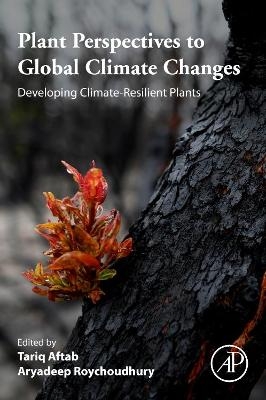
Plant Perspectives to Global Climate Changes
Academic Press Inc (Verlag)
978-0-323-85665-2 (ISBN)
Advancing ecophysiological understanding and approaches to enhance plant responses to new environmental conditions is critical to developing meaningful high-throughput phenotyping tools and maintaining humankind’s supply of goods and services as global climate change intensifies.
Tariq Aftab received his PhD from the Department of Botany at Aligarh Muslim University, India, where he is currently a Senior Assistant Professor. He is the recipient of a prestigious Leibniz DAAD fellowship from Germany, a Raman Fellowship from the Government of India, and Young Scientist Awards from both the State Government of Uttar Pradesh and the Government of India. He has also served as a Visiting Scientist at IPK Gatersleben, Germany, and in the Department of Plant Biology at Michigan State University, United States. Dr. Aftab has edited numerous books for major international publishers, including Elsevier, Springer Nature, and CRC Press. He has co-authored several book chapters and published extensively in peer-reviewed, international journals. His research interests include physiological, proteomic, and molecular studies on medicinal and crop plants. Aryadeep Roychoudhury is Professor of Life Sciences at Indira Gandhi National Open University (IGNOU), New Delhi, with over 20 years of research experience in plant molecular biology and biotechnology. He earned his PhD from Bose Institute under Jadavpur University and completed postdoctoral research on transgenic rice for enhanced salt and drought tolerance. His work currently focuses on molecular and physiological responses of plants to abiotic stresses such as fluoride, heavy metals, salinity, and drought, including regulation by transcription factors and signaling pathways. Prof. Roychoudhury has led multiple government-funded projects and is recognized among the Top 2% Scientists in the list released by Stanford University in collaboration with Elsevier.
1. Climate change impact on plants: Plant responses and adaptations
2. Towards understanding abiotic stress physiological studies in plants: Conjunction of genomic and proteomic approaches
3. Co-overexpression of genes in plants for abiotic stress tolerance
4. Molecular investigation of plant-environment interaction at functional level
5. Physiological, biochemical, and molecular adaptation mechanisms of photosynthesis and respiration under challenging environments
6. Harnessing the potential of modern omics approaches to study plant biotic and abiotic stresses
7. Soil-plant interactions for agricultural sustainability under challenging climate change
8. Biological nitrification inhibition for sustainable crop production
9. Application of nanoparticles in developing resilience against abiotic stress in rice plant (Oryza sativa L.)
10. Physiological mechanisms and adaptation strategies of plants under nutrient deficiency and toxicity conditions
11. Genomics-based approaches to improve abiotic stress tolerance in plants: Present status and future prospects
12. Transcription factors involved in plant responses to heavy metal stress adaptation
13. The role of soil microorganisms in plant adaptation to abiotic stresses: Current scenario and future perspectives
14. Ecological aspects of the soil-water-plant-atmosphere system
15. Role of miRNAi technology and miRNAs in abiotic and biotic stress resilience
16. CRISPR-Cas9-mediated genome editing technology for abiotic stress tolerance in crop plant
17. Reactive oxygen and nitrogen species: Antioxidant defense studies in plants
18. Role of plant hormones in combating biotic stress in plants
19. CRISPR-mediated genome editing for developing climate-resilient monocot and dicot crops
20. Mechanism of temperature stress acclimation and the role of transporters in plants
21. Role of β-aminobutyric acid in generating stress-tolerant and climate-resilient plants
22. Wild relatives of plants as sources for the development of abiotic stress tolerance in plants
23. Role of magnetopriming in alleviation of abiotic stress in plants
| Erscheinungsdatum | 04.10.2021 |
|---|---|
| Verlagsort | Oxford |
| Sprache | englisch |
| Maße | 191 x 235 mm |
| Gewicht | 1110 g |
| Themenwelt | Naturwissenschaften ► Biologie ► Botanik |
| ISBN-10 | 0-323-85665-9 / 0323856659 |
| ISBN-13 | 978-0-323-85665-2 / 9780323856652 |
| Zustand | Neuware |
| Informationen gemäß Produktsicherheitsverordnung (GPSR) | |
| Haben Sie eine Frage zum Produkt? |
aus dem Bereich