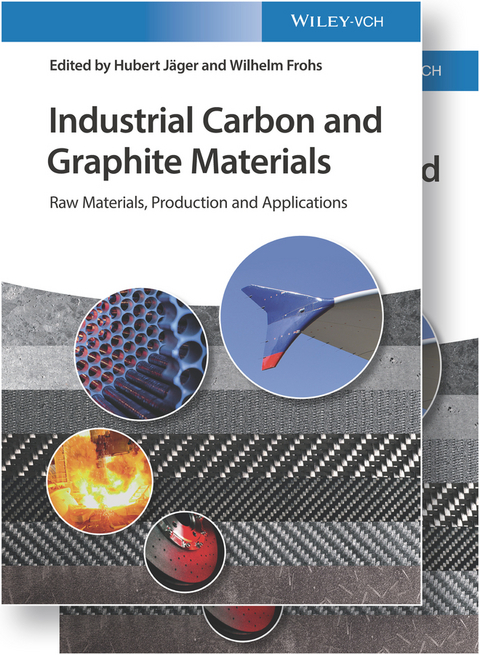
Industrial Carbon and Graphite Materials (eBook)
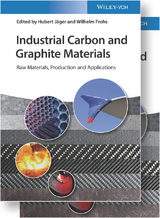
Following a short introduction, the main part of this reference deals with industrial forms, their raw materials, properties and manifold applications. Featuring chapters on carbon and graphite materials in energy application, and as catalysts. It covers all important classes of carbon and graphite, from polygranular materials to fullerenes, and from activated carbon to carbon blacks and nanoforms of carbon.
Indispensable for chemists and engineers working in such fields as steel, aluminum, electrochemistry, nanotechnology, catalyst, carbon fibres and lightweight composites.
Hubert Jager received his PhD from the Technical University of Karlsruhe. He started his industrial career in 1986 at SGL Carbon. Since then, he held various positions in R&D, production, technical service and others. Since 2014 he is Professor at the Institut fur Leichtbau und Kunststofftechnik (IKL) at the Technical University of Dresden. He is author of several papers in polymer chemistry, SiC-fiber composite technology and carbon fiber surface chemistry.
Wilhelm Frohs received his PhD 1989 under the guidance of Prof. Fitzer. In the same year he joined SGL Carbon and has held various R&D positions. His current activities are focused on raw material development. He is author of many papers in the fields of carbon fibers, petroleum, and coal tar pitch coke, coal tar pitch, and graphite electrodes. Since 2010 he is president of the German Carbon Group (Arbeitskreis Kohlenstoff, AKK).
Hubert Jäger received his PhD from the Technical University of Karlsruhe. He started his industrial career in 1986 at SGL Carbon. Since then, he held various positions in R&D, production, technical service and others. Since 2014 he is Professor at the Institut für Leichtbau und Kunststofftechnik (IKL) at the Technical University of Dresden. He is author of several papers in polymer chemistry, SiC-fiber composite technology and carbon fiber surface chemistry. Wilhelm Frohs received his PhD 1989 under the guidance of Prof. Fitzer. In the same year he joined SGL Carbon and has held various R&D positions. His current activities are focused on raw material development. He is author of many papers in the fields of carbon fibers, petroleum, and coal tar pitch coke, coal tar pitch, and graphite electrodes. Since 2010 he is president of the German Carbon Group (Arbeitskreis Kohlenstoff, AKK).
Introduction: The Future of Carbon Materials - The Industrial Perspective
The Element Carbon
History of Carbon Materials
Recommended Terminology for the Description of Carbon as a Solid (© 1995 IUPAC)
Graphite
Industrial Carbons
Carbon and Graphite for Electrochemical Power Sources
Carbon and Graphite for Catalysis
Activated Carbon
Carbon Black
Carbon Fibers
Carbon Fiber Composites
Nanocarbons
1
Introduction: The Future of Carbon Materials – The Industrial Perspective
Hubert Jäger1, Wilhelm Frohs2, and Tilo Hauke2
1 Technische Universität Dresden, Institute of Lightweigth Engineering and Polymer Technology (ILK), Hohlbein Street 3, Dresden, 01307, Germany
2 SGL Carbon GmbH, Werner‐von‐Siemens‐Street 18, 86405 Meitingen, Germany
1.1 Overview
This chapter provides information about the industrial importance of various carbon and graphite materials. Carbon and graphite materials are mostly unknown to the public. They are obvious in few consumer products only, such as lead pencils, or in sporting goods as carbon fibers, for example.
In contrast, the importance of carbon materials for the production of iron, steel, and aluminum is not common knowledge. The iron, steel, and aluminum industry created in 2011 a global market value of around 1100 billion €. This is equivalent to around 50% of the value of the global annual crude oil production. Although we will not consider metallurgical coke in this chapter, the market value should be mentioned; it is around 155 billion €. Also not considered here are carbon black (11 billion €) and activated carbon (1.8 billion €). The market value of carbon materials in total (without metallurgical coke) is at around 42 billion € (Figure 1.1). The biggest contributor with a market value of 18 billion € is carbon anodes for aluminum electrolysis. Within the group of polygranular carbon materials, the anodes are followed by graphite electrodes for the production of electric arc furnace (EAF) steel with a market value of six billion €. Smaller markets are cathodes for the production of aluminum (1.4 billion €), fine‐grained graphite for multifold applications (0.7 billion €), furnace linings for blast furnace steel production (0.3 billion €), and carbon electrodes for the production of silicon (0.2 billion €). Other carbon materials like natural graphite, carbon fibers, and graphite for Li‐ion batteries play a minor role versus the conventional carbon products yet. Changes may happen in the near future driven by the need for the efficient storage and use of energy. The market for conventional carbon materials will continue to grow driven by the demand coming from the BRIC countries (Brazil, Russia, India, and China).
New forms of carbon, the carbon nanomaterials, created huge expectations but are currently not produced in an industrial scale with the exception of multiwall carbon nanotubes (MWCNTs). With the recent demonstration of the potential of graphene, a single graphite layer, in microelectronic circuits, we might see the beginning of a new market for carbon materials.
Figure 1.1 Carbon materials and their market value.
1.2 Traditional Carbon and Graphite Materials
Traditional carbon materials that are considered in this chapter are:
- Graphite electrodes for melting of steel scrap.
- Carbon electrodes for silicon production.
- Cathodes for the aluminum electrolysis.
- Furnace linings for blast furnaces.
- Fine‐grained graphite for silicon production, machining, and others.
With the availability of stable electrical power networks, the electricity was used for heat generation and electrochemical industrial processes. Moisson demonstrated the first steel production with an EAF in 1891. The first EAF plant started its operation in 1906 (Remscheid, Germany). Simply baked carbon electrodes most probably with anthracite and carbon black as filler were used. The electrode diameter was small. In the 1920s more and more electrodes were used, which had been graphitized. The production of EAF steel grew to around 20 million t in 1950. After 1950 the production of EAF steel developed rapidly and exceeded 100 million t in the 1970s. The raw material in this time period was often pitch coke produced by chamber coking. Special coke grades, so‐called needle cokes, produced in the delayed coking process of crude oil refineries were developed later in 1960 and commercialized in 1970. This development represented a quantum leap in the quality of graphite electrodes. The most frequently used electrode became an electrode with 600 mm in diameter. As a consequence, there was substantial progress in the stability and efficiency of the melting process. The average consumption of graphite electrodes was reduced to below 4 kg/t steel. Further improvements in raw material quality, graphite electrode processing, furnace technology, and steelmaking process regulations reduced the graphite electrode consumption to about 2 kg/t steel in average (Figure 1.2). In particular the water spraying on top of the furnace roof was a genius idea to reduce significantly the graphite consumption due to oxidation. The lowest graphite consumption figure achieved so far was 0.74 kg/t with an electrode with a diameter of 800 mm on a direct current (DC) furnace.
Graphite electrodes are produced in mostly all continents. Traditional graphite electrode producers are GrafTech International, the SGL Group, and the Japanese producers Tokai, SDK, and Nippon Carbon. Later electrode producer followed in India and recently in China (Figure 1.3).
The production of EAF steel reached about 550 million t in 2020. Much stronger was the growth in blast furnace steel (Figure 1.4). This situation was created by the economic growth in China, which, as a young economy, is suffering the steel scrap required for EAF process. This will change over the times and the EAF process will pick up.
Figure 1.2 Development of the specific consumption of graphite electrodes.
Figure 1.3 Graphite electrode producers and their production capacity (2018). SGL: Since 2017 Showa Denko.
Figure 1.4 Blast furnace and EAF steel production.
Graphite electrodes are exposed to extreme conditions during the melting of steel. From a tip temperature of several thousand degrees centigrade, the temperature falls to about 1000 °C close to the roof of the furnace and to a few hundred degrees centigrade on top of the roof. Lengthwise and transversal temperature gradients create extensive thermal stresses. These high stresses initiate material cracks that can lead to severe material losses during the melting process (Figure 1.5).
Figure 1.5 Graphite electrode. (a) Graphite electrode with crack in the joint area. (b) Finite element simulation of temperature distribution.
The biggest disadvantage of these graphite losses is the expensive interruptions in the steel production chain. Thus the efforts of the graphite electrode producers focused on the minimization of these losses by the use of improved raw materials improved the process consistency, impacting the thermal compatibility between the connecting pin and the graphite electrode. These are only some approaches to minimize material losses and to enable a high efficiency of the scrap melting process. Although graphite electrodes have been produced since almost hundred years, the complete understanding was never accomplished.
Carbon electrode means a solely baked and not graphitized electrode composed of calcined anthracite and or synthetic graphite. These prebaked electrodes are an alternative to the Söderberg electrodes, a green paste that is baked and graphitized during its application in the EAF. Carbon electrodes reach diameters up to 1400 mm (Figure 1.6). They are mainly used for the production of metallic silicon and phosphorus. Notably the production of silicon doubled in between 1990 and 2010 (Figure 1.7). The strongest driver was the solar industry. The number of carbon electrode producers is rather small (Figure 1.8). The estimated carbon electrode production capacity is slightly above the demand. This free capacity will soon be covered as the demand for silicon will further grow with the ongoing installation of solar panels. As in the case of graphite electrodes, the customer expects a smooth operation without excessive consumption.
Figure 1.6 Carbon electrodes with diameters up to 1400 mm.
Figure 1.7 The demand for carbon electrodes.
Figure 1.8 Carbon electrode producer and capacity. SGL: Since 2018 COBEX.
Cathodes build the bottom of the Hall–Héroult electrolysis cell for the production of primary aluminum. This process was developed in 1886 and is still unchanged in its basic principles today. Alumina is reduced in a cryolite bath electrochemically to elemental liquid aluminum (Figure 1.9). The electric current passes through the bath to the anode electrode on top of the cell. The anodes were consumed during this electrochemical process and react to CO2. The anode consumption per ton of aluminum is in average 0.47 t. For the production of 41 million t of aluminum in the year 2011, the demand for carbon anodes is 19.3 million t. Aluminum is strongly growing with an...
| Erscheint lt. Verlag | 17.3.2021 |
|---|---|
| Sprache | englisch |
| Themenwelt | Naturwissenschaften ► Chemie |
| Schlagworte | Carbon materials • Carbon Materials, Graphite, Polygranular Carbon, Activated Carbon, Carbon Black, Catalysis, Energy, Carbon Fibres, Composites, Nanocarbon, industrial applications, electrochemistry, mechanical engineering, nuclear technology, nanotechnology, ceramics, fibers, polymers • Chemie • Chemistry • Industrial Chemistry • Kohlenstoffmaterial • Kohlenstoffmaterialien • Materials Science • Materialwissenschaften • Nanochemie • nanochemistry • Nanotechnologie • nanotechnology • Technische u. Industrielle Chemie |
| ISBN-10 | 3-527-67405-5 / 3527674055 |
| ISBN-13 | 978-3-527-67405-3 / 9783527674053 |
| Informationen gemäß Produktsicherheitsverordnung (GPSR) | |
| Haben Sie eine Frage zum Produkt? |
 EPUB (Adobe DRM)
Kopierschutz: Adobe-DRM
Adobe-DRM ist ein Kopierschutz, der das eBook vor Mißbrauch schützen soll. Dabei wird das eBook bereits beim Download auf Ihre persönliche Adobe-ID autorisiert. Lesen können Sie das eBook dann nur auf den Geräten, welche ebenfalls auf Ihre Adobe-ID registriert sind.
Details zum Adobe-DRM
Dateiformat: EPUB (Electronic Publication)
EPUB ist ein offener Standard für eBooks und eignet sich besonders zur Darstellung von Belletristik und Sachbüchern. Der Fließtext wird dynamisch an die Display- und Schriftgröße angepasst. Auch für mobile Lesegeräte ist EPUB daher gut geeignet.
Systemvoraussetzungen:
PC/Mac: Mit einem PC oder Mac können Sie dieses eBook lesen. Sie benötigen eine
eReader: Dieses eBook kann mit (fast) allen eBook-Readern gelesen werden. Mit dem amazon-Kindle ist es aber nicht kompatibel.
Smartphone/Tablet: Egal ob Apple oder Android, dieses eBook können Sie lesen. Sie benötigen eine
Geräteliste und zusätzliche Hinweise
Buying eBooks from abroad
For tax law reasons we can sell eBooks just within Germany and Switzerland. Regrettably we cannot fulfill eBook-orders from other countries.
aus dem Bereich